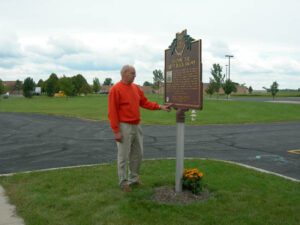
The landscape of northwest Ohio was formed by melting ice and the glacial lakes left behind in its wake. Because of the low gradient (3 feet fall per mile) to the northeast, the flat lacustrine plain evolved into a large swamp. A massive swamp forest with huge hardwoods, broken only sporadically with intermittent wet prairies and savannahs, dominated the landscape. Both prehistoric and historic Indians farmed the flood plains of the Maumee River and its tributaries: Auglaize, Tiffin, and Blanchard rivers. (continued on other side)
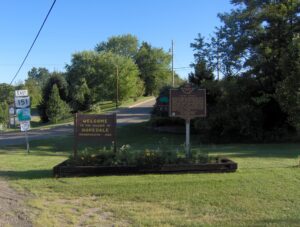
Platted by educator and abolitionist Cyrus McNeely in 1849, Hopedale was the site of McNeely Normal School, later Hopedale Normal College, the first coeducational college for teachers in eastern Ohio. It operated from 1849 to 1902. Among its graduates was George Armstrong Custer in 1856. Hopedale served as an important stop on the Underground Railroad for slaves fleeing bondage in the southern states. Local tradition notes several “stations” in the village, three at private homes and one at a hotel.
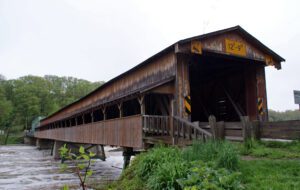
Replacing an earlier bridge that was carried away in a spring flood, the Harpersfield Covered Bridge was built in 1868 and spans the Grand River, a state-designated wild, and scenic river. This bridge, which currently carries County Road #154 (Harpersfield Road), is a two-span wooden Howe truss bridge, with center pier. The great flood of 1913 washed away the northern approach and it was at this time that the additional 140 foot steel truss was added. Extensive rehabilitation in 1992 included strengthening the lower chords, lowering and replacing the floor, and adding a cantilevered walkway. The 228-foot-long Harpersfield Bridge is the longest covered bridge in Ohio and is on the National Register of Historic Places.
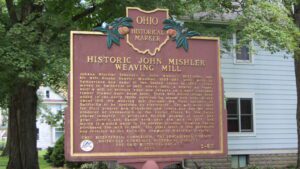
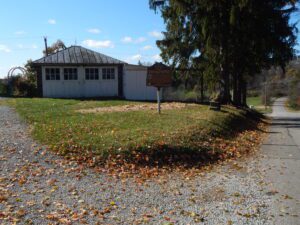
Johann Mischler (changed to John Mishler), 1852-1930, and his wife Rosina Beyeler Mischler, 1852-1927, were born in Switzerland and came to the United States in 1882. They moved to Smithville in 1887 where John, a weaver by trade, built a mill to produce rugs and carpets on a hand operated timber framed barn beam loom. Three belt driven looms were added in the early 1900s powered by steam and later diesel. About 1915, the weaving mill became the first business in Smithville to be operated by electricity. The mill wove cloth for fruit presses and dishcloths and towels and was the only producer of cheesecloth in the United States for the Swiss cheese industry. It produced 40,000 pounds of cloth per year. John’s son Daniel took over the mill in 1930 and moved it a block away to its present location. Charles Norris purchased the mill in 1983. Ten years later, it was purchased and restored by the Smithville Community Historical Society.
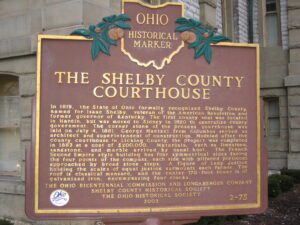
In 1819, the State of Ohio formally recognized Shelby County, named for Isaac Shelby, veteran of the American Revolution and former governor of Kentucky. The first county seat was located in Hardin, but was moved to Sidney in 1820 to centralize county government. The corner stone of the present courthouse was laid on July 4, 1881. George Maetzel from Columbus served as architect and superintendent of construction. Modeled after the county courthouse in Licking County, the project was completed in 1883 at a cost of $200,000. Materials, such as limestone, sandstone, and marble arrived by canal boat. The French Second Empire style building has four symmetrical sides facing the four points of the compass, each side with pillared porticoes approached by broad stone steps. A figure of Lady Justice holding the scales of equal justice surmounts each facade. The roof is classical mansard, and the center170-foot tower is of galvanized iron, encompassing four clocks.
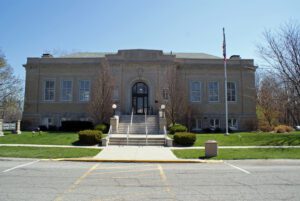
In 1912, the president of the Public Library Association in Paulding requested funding from philanthropist Andrew Carnegie to build a library in Paulding. At first the Carnegie Corporation of New York refused, stating that it only provided funding to communities with larger populations, but when the Library Association said it would serve the entire county, which had a larger population, the request was granted. As a result Paulding became the site for the first “county” Carnegie library in the United States, built for a total cost of $40,000. Carnegie provided funding for 2,811 libraries, of which 1,946 were built in the United States. Placed on the National Register of Historic Places in 1984, the Paulding County Carnegie Library continues to service the needs of all citizens of Paulding County.
These structures stand as an exception to the usual wood frame or brick construction of farm buildings in this region in the late nineteenth century. The house and barn, built circa 1871 and 1883-1885 respectively, reflect Frederick Kindelberger’s (1835-1911) creativity and vision to instill a responsibility to the land. The Kindelberger family purchased the farm in 1846, after they had emigrated from Alsace-Lorraine. The walls of the barn were created using a distinct architectural design, whereas they taper from 25 inches thick at the base to 12 inches thick at the top. Stonemasons and family members labored using sandstone, which was quarried on the eighty-acre farm, to construct the buildings. Due to their stone construction, the house and barn were placed on the National Register of Historic Places in 1980.
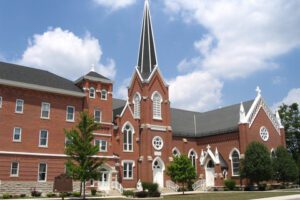
The Sisters of the Precious Blood, founded in Switzerland by Maria Anna Brunner in 1834, began their ministry of prayer and education in Mercer County here at Maria Stein (Our Lady of the Rock). Father Francis de Sales Brunner, a Missionary of the Precious Blood, brought the Sisters to America in 1844, and in 1846 established the foundation at Maria Stein, named after a Benedictine Abbey in Switzerland. The convent was the Motherhouse of the Sisters of the Precious Blood until 1923. Relics of the saints were brought to this site from Italy in 1875. The present convent and relic chapel (National Marian Shrine of the Holy Relics), built during 1890-1902, were placed on the National Register of Historic Places in 1976.