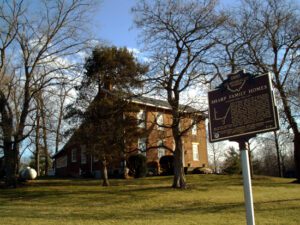
The Sharp family homes and their locations on N. State Street and Africa Road mark an important route through Westerville on the Underground Railroad. The family patriarch, Garrit Sharp, was an original settler of Sharp’s Settlement, now Westerville, and donated land for and helped organize the first Methodist church. He is also associated with the founding of Blendon Young Men’s Seminary, which was acquired by Otterbein College, an institution with enrollment open to African Americans and women from its inception in 1847. He and his sons were all noted abolitionists who, along with Bishop William Hanby and Otterbein president Lewis Davis, assisted southern slaves on their road to freedom. From the Sharp homes, slaves would have proceeded north to the house of Samuel Patterson on Africa Road and along Alum Creek to the Quaker settlement near Marengo in Morrow County.
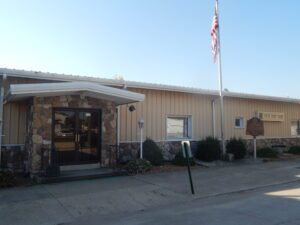
The completion of the Wabash and Erie Canal on July 4, 1843 brought many new settlers into this region. The Wabash and Erie Canal connected with the Miami and Erie Canal at Junction. Antwerp, ideally located on the Maumee River, was seen as a perfect place in which to establish a town. That same year surveyors W. Wilshire Riley and Samuel Rice platted what would become Antwerp. Naming rights belonged to Riley and storeowner Horatio N. Curtis, who wanting a name not duplicated anywhere else in the country, named it after Antwerp, Belgium. Early pioneers subdued the massive forests that once formed the “Black Swamp” and built a thriving city. Antwerp was incorporated in 1863. (continued on other side)
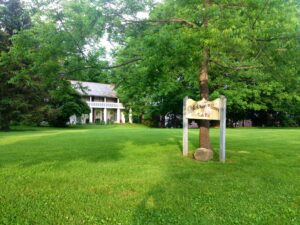
Robert Caldwell and his family, from Chester County, Pennsylvania, moved to the Northwest Territory in 1795. In 1809, they bought and cleared land along Duck Creek in what became Olive Township, Morgan County (in 1819). In 1832 Robert’s son, Samuel and his wife Sarah Brownrigg Caldwell built the “Ball-Caldwell” house. Samuel Caldwell advocated for the formation of Noble County, established in 1851. In the contest to determine the site of the county seat, Caldwell promised a donation of land if it would be used for that purpose, which is was in 1857. In gratitute, the commissioners named the county seat “Caldwell.”
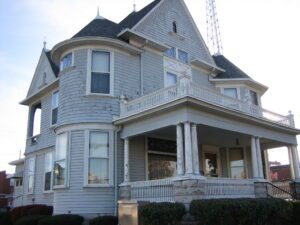
The museum of the Mercer County Historical Society, the Riley Home represents six generations of the Riley family in the county. The first Riley to arrive here was Captain James Riley, who surveyed the area in 1819, after it was opened to American settlement following the Treaty of Saint Marys in 1818. Captain Riley was elected to the Ohio General Assembly in 1823. Captain Riley’s son, James Watson Riley platted Celina in 1834, was Mercer County’s Clerk of Courts, and then represented the area in the Ohio General Assembly beginning in 1843. (Continued on other side.)
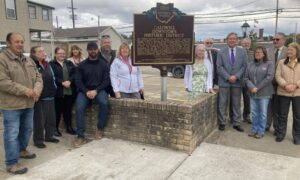
The Caldwell Downtown Historic District is the historic commercial and governmental core of the Village of Caldwell, which was founded in 1857 on farmland owned by Joseph and Samuel Caldwell. Caldwell serves as the county seat of Noble County, the last of Ohio’s 88 counties to be organized. The agricultural community prospered and by 1873 was the second-largest producer of tobacco in Ohio. The Pennsylvania Railroad arrived in 1872, and the development of salt, oil, coal, and natural gas extraction companies followed during the 1880s. Two separate fires in 1897 devastated portions of the north and south quadrants of the district. As a result, Caldwell formed a volunteer fire department and the Village Council introduced legislation prohibiting construction of wood buildings within a block of the public square. (Continued on other side)
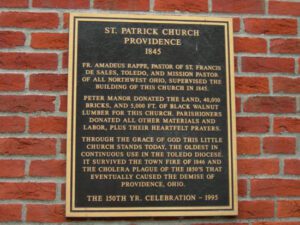
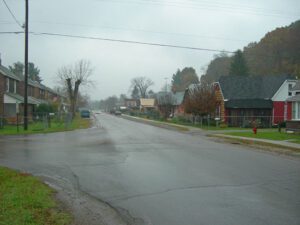
The town of Providence was born, thrived and died with the Miami & Erie Canal. It was platted in 1835 by French trader Peter Manor, swept by fire in 1846, ravaged by cholera in 1854, and finally unincorporated in 1928. Today, only the Irish builders’ St. Patrick’s Church (1845), the oldest in the Toledo Diocese; the cemetery; and Peter Manor’s house (1845) remain. The Providence Dam, built in 1838 to create a water supply for the canal’s remaining 25 miles to Toledo, was rebuilt in 1908. Peter Manor’s mill stands downstream one-half mile at Canal Lock #9, where it was built in 1822, rebuilt in 1846, and operates today as the Isaac Ludwig Historic Mill. The National Historic Register of Historic Places listed this district in 1975, the mill in 1974.
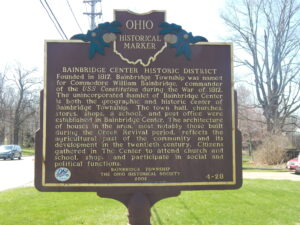
Bainbridge Center Historic District. Founded in 1817, Bainbridge Township was named for Commodore William Bainbridge, commander of the USS Constitution during the War of 1812. The unincorporated hamlet of Bainbridge Center is both the geographic and historic center of Bainbridge Township. The town hall, churches, stores, shops, a school, and post office were established in Bainbridge Center. The architecture of houses in the area, most notably those built during the Greek revival period, reflects the agricultural past of the community and its development in the twentieth century. Citizens gathered in The Center to attend church and school, shop, and participate in social and political functions.
Originally known as Hocking Furnace, Haydenville was founded by and named for Columbus industrialist Peter Hayden (1806-1888), who energetically developed the coal, iron, sandstone, and fire clay deposits found in abundance in this area. Here he operated an iron furnace, coal mines and sandstone quarries, shipping products on the Hocking Canal and, later, the Hocking Valley Railroad he helped build. The incorporation of the Haydenville Mining and Manufacturing Company in 1882 initiated the manufacture of brick and ceramic tile from fire clay. Business boomed in the late 19th century as cities paved their streets with brick and fireproof construction became popular in the wake of widely publicized and tragic fires.