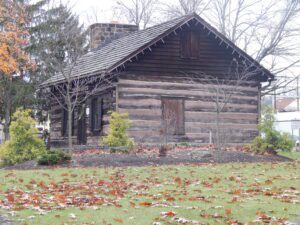
This log building was constructed in 1801 by David Hoge on the west side of Third Street. It served as his home and was the first Federal land office in that part of the Northwest Territory known as the Seven Ranges. In 1809 it was moved and 12 years later encased in a brick structure where it was discovered in 1940. It has been preserved by the citizens of Jefferson County.
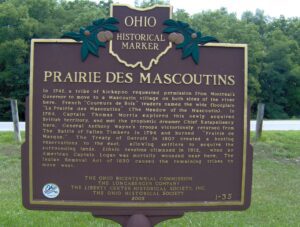
In 1742, a tribe of Kickapoo requested permission from Montreal’s Governor to move to a Mascoutin village on both sides of the river here. French “Coureurs de Bois” traders named the wide floodplain “La Prairie des Mascoutins” (The Meadow of the Mascoutin). In 1764, Captain Thomas Morris explored this newly acquired British territory, and met the prophetic dreamer Chief Katapelleecy here. General Anthony Wayne’s troops victoriously returned from The Battle of Fallen Timbers in 1794 and burned “Prairie de Masque.” The Treaty of Detroit in 1807 created a hunting reservation to the east, allowing settlers to acquire the surrounding lands. Ethnic tensions climaxed in 1812, when an American Captain Logan was mortally wounded near here. The Indian Removal Act of 1830 caused the remaining tribes to move west.
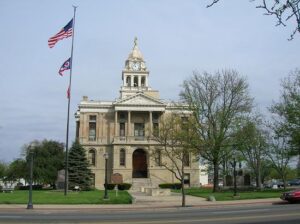
Opened on May 1, 1885, this is the third Fayette County Court House building. Ohio artist Archibald Willard, who is best known for the patriotic painting, “The Spirit of ’76,” was commissioned by the firm Cooks Brothers to do painting and fresco work for the interior walls of the courthouse. Willard did not sign his work and the artist’s identity remained a mystery for nearly 75 years until confirmation was made in August 1956. The artist’s name was cleverly disguised in the delivery address of the letter in “The Spirit of the U.S. Mail” mural. The other primary murals, “Spirit of Electricity” and “Spirit of the Telegraph,” adorn the third floor corridor.
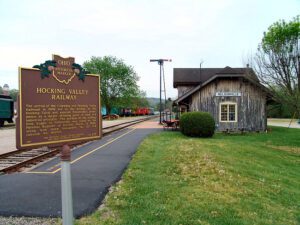
The arrival of the Columbus and Hocking Valley Railroad in 1869 led to the decline of the Hocking Canal and assured Nelsonville’s prominence as a major shipping point of coal and industrial products. The portion of the railway from Logan in Nelsonville was listed on the National Register of Historic Places in 1988, along with steam locomotive #33 and caboose #90704.
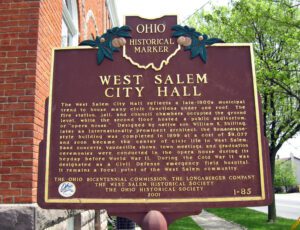
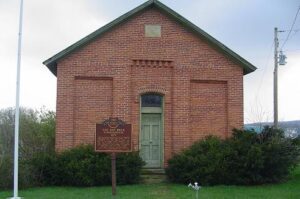
The West Salem City Hall reflects a late-1800s municipal trend to house many civic functions under one roof. The fire station, jail, and council chambers occupied the ground level, while the second floor hosted a public auditorium, or “opera house.” Designed by native son William K. Shilling, later an internationally prominent architect, the Romanesque-style building was completed in 1899 at a cost of $9,077 and soon became the center of civic life in West Salem. Band concerts, vaudeville shows, town meetings, and graduation ceremonies were conducted in the opera house during its heyday before World War II. During the Cold War it was designated as a Civil Defense emergency field hospital. It remains a focal point of the West Salem community.
Typical of many schoolhouses in the Frankfort area during the 1800s, this school, with its pot-bellied stove and flip-top desks, was part of the public school system of that era. The building and its contents have been restored by the citizens of Frankfort in conjunction with the Budd Company.
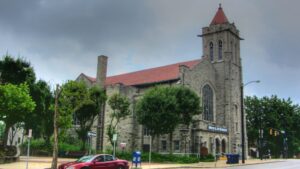
Oldest Religious Congregation in north-central Ohio. First Methodist Sermon preached at the “spring” in 1809 by Rev. James Copus. Services then conducted in blockhouse, 1811; in first court house, 1813; at church home of Dr. William B. James, 1814; first church building located N.W. corner Park Avenue East and Adams, 1820; present site in 1870. All land donated by General James Hedges, a distinguished member.
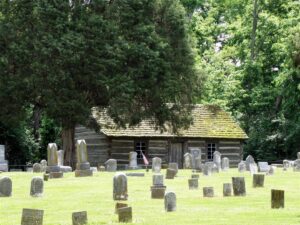
To Commemorate the first church erected in Union Township, Miami County, Ohio, this log replica was constructed in 1976 by the Union Township 4-H Clubs and the West Milton area Camp Fire Girls. The Laura Lions Club established this historic marker which stands on the site of the West Branch Quaker Burial Grounds near the location of the original church.