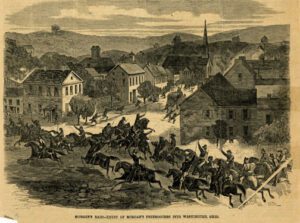
General John Hunt Morgan of Kentucky led a force of Confederate calvarymen into Meigs County during a forty-six day raid north of the Ohio River. The advance forces burned Benjamin Knight’s carding mill and sawmill, the Shade River Bridge, and pillaged local businesses in Chester on July 18, 1863, while waiting for the rest of the column to catch up. This two-hour halt delayed General Morgan’s arrival at the ford at Buffington Island until after dark, allowing Union troops to arrive before he could make his escape. General Morgan surrendered eight days later near West Point in Columbiana County, the northernmost point ever reached by Confederate forces during the Civil War.
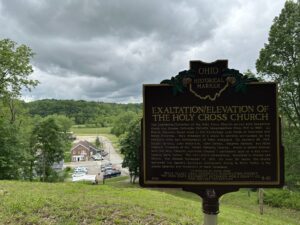
The Exaltation/Elevation of the Holy Cross Church served both Byzantine Greek and Russian Orthodox Catholic congregations from 1915 to 1967. As Slovak migrants found work in the Cambridge coal fields of Guernsey and Noble Counties, they dreamed of a place to worship surrounded by the religious rites and iconography of their homeland. On January 26, 1914, Daniel Varhola, John Fetkovich, John Demko, Stephen Varhola, and Mike Zeleznik (trustees of the “Greek Catholic Church, which is united forever with the Holy Catholic Apostolic Church”) purchased land on a hill overlooking Belle Valley. The two-sided cornerstone, inscribed in Russian and Slovak, was blessed November 15, 1915. For over 50 years, the church anchored the Eastern European immigrants living in Belle Valley to the ethnic identity and traditions of their homeland. (Continued on other side)
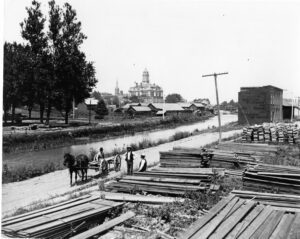
Miami & Erie Canal and Napoleon’s First Cemetery. The Miami & Erie Canal stretched approximately 250 miles from Cincinnati to Toledo. Napoleon and other towns on the Maumee River’s banks were on a slackwater section of the canal. Between 1825 and 1845, laborers constructed the canal using shovels, picks, wheelbarrows, and horse and mule-drawn carts. In Henry County, Napoleon, and elsewhere, German and Irish immigrants and area farmers did the work and were paid around 30 cents a day. As the canal brought more people and business to the area, villages such as Florida, Damascus, and Texas flourished and the county seat of Napoleon boomed. The canal and consequent growth took their tolls, however. Sickness and disease such as “ague” (malaria) and cholera spread and carried off many. Napoleon’s first cemetery was located in the vicinity of 500 East Clinton Street, near the route of the canal.
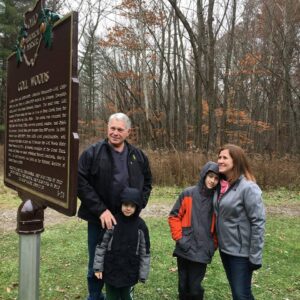
Two Deputy U.S. General Land Office Surveyors traversed Goll Woods: Benjamin Hough in 1815 and Captain James Riley in 1821. Hough (1772-1819) established the Michigan Meridian in 1815 and was county and state office holder in Ohio. Riley’s life was more tumultuous. Riley (1777-1840) captained the merchant ship Commerce, which wrecked off the Saharan coast in 1815. Riley and crew were enslaved for four months until ransomed by British diplomat William Willshire. In 1817, Riley published a famous account of his time in North Africa, and, in 1819, was appointed a surveyor by Surveyor General Edward Tiffin. Moving to Northwest Ohio, Riley named the village he founded in 1822, Willshire, for his deliverer. Riley returned to New York in 1826 and to the sea, where he died. Riley’s book went through more than twenty editions by 1860 and Abraham Lincoln credited the account as one that influenced him deeply.
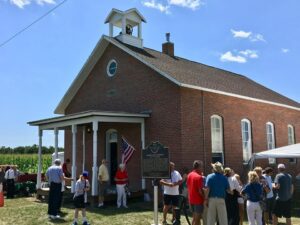
Bridenbaugh District No. 3 School. One-room schools were commonly named for people who furnished land for the building. Michael Bridenbaugh (1820-1895), who settled in Riley Township in 1835, and wife Jemima (1834-1903) sold a half-acre of land to the Riley Township school board in 1873. The first school on the site was a wooden structure, built in 1878. It was replaced by a brick building in 1889. The school operated until 1927, after which the district was consolidated. Students attended classes in nearby Pandora. (Continued on the other side)
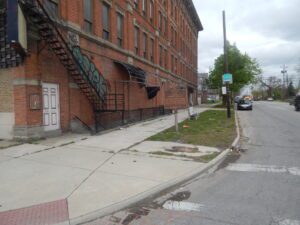
The pioneer village of Vistula is now bounded by Walnut, Champlain, Chestnut, Magnolia, and Summit streets. Established in 1833 by Benjamin F. Stickney and Edward Bissell, Vistula was merged with its rival, Port Lawrence, and in 1837 both villages were incorporated as Toledo. The Vistula Historic District, Toledo’s oldest neighborhood, was listed on the National Register of Historic Places in 1978.
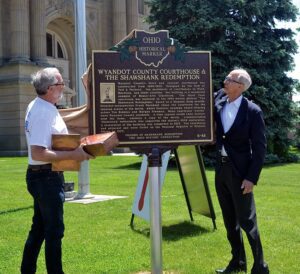
Wyandot County’s third and current courthouse was constructed from 1899-1900. Designed by the firm of Yost & Packard, the architects of courthouses in Wood, Harrison, and other counties, the building is a wonderful example of Beaux-Arts Classicism. The third floor courtroom was featured in the 1994 motion picture “The Shawshank Redemption,” based on a Stephen King novella. Director-screenwriter Frank Darabont chose the courtroom for the opening scenes of the movie, which features Academy Award-winning actors Tim Robbins and Morgan Freeman. Many courtroom “extras” were Wyandot County residents. A time capsule inside Lady Justice, atop the dome, contains a copy of the movie, commemorating ‘Shawshank’ enthusiasts who supported the statue’s 2009 restoration. A restoration of the building was completed in 2015. The courthouse and adjacent jail were listed on the National Register of Historic Places in 1973.
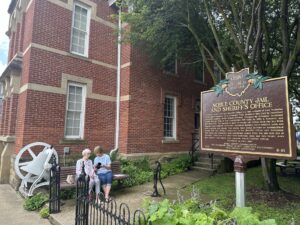
The Noble County Jail and Sheriff’s Office is a fine example of Late Victorian architecture designed by a prominent Ohio architect and built by important nineteenth century Noble County builders. Designed by Columbus architect Joseph Warren Yost, it was constructed 1881-1882 by Mills & Summers and cost $9,477.55. The building is made of orange-red bricks from the Ava Brick Company and features horizontal sandstone banding and a detailed gable end with brackets and finials. The Queen Anne design includes an asymmetrical façade with two distinct entrances to the Sheriff’s Office and Residence. The office and residence face courthouse square while the jail cells are at the rear. There are four first-floor individual cells and two larger men’s and women’s cells above with concrete barrel-vaulted ceilings. (Continued on other side)