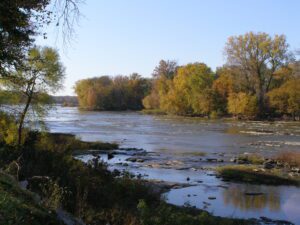
This site, at the head of the Great Rapids of the Maumee, has been a major river crossing for centuries. The village was platted in 1833 as Gilead but was overshadowed by rival Providence during the canal era. In 1868 the name Grand Rapids was adopted, and the town prospered with the arrival of the railroad in 1877. Fires ravished the village in the late 1890s and spring floods have remained a threat. Restoration of the Victorian architecture began in 1975 and has helped revitalize this village along the historic Maumee.
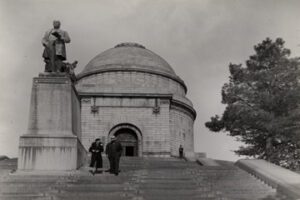
William McKinley served the nation as president, the people of Ohio as governor, and the citizens of his congressional district as a representative. McKinley was shot by an assassin in Buffalo, New York, in September 1901 and died several days later. The McKinley National Memorial, funded by children’s donations, was dedicated in 1907. It is the burial site of the 25th President, First Lady Ida Saxton McKinley, and two daughters. Designed by architect Harold Van Buren Magonigle, the pink Milford granite structure was designated a National Historic Landmark in 1975.
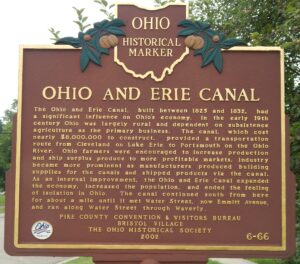
The Ohio and Erie Canal, built between 1825 and 1832, had a significant influence on Ohio’s economy. In the early 19th century Ohio was largely rural and dependent on subsistence agriculture as the primary business. The canal, which cost nearly $8,000,000 to construct, provided a transportation route from Cleveland on Lake Erie to Portsmouth on the Ohio River. Ohio farmers were encouraged to increase production and ship surplus produce to more profitable markets. Industry became more prominent as manufacturers produced building supplies for the canals and shipped products via the canal. As an internal improvement, the Ohio and Erie Canal expanded the economy, increased the population, and ended the feeling of isolation in Ohio. The canal continued south from here for about a mile until it met Water Street, now Emmitt Avenue, and ran along Water Street through Waverly.
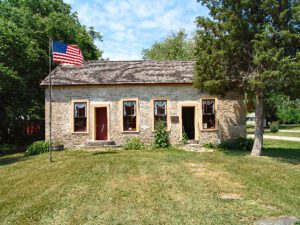
Built in 1822, this native limestone structure was the home of Benajah Wolcott, first keeper of the Marblehead Lighthouse (originally called the Sandusky Bay Light), and his second wife, Rachel Miller Wolcott. Benajah maintained the lighthouse from 1822 until his death ten years later. After Benajah’s passing the U.S. Government appointed Rachel as the keeper, making her the first female lighthouse keeper on the Great Lakes. The building is the oldest known residence still standing in Ottawa County and is a fine example of a “hall-and-parlor house,” an early American home design.
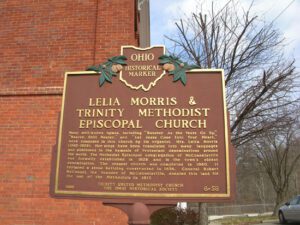
Many well-known hymns, including “Sweeter As the Years Go By,” “Nearer, Still Nearer,” and “Let Jesus Come Into Your Heart,” were composed in this church by its organist, Mrs. Lelia Morris (1862-1929). Her songs have been translated into many languages and published in the hymnals of Protestant denominations around the world. The Methodist Episcopal congregation of McConnelsville was formally established in 1826 and is the town’s oldest denomination. The present church was completed in 1860. It replaced a stone building constructed in 1836. General Robert McConnel, the founder of McConnelsville, donated this land for the use of the Methodists in 1817.
Congregations of the Religious Society of Friends (Quakers), called “meetings”, worshiped in plain meeting houses. On this site stood the last Richland Friends Meeting House, built in 1872. Ninety-four Friends established the meeting in 1826 and it endured for 147 years. The cemetery is where many generations of members of this meeting are buried. The faith, based on pacifism and simplicity, blossomed in the region during the first half of the 19th century. (Continued on other side)
This hamlet, located one mile southwest from here, was never platted, but was named after William Woods, president of the three-story brick Woodsdale paper mill constructed in 1867. Flanking the mill were the company office and store and several workers’ houses. Previous to this, the area flourished from the presence of two grist mills on the Great Miami River and from the Miami & Erie Canal. Additional enterprises such as a stone quarry, ice cutting company, and grain elevator operated here during the late 19th and early 20th centuries. Woodsdale was also known for the Woodsdale Island Amusement Park and the LC&D Railroad depot. The park, established on an island between the Miami & Erie Canal and the Great Miami River in 1891, was the site of picnics, political rallies, a large dance hall, and amusement rides–including a beautiful swan boat. The great flood of 1913 completely destroyed the park.
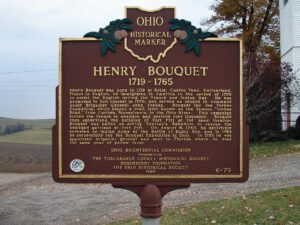
Desperately trying to protect their homeland, the Delaware Indian Nation who lived here in the Tuscarawas Valley, joined the French against the English during the French and Indian War, 1754-1763. After the French defeat, the Delawares, dissatisfied with the treaty terms, joined an Indian Confederacy to attack the English in early 1763. Known as Pontiac’s Rebellion, the uprising was lead by Ottawa chief Pontiac. In response, the English commander, General Jeffrey Amherst, ordered Colonel Henry Bouquet to mount a 1,500-man expedition to subdue the Confederacy in Ohio. The Army arrived at this location on October 13, 1764. The camp, known as Camp 14, was located in this valley between the two small streams on the side of the hill. Proceeding on to the Delaware town of modern-day Coshocton, Bouquet negotiated a surrender with the Delaware, Shawnee, and Wyandot who then relinquished over two hundred white prisoners.