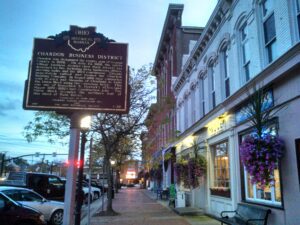
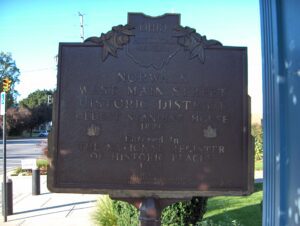
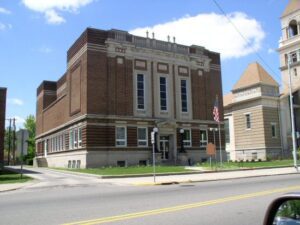
Chardon was designated the county seat of Geauga County in 1808. On July 25, 1868, the entire village business district (now Main Street) was destroyed by fire, including forty businesses, offices, meeting halls, and the 1824 courthouse. Citizens immediately rallied and formed the Chardon Building Company. In August 1868 they contracted with Herrick and Simmons of Cleveland to build the Union Block using fire-resistant brick. This was one of Rensselaer R. Herrick’s (Cleveland Mayor 1879-1882) last construction jobs. The Union Block occupies the northern half of this block of Main Street. (Continued on other side)
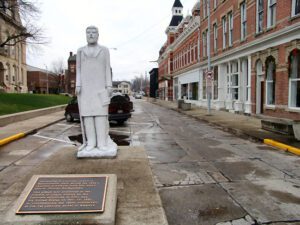
America’s first concrete streets were those which surrounded this court house. Concrete was first used in 1891 to provide an 8-foot strip along Main Street where horses were hitched. Two years later Court Avenue was paved with concrete made from native marl supplied by the Buckeye Cement Company, 8 miles to the northeast. This marker was erected in 1968 at the 75th anniversary of the paving of Court Street.
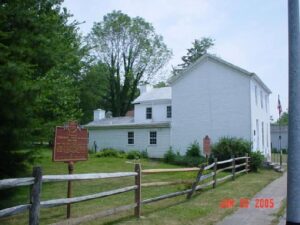
U.S. Grant, general-in-chief of the Armies of the United States, 18th president and first native Ohioan to be elected chief executive, lived in this house from 1824 to 1839. Jesse R. Grant, his father, built the original part fronting Water Street in 1824 and later built an addition fronting Main Cross Street, now Grant Avenue. “This place remained my home, until at the age of seventeen, in 1839, I went to West Point.” Memoirs of U.S. Grant
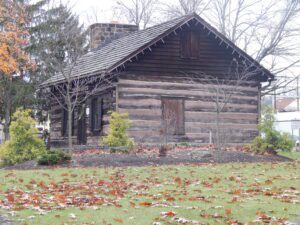
This log building was constructed in 1801 by David Hoge on the west side of Third Street. It served as his home and was the first Federal land office in that part of the Northwest Territory known as the Seven Ranges. In 1809 it was moved and 12 years later encased in a brick structure where it was discovered in 1940. It has been preserved by the citizens of Jefferson County.
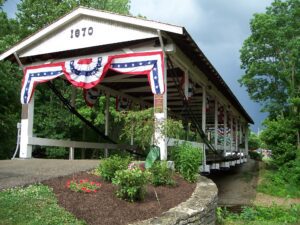
Restored in 1963, the Germantown Covered Bridge on East Center Street, spanning Little Twin Creek, was 93 years old and is reputed to be the only existing covered bridge of its kind in the world. For 41 years this unique inverted bow string truss covered bridge spanned Little Twin Creek on the Dayton Pike in Germantown, Ohio. In 1911 it was removed to its present location where it has been restored and beautified as a link with Ohio’s early history. It is a symbol of individual initiative in America’s early history.
A group of Freemasons, inspired by the concepts of a new country, of Freedom with Responsibility, Brotherly Love, and Truth, formed Harmony Lodge near this site in 1809, the first Masonic lodge in western Ohio. Meetings were held in the log court house, located on Lot 174, East Court Street, and also in Dayton and Springfield.