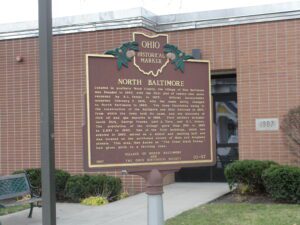
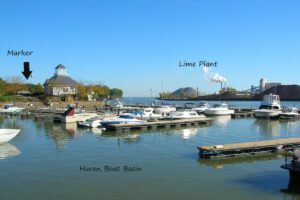
Located in southern Wood County, the village of New Baltimore was founded in 1860, with the first plat of twenty-nine acres recorded by B.L. Peters in 1873. Official incorporation occurred February 7, 1876, with the name being changed to North Baltimore in 1880. The town flourished owing to the construction of the Baltimore and Ohio Railroad in 1873, from which the town took its name, and the discovery of rich oil and gas deposits in 1886. First settlers included: Jacob Dirk, George Franks, Levi A. Tarr, and B.L. Peters. The population of the village grew from 700 in 1880 to 2,857 in 1890. One of the first buildings, which was erected in 1860, served as a school and meeting hall and was located on the northwest corner of Main and Broadway streets. This area, then known as “The Great Black Swamp,” had given birth to a thriving town.
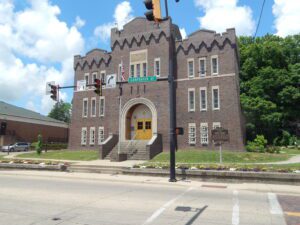
In the first years of the twentieth century, Athens’ citizens formed a new National Guard company. The guardsmen initially held drill at the Campbell Block on Court Street, but soon the Athens Commercial Club began advocating for an armory from the Ohio National Guard. In 1912, the Armory Board approved the request. Plans were drawn up for the armory and the Guard purchased land from the Athens Brick Company at the foot of Shale Hill. Construction began in the spring of 1915 and the Armory opened in December. In March of 1917, the city held a dedication ceremony and parade. Before World War I, the Athens Armory housed Company L and the Machine Gun Company, both part of the 7th Infantry Regiment, Ohio National Guard. (Continued on other side)
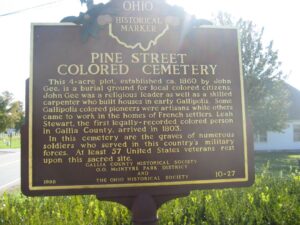
This 4-acre plot, established ca. 1860 by John Gee, is a burial ground for local colored citizens. John Gee was a religious leader as well as a skilled carpenter who built houses in early Gallipolis. Some Gallipolis colored pioneers were artisans while others came to work in the homes of French settlers. Leah Stewart, the first legally-recorded colored person in Gallia County, arrived in 1803. In this cemetery are the graves of numerous soldiers who served in this country’s military forces. At least 57 United States veterans rest upon this sacred site.
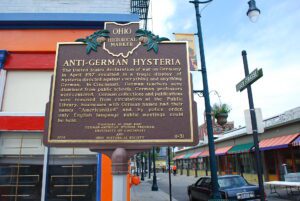
The United States’ declaration of war on Germany in April 1917 resulted in a tragic display of hysteria directed against everything and anything German. In Cincinnati, German teachers were dismissed from public schools, German professors were censored, German collections and publications were removed from circulation at the Public Library, businesses with German names had their names “Americanized” and, by police order, only English language public meetings could be held. (Continued on other side)
In the early 1800s, Jabez Wright, an early Huron County judge, purchased a large tract of lakeside land on the north side of what is now Cleveland Road. There Wright built an eight-room farmhouse that later served as a “station” on the fabled Underground Railroad, playing a vital role in aiding fugitive African-American slaves to freedom. Beneath Wright’s farmhouse was a sixteen foot-wide and ninety foot-long tunnel. Escaped slaves entered the passage through a trap door in the home’s basement and exited into a corn crib located a mere one hundred feet from Lake Erie. There the slaves awaited the arrival of rowboats transporting them to vessels heading north to Canada. (Continued on side two)
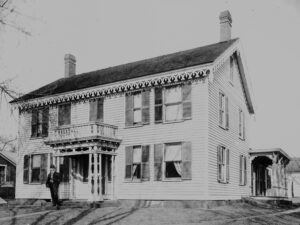
The Johnson House was built in 1852 and its first owner was Henry J. Traver (1827-1911), owner of Traver & Company carriage factory across the street. From 1877 until 1994 the house was the residence and office of four doctors who maintained their practices there. The first was Dr. Daniel Cranz (1854 — 1914); followed by Dr. Thomas Ritter (1855—1928). In 1900, Dr. Robert Johnson (1878 — 1952) purchased the house. His daughter Dr. Myra Johnson (1909 — 1994) took over the practice after he died and until she retired in 1976. After her death, the house was converted into a museum. It is operated by the Wadsworth Area Historical Society and owned by the City of Wadsworth. (Continued on other side)
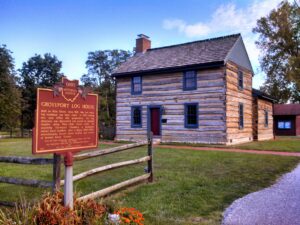
Built on Main Street, circa 1815, this two story log residence was later sided. In 1974 during new post office site preparation, the log structure was discovered and moved to present location along Ohio-Erie Canal route. In adjoining Groveport Cemetery a monument honors local resident, John S. Rarey (1828-1866), internationally known horse trainer and owner of famous horse, Cruiser.
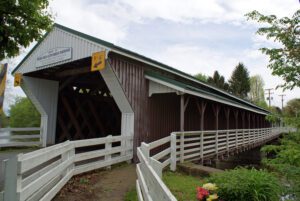
The Newton Falls covered bridge was built over the east branch of the Mahoning River around 1831. A crosswalk was added in 1921 for children crossing the bridge on their way to the school on Center Street. The Newton Falls bridge is considered the second oldest existing covered bridge in Ohio, the oldest covered bridge in use on its original site, the only covered bridge in the state with a covered crosswalk, and the last surviving covered bridge in Trumbull County. Built on the Town Lattice truss plan, the bridge is 123 feet long and twenty-four feet wide. It has a clear span of 101 1/2 feet and a sixteen foot-wide roadway. Listed on the National Register of Historic Places in 1974, the structure is maintained by Trumbull County.