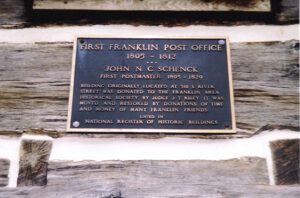
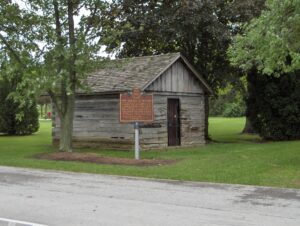
The oldest known structure standing in Franklin, the Old Log Post Office is a reminder of the links the community’s earliest members maintained to the rest of the young state of Ohio and to the United States during the early nineteenth century. John Noble Cumming Schenck, older brother of one of the founders of Franklin, William C. Schenck, established a store here in 1802. In 1805 President Thomas Jefferson appointed John Schenck postmaster of Franklin, a position he held until 1829. Schenck’s store is considered Franklin’s first post office and was one of the first four in Warren County. This building first stood at 310 South River Street and over the years was completely covered by additions and clapboards. They were removed in October 1974 and the house was moved to this location on December 6 of that year. In 1976 the structure was listed on the National Register of Historic Places.
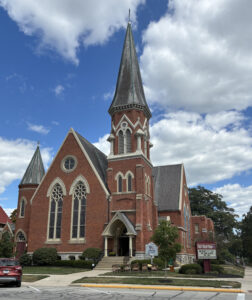
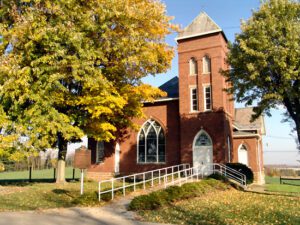
Sidney’s First Presbyterian Church formally organized on September 4, 1825, under the guidance of Reverend Joseph Stevenson, who traveled from Bellefontaine for that purpose. The original eight-member congregation worshipped outdoors or in the Shelby County Courthouse until able to finance their own building in 1834. First Presbyterian’s small frame chapel was constructed on the half-acre parcel that became their permanent home. Two centuries later, the congregation continues to worship at the corner of Miami Avenue and North Street on Lot 109, set aside for religious use in Charles Starrett’s 1819-1820 agreements platting Sidney’s original 70-acre tract. (Continued on other side)
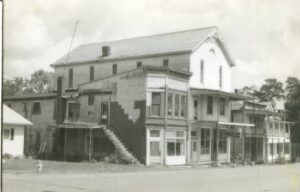
The commercial building that stood at 305 Main Street for over a century was built by Justus S. Law in 1897. On April 1, 1897, Law leased the Odd Fellows and Knights of Pythias joint-use of the third floor, rent-free, for 99 years after they completed its construction and added a slate roof to the building. Although the Pythians purchased the remainder of the building in 1921, they continued to share their “Castle Hall” with the Odd Fellows until 1965. In July 1974, the Pythians assigned their Pleasant City property to the Ohio Knights of Pythias Home in Springfield. From 1974 to 2012 the property exchanged private ownership multiple times until forfeited to the state in 2020. After the dilapidated Victorian building was demolished in 2021 the land was donated to the Village of Pleasant City.
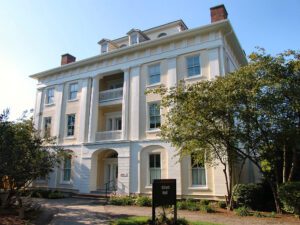
Built in 1833 as a health resort named the Mansion House Hotel, Elliott Hall is noted as Ohio’s oldest collegiate Greek Revival building. The closure of the Bank of the United States and an economic panic in 1837 created nation-wide financial difficulties, which led to the decline of the luxury resort. Under the leadership of Reverend Adam Poe, minister of William Street Methodist Church, the citizens of Delaware purchased the building for the establishment of a Methodist college for men. Ohio Wesleyan University was chartered on March 7, 1842, and the founding building was named for Dr. Charles Elliott, Ohio Conference leader who helped examine the site and establish the university. In 1877, Ohio Wesleyan University and the Ohio Wesleyan Female College merged into a co-educational institution. Elliott Hall was moved to its present location in 1892 when University Hall was built.
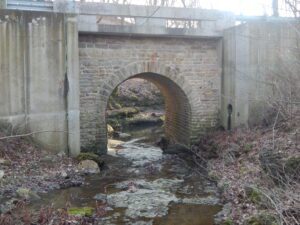
Listed on the National Register of Historic Places in 2009, the span is the oldest in Clark County a traveler can cross. It is also one of the oldest stone bridges in use in Ohio. Stone mason Samuel S. Taylor (1837-1930) built the culvert from locally quarried limestone in 1871, his first public works project. A Civil War veteran, Taylor worked on several projects, including the Mill Run underground sewer (1877), Champion’s East Street shops (1883), and the foundation for Springfield’s city hall (1890).
Zion (Ribel’s) Church was built on this site in 1808. The log structure was located in the Zion Ridge Cemetery, adjacent to the first school in Thorn Township. The congregation of Zion Reformed Church is the oldest in Perry County still in existence. The church was officially organized in 1806 when the German Reformed and Lutheran congregations joined together in building the first church in Perry County. They purchased this land on June 30, 1806, and shared the building, alternating Sundays, until 1911. In 1803, Reverend Johannes Christian Koenig (John King) became the first minister to settle in Perry County and became the founding minister for the German Reformed congregation. In 1805, Reverend Wilhelm Georg Forster (William Foster) was the first Lutheran minister to settle in Perry County and was the founding minister for the Lutherans. The present Zion Reformed Church was built across the street from the original church in 1910.
The village was laid out on August 18, 1847, by Benjamin Todd, and consisted of 18 lots in Section 26 of Pleasant Township. Originally named Pleasantville, it was incorporated in 1858 and the name was changed in honor of Maj. Gen. Alexander Macomb, famous for defending Plattsburgh, N.Y., during the War of 1812 and later Commander of the U.S. Army. William Chapman was the first mayor.
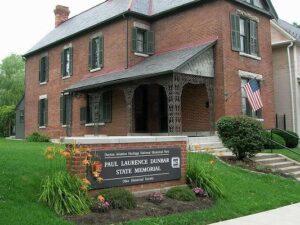
The first African-American to achieve prominence as a poet, Paul Laurence Dunbar was born and raised in Dayton, the son of former slaves. Working as an elevator operator while he established himself as a writer, Dunbar published his first book of poems, Oak and Ivy, in 1893. His third collection, Lyrics of a Lowly Life (1896) with an introduction by another Ohio-born author William Dean Howells, gained Dunbar widespread critical acclaim and popular recognition. Widely published in contemporary journals and literary magazines, Dunbar employed both turn-of-the-century African-American dialect and standard English verse to give a voice to the themes of everyday discrimination and struggles for racial equality. Tuberculosis cut his life short at age 33. Dunbar’s body of work includes twelve volumes of poetry, four books of short stories, a play, and five novels.