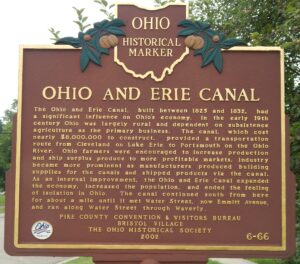
The Ohio and Erie Canal, built between 1825 and 1832, had a significant influence on Ohio’s economy. In the early 19th century Ohio was largely rural and dependent on subsistence agriculture as the primary business. The canal, which cost nearly $8,000,000 to construct, provided a transportation route from Cleveland on Lake Erie to Portsmouth on the Ohio River. Ohio farmers were encouraged to increase production and ship surplus produce to more profitable markets. Industry became more prominent as manufacturers produced building supplies for the canals and shipped products via the canal. As an internal improvement, the Ohio and Erie Canal expanded the economy, increased the population, and ended the feeling of isolation in Ohio. The canal continued south from here for about a mile until it met Water Street, now Emmitt Avenue, and ran along Water Street through Waverly.
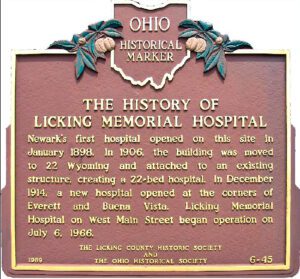
Newark’s first hospital opened on this site in January 1898. In 1906, the building was moved to 22 Wyoming and attached to an existing structure, creating a 22-bed hospital. In December 1914, a new hospital opened at the corners of Everett and Buena Vista. Licking Memorial Hospital on West Main Street began operation on July 6, 1966.
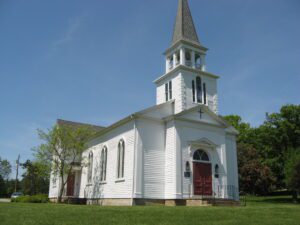
The first home of the oldest Episcopal parish in the Connecticut Western Reserve, the St. James Episcopal Church was built between 1827 and 1828. Philander Chase, first Bishop of the Diocese of Ohio, consecrated it in 1829. The belfry and steeple were added in 1881. It was moved to this site from its original Market Street location in 1972 after the parish built a new church. Renamed the St. James Meeting House, it is the anchor of a community of historic buildings that includes the Beardsley-Walter-Diehm House (circa 1828), the Oswald Detchon House (circa 1840), and the Schiller-Chuey Summer Kitchen. The oldest known structure in Boardman, the St. James Meeting House was added to the National Register of Historic Places in 1979.
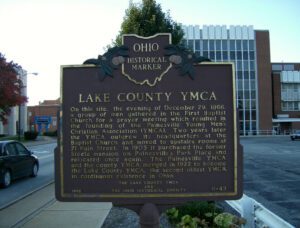
On this site, the evening of December 29, 1866, a group of men gathered in the First Baptist Church for a prayer meeting which resulted in the founding of the Painesville Young Men’s Christian Association (YMCA). Two years later the YMCA outgrew its headquarters at the Baptist Church and moved to upstairs rooms at 71 Main Street. In 1905 it purchased the former Steele mansion on Painesville’s Park Place and relocated once again. The Painesville YMCA and the county YMCA merged in 1922 to become the Lake County YMCA, the second oldest YMCA in continuous existence in Ohio.
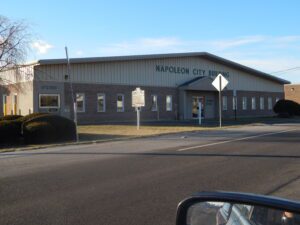
The completion of the Miami and Erie Canal passing through Napoleon in 1843 provided a way to receive manufactured goods, export farm products, and power local mills. The early industries of Napoleon utilized the canal as a source of reliable water power, which led to the development of a mid-19th-century industrial waterfront. Some of the local businesses that relied on the canal were Sayger’s Saw-mill (1843), John Ritter Flouring Mill (1850), Augustin Pilliod’s Napoleon Flouring Mill (1853), and the Napoleon Woolen Mill (1863). These mills used flumes, or artificial channels, to divert canal water to their water wheels. These brick-arch flumes were instrumental in bringing Napoleon into the national economy.
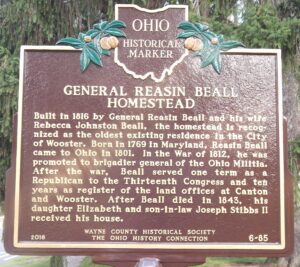
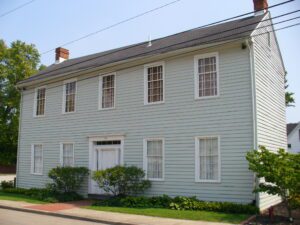
Built in 1816 by General Reasin Beall and his wife Rebecca Johnston Beall, the homestead is recognized as the oldest existing residence in the City of Wooster. Born in 1769 in Maryland, Reasin Beall came to Ohio in 1801. In the War of 1812, he was promoted to brigadier general of the Ohio militia. After the war, Beall served one term as a Republican to the Thirteenth Congress and ten years as a register of the land offices at Canton and Wooster. After Beall died in 1843, his daughter Elizabeth and son-in-law Joseph Stibbs II received his house.
First Lady Lucy Ware Webb Hayes was born in this four-room Federal Vernacular house in 1831. Well educated for her time, she attended local schools, took classes in the preparatory department of Ohio Wesleyan University in Delaware, and graduated from Wesleyan Female College in Cincinnati in 1850. She married lawyer and future U.S. President Rutherford B. Hayes in 1852. They raised five children to adulthood. As a colonel’s wife during the Civil War, “Mother Lucy” boosted morale for the soldiers of the 23rd Ohio Volunteer Infantry regiment. In 1870, during Hayes’ first term as governor of Ohio, Lucy helped establish the Ohio Soldiers’ and Sailors’ Orphans’ Home as a state institution. (continued on other side)
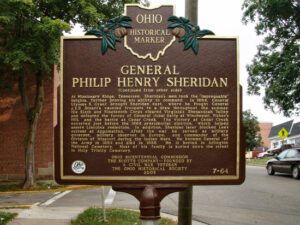
Philip Sheridan was most likely born in County Cavan, Ireland in 1831, but records do not indicate his actual birthplace. His family moved to Somerset when Philip was a child and lived down the avenue from this site. His family later owned the house across the street. His military interest was inspired by “Muster” day and frequent visits from a young West Pointer named William T. Sherman. Sheridan graduated from the United States Military Academy in 1853 and served on the Western Frontier Indian campaigns prior to the Civil War. In 1862, Sheridan became Colonel of the Second Michigan Calvary. At Stones River, Tennessee, he commanded a Division of the Twentieth Corps and stubbornly held General William S. Rosecrans’ right flank, distinguishing himself in battle. (continued on other side)