

, OH
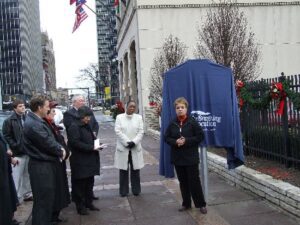
The Breathing Association was founded in 1906 as the Tuberculosis Society under the leadership of public health advocate Carrie Nelson Black. The society provided nutrition, medical care, and sanitorium services to people who could not afford proper medical care. A tuberculosis dispensary was operated at 40 South Third Street in Columbus for Ohioans needing consultation and treatment. Tuberculosis, known as the White Plague, killed one out of nine persons in Columbus during the early 1900s. An Open Air School was established on Neil Avenue in 1913 for children in homes where there were one or more cases of tuberculosis. In 1931, the Nightingale Cottage was opened on Brice Road as a tuberculosis preventorium for children. As tuberculosis became controllable, the agency became focused on emerging lung health issues. Today, The Breathing Association continues as a leading resource on lung health issues and preventing lung disease.
, OH
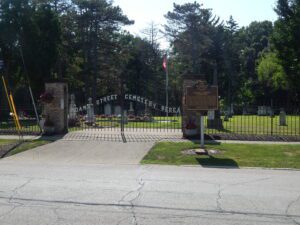
Known as the “Village Cemetery,” this was Berea’s main burial ground from 1834 to the 1880s. However, in 1886, the Cleveland Stone Co. purchased quarries adjacent to the cemetery, where Coe Lake is today. Quarrying had already caused flooding and landslides in the area. Local stories say that the company operated too near to the edge of cemetery, causing a landslide in the northwest corner that exposed some graves. Worried families moved their loved ones’ remains to other cemeteries, including those of five Civil War veterans. Pioneering families, 16 Civil War veterans, 3 mayors of Berea, several quarry owners, and many ordinary people still rest here. Of the original 589 burials, 40% were children. (Continued on other side)
, OH
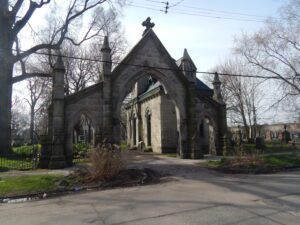
In January 1836, Barber and Lord sold a six-acre parcel for $160 that was to be used “forever as a public burying ground.” When Ohio City incorporated, the township cemetery became the city cemetery. Ohio City’s council established the cemetery’s rules and regulations, appointed a sexton, arranged for the ground to be platted, and purchased a hearse. After annexation by Cleveland, the cemetery became known as “the west side cemetery” and, later, the Monroe Street Cemetery. Under Cleveland’s charge, the cemetery was landscaped, protected by patrolmen, and fenced to keep out wandering hogs. Until the late 1890s, Monroe Street was the only public cemetery on Cleveland’s west side. Architect Joseph Ireland designed the cemetery’s Gothic Revival gateway arch (1874). Architect Walter Blythe designed the cemetery’s gatehouse, also in the Gothic Revival style (1876).
, OH
The Cincinnati Stock Exchange (CSE), founded in 1885, was headquartered in the Dixie Terminal Building at 49 East 4th Street. The CSE emerged as an innovator in stock trading when it started the nation’s first computerized stock exchange in 1976, allowing brokers to execute customer orders directly through their CSE National Securities Trading System data terminals. Computerization revolutionized stock exchanges domestically and then globally, as computers accepted, matched, and executed orders for stocks automatically, eliminating manual processing. The New York Stock Exchange acquired the CSE in 2017.
, OH
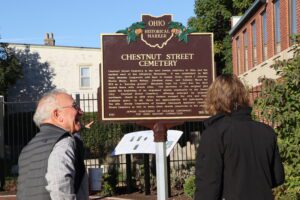
Chestnut Street Cemetery is the first Jewish cemetery in Ohio and the earliest west of the Allegheny Mountains. It was established in 1821 when Nicholas Longworth sold land to Joseph Jonas, David I. Johnson, Morris Moses, Moses Nathan, Abraham Jonas, and Solomon Moses for $75 as a “burying ground.” Benjamin Lape (or Leib) was the first buried there with Jewish rites. The purchase of the original plot marks the beginning of an organized Jewish community in the Queen City. Chestnut Street Cemetery, although enlarged by adjacent purchases, closed in 1849 when cholera ravaged the city and filled available space. In all, there are approximately 100 interments on the site. Jewish Cemeteries of Greater Cincinnati maintains Chestnut Street Cemetery as well as many other Jewish cemeteries in the region.
, OH
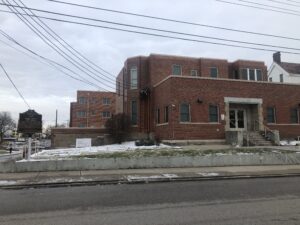
Walnut Hills has been home to a significant middle- and working-class Black community since the 1850s. In 1931, African American entrepreneur Horace Sudduth bought 1004 Chapel Street and then the row of buildings across Monfort, naming them the Manse Hotel and Annex. Throughout the 1940s, hotel dinner parties could move to the Federation of Colored Women’s Clubs house next door for dancing. A large addition to the Manse in 1950 created its own ballroom, 24-hour coffee shop, upgraded Sweetbriar Restaurant, and more guest rooms. It appeared in the Negro Motorist’s Green Book between 1940-1963, providing local, transient, and residential guests both catered meetings and top entertainment during the last decades of segregation. It closed in the late 1960s when the economic need for a first-class segregated hotel disappeared in the age of Black Power.
, OH
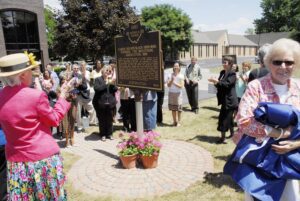
The Breathing Association was founded in 1906 as the Tuberculosis Society under the leadership of public health advocate Carrie Nelson Black. The society provided nutrition, medical care, and sanitorium services to people who could not afford proper medical care. A tuberculosis dispensary was operated at 40 South Third Street in Columbus for Ohioans needing consultation and treatment. Tuberculosis, known as the White Plague, killed one out of nine persons in Columbus during the early 1900s. An Open Air School was established on Neil Avenue in 1913 for children in homes where there were one or more cases of tuberculosis. In 1931, the Nightingale Cottage was opened on Brice Road as a tuberculosis preventorium for children. As tuberculosis became controllable, the agency became focused on emerging lung health issues. Today, The Breathing Association continues as a leading resource on lung health issues and preventing lung disease.
, OH
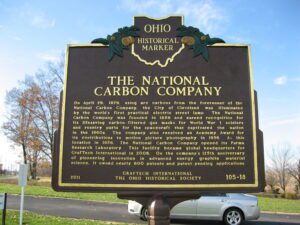
On April 29, 1879, using arc carbons from the forerunner of the National Carbon Company, the City of Cleveland was illuminated by the world’s first practical electric street lamp. The National Carbon Company was founded in 1886 and earned recognition for its lifesaving carbon-filtered gas masks for World War I soldiers and reentry parts for the spacecraft that captivated the nation in the 1960s. The company also received an Academy Award for its contributions to motion picture photography in 1956. At this location in 1956, The National Carbon Company opened its Parma Research Laboratory. This facility became global headquarters for GrafTech International in 2006. On the company’s 125th anniversary of pioneering innovation in advanced energy graphite material science, it owned nearly 800 patents and patent-pending applications.