

, OH
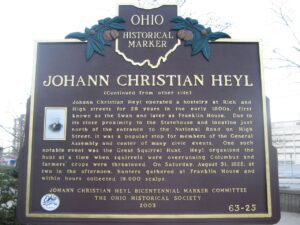
Johann Christian Heyl (1788-1877), the first German and first Lutheran to settle in Columbus, was one of the original 15 settlers of the city. A baker by trade, Heyl came to bake for the soldiers quartered in Franklinton during the War of 1812. He founded the city’s first Lutheran Church and helped financially underwrite the German Theological Seminary, which later became Capital University. An early civic leader, Heyl served on City Council for 14 years, was County Treasurer for 8 years, an associate judge in the Court of Common Pleas for 14 years, was appointed to the first public school board, and was the first Chief of the Fire Department. His Sunbury Road home was a stop on the Underground Railroad. (continued on other side)
, OH
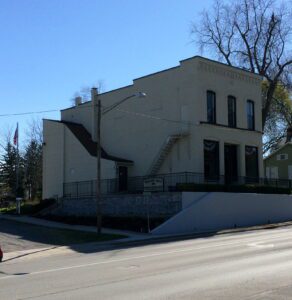
Henry Hanford Wakeman (1840-1879) of New York came to Waterville and became a successful businessman. He conceived the idea of a local Masonic Lodge, which became Wakeman Lodge No. 522 Free and Accepted Masons in 1879, and bequeathed $1,000 toward the construction of a meeting place. In 1880, a cornerstone was laid and this building was dedicated on October 21, 1881. For over 100 years, the Masons held their meetings upstairs while the lower floor was often rented out to a succession of businesses or used for public gatherings. Rising maintenance expenses and lower membership numbers caused the Masons to put Wakeman Hall up for sale in 1995. The Waterville Historical Society purchased the building in 1997 and spent several years rehabilitating it to serve as a local history archive and the Historical Society’s meeting place.
, OH
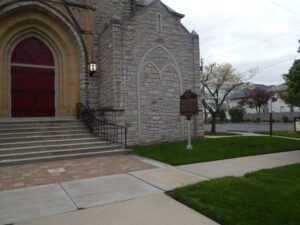
In 1886, thirty-six members from Toledo’s downtown Lutheran church, St. Paul’s, met to form a German-speaking Lutheran congregation for immigrants from Pommern, Mecklenburg and Hanover. Initially worshipping at St. Stephen’s at the corner of Harrison and Oliver Street, the congregation built a frame church on this site in 1887. That same year St. Lucas pioneered an early form of health insurance, The Mutual Sick Benefit Society, that later became a larger fraternal organization called The Mutual Sick Benefit Society for Ohio and Other States. In 1999, after joining a program called Reconciling in Christ, St. Lucas became the first Lutheran congregation in northern Ohio to publicaly welcome the LGBT communities. Named after Saint Luke, the patron saint of physicians, the church’s history is one of healing.
, OH
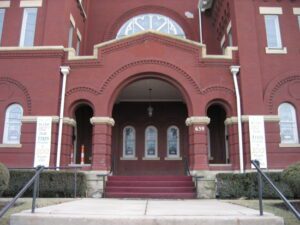
Organized in 1823 as Bethel African Methodist Episcopal Church, St. Paul A.M.E. Church is the oldest congregation of African descent in Columbus. The church, founded by Moses Freeman and 13 other members from the Town Street Church, was originally located on the east side of Lazelle Street. Several buildings were erected to meet the needs of the growing congregation. The present edifice, located at 639 E. Long Street, was completed in 1906. St. Paul has several outreach ministries, including The Prison Ministry, Alzheimer Ministry, Karen’s House, Community Development Corporation, Health Concerns Committee, St. Paul Tutorial and Enrichment Program (STEP), St. Paul Scholarship Program, St. Paul Drama Ministry, Jam’N Jefferson Park Festival, and Church Without Walls.
, OH
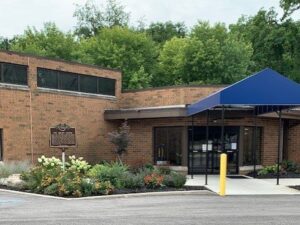
The Rotary Club of Toledo founded the “Toledo Society for Crippled Children” in 1920 to care for and treat children with disabilities, primarily those with polio. After a decade of fundraising and a substantial bequest from Edward Drummond Libbey, the Society opened a convalescent home in 1931 and moved to its own state-of-the-art facility in 1938. As the 1950s Salk vaccine reduced the prevalence of polio and the needs of Toledo’s disabled changed, the Society shifted focus to offer preschool care, adult rehabilitation, and independent living. The Society relocated to the 17-acre Monroe Street Campus in 1980 and adopted the name “The Ability Center of Greater Toledo” in 1990. The Ability Center proudly celebrated 100 years of “service above self” in 2020 and continues to create a disability-friendly Toledo.
, OH
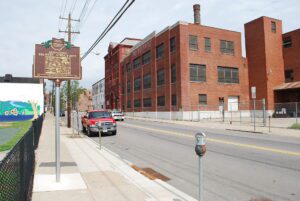
The Brewery District contains the majority of Cincinnati’s remaining breweries and associated structures such as icehouses, bottling buildings, offices, and stables. With the first brewery north of Liberty Street founded in1829, German immigrants fueled the growth of the brewing industry; by 1891, Cincinnati breweries produced over four barrels of beer per resident annually, almost twice as much as any other city in the nation. The brick breweries were typically designed in the Romanesque Revival style, and larger complexes often covered multiple city blocks. To produce the lager style beer common by 1860, typically very deep basements were dug or tunnels were cut into hillsides for the lagering process. At the height of production, 18 of the 36 breweries in greater Cincinnati were operating in Over-the-Rhine and the West End. Prohibition in 1919 closed most of the breweries permanently.
, OH
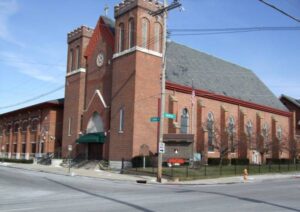
Built in 1852 and dedicated a year later, St. Patrick Church is the second oldest Roman Catholic Church in Columbus. Founded as the English speaking parish, this church of Norman Gothic design served as the home for three future bishops. Located on Naghten Street, the “Irish Broadway” of the nineteenth century, St. Patrick’s parish provided a vital place for the acculturation of the neighborhood Irish immigrants into mainstream American society. The Irish heritage is remembered through the shamrocks that emblazon the heads of each pew. Severely damaged by “the Great Fire” in 1935, the church was quickly restored and serves today as a vibrant religious center for central Ohio. The Dominican Fathers have staffed St. Patrick Church since 1885.
, OH
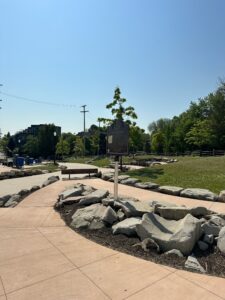
Opened in July 1862, the 35 1/2-acre site here in Brooklyn Township’s University Heights served as the largest Civil War army camp of rendezvous, organization, and training in northeast Ohio. It was bordered by Hershel (now West 5th) and University (now West 7th) streets and Railway and Marquard avenues. A wartime high of 4,151 volunteers occupied the barracks here on December 5, 1862. Lieutenant William Dustin of the 19th Ohio Volunteer Artillery wrote, “It was a table land above the city and admirably suited to the use of a camp of instruction. It was as level as a floor and carpeted with grass. The capacious pine barracks held about 25 each of the battery’s men.” A total of 15,230 men trained here during the war–4.9 percent of the 310,646 enlistments in Ohio. More than 11,000 soldiers were discharged here at war’s end. It closed in August 1865. (continued on other side)