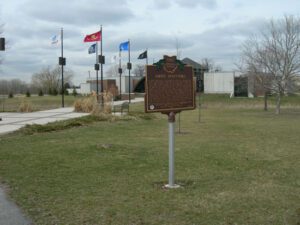
Company E of the 30th Ohio Volunteer Infantry was the only full infantry company formed in Jerome Township. Capt. Elijah Warner organized the unit in the village of Jerome and it was mustered into the Union Army at Camp Chase in Columbus on August 29, 1861. A total of 102 men from the township fought in the regiment throughout the war, while approximately 25% of the total population of the Jerome Township served. Company E performed outstanding service, participating in the Antietam, Vicksburg, and Atlanta Campaigns, Sherman’s March to the Sea and the March through the Carolinas, and the in the Grand Review in Washington, D.C. Of the 102 Jerome Township men in Company E, 32 perished during the war. The regiment was mustered out of service August 13, 1865.
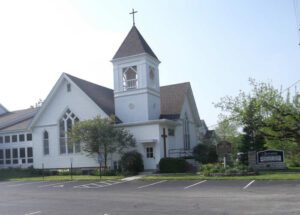
The first African American congregation and first African American Methodist Episcopal (AME) Church in Dayton trace their roots back to the early 1830s. They were organized by Father Thomas Willis and a small group of faithful men and women. After several moves, the congregation settled on Eaker Street and the church was dedicated in the early 1870s. The church was rededicated in 1882 and renamed Wayman Chapel AME Church. The eminent poet Paul Laurence Dunbar and his mother Matilda attended and worshiped at the Eaker Street church. His untimely death in 1906 brought family and friends to his funeral services held at the church. By 1923 church leadership felt the need for more secure space for the growing congregation and moved to a new building at Fifth and Banks streets. Three elegant chandeliers for the sanctuary were donated by the city’s newspaper, the Dayton Daily News. (Continued on other side)
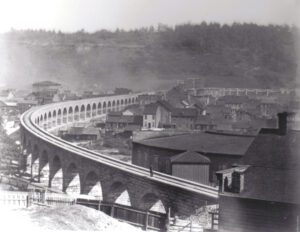
Construction of this Great Stone Viaduct began in 1870 at Union Street as an Ohio approach to the railroad bridge spanning the Ohio River. It was completed to Rose Hill in April 1871, and the entire bridge span connecting Ohio to West Virginia, of which the Viaduct is a part, was opened to rail traffic on June 21, 1871. Jointly constructed by the Baltimore & Ohio Railroad and the Central Ohio Railroad, its sandstone piers rise in varying heights 10 to 20 feet above the streets, from which are placed 43 stone arches supported by 37 ring stones (18 on each side of a keystone) intended to symbolize a united Union consisting of 37 states. Placed on the National Register of Historic Places in 1976, this Ohio River crossing became known as the “Great Shortline to the West.”
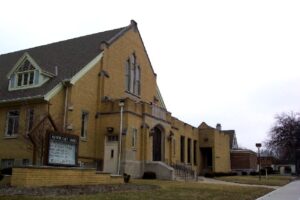
The Marlborough Society of Friends Meeting was established in 1813 by the Salem Quarterly Meeting at the request of the Springfield (Damascus) Meeting. The Marlborough Friends and Lexington Friends combined to become the Alliance Friends in 1865 and relocated to 322 East Perry Street in Alliance, which was the site of a Methodist Episcopal Church. The Marlborough Friends Meeting House and the burying ground were sold to W.W. Holibaugh in 1897 and remain in private ownership. When State Route 619 was widened in 1941, some burials were exhumed and re-interred
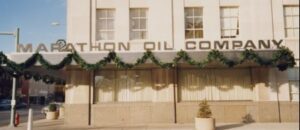
Marathon Center for the Performing Arts, 200 W. Main Cross Street
Findlay
, OH
Site of the first Findlay Field Office for what was to become a world-wide oil company, formerly locally owned and operated. 1887: The Ohio Oil Company was incorporated by five independent oil producers in the Lima field. 1901: J.C. Donnell elected President of the Ohio Oil Company. Company’s ‘big well,’ the “Hugh McMurray,” comes in. 1929: Construction begins on new office building at South Main Street and Hardin Streets. 1962: Name changed to Marathon Oil Company to reflect international operations.
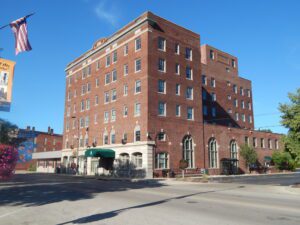
The Hotel Ashtabula was built in 1920 during an economic boom that lasted most of that decade. Architecturally, it represents a combination of Second Renaissance Revival and Georgian Revival styles. The H.L. Stevens and Company of Chicago and New York designed and built the hotel and others like it in Cleveland, Dayton, and Warren, Ohio and throughout the Midwest. The building included a ball room accommodating 300, a dining room that could seat 125, and club meeting and social rooms. A prominent structure of this downtown street, the Hotel Ashtabula was a hub for social activity. (Continued other side)
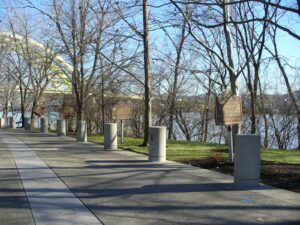
801 E. Pete Rose Way, Bicentennial Commons at Sawyer Point
Cincinnati
, OH
In memory of the Irish people who left a country where only their rivers run free. The Irish came to Cincinnati where they contributed to housing, education, employment, religious freedom, medical care and recreation, and embraced all aspects of life in the city. The descendants of Irish immigrants hope that our hands will ever be extended in friendship and never in want.
In 1810, early settlers here were Major Amos Spafford (1753-1818), his wife Olive (1756-1823), and their children Samuel, Aurora , Chloe (Mrs. Almon Gibbs), and Anna (Mrs. Richard Craw). In 1796, Spafford, a native of Connecticut, was a surveyor for the Connecticut Land Company. He drew the first map laying out Cleveland and named the city. He left there in 1810 following appointment as custom’s collector and postmaster for the new port at the foot of the Maumee River rapids, Port Miami of Lake Erie. Spafford was granted a 160 acre land patent on River Tracts #64 and #65 in Waynesfield township, signed by President James Monroe and was able to purchase it following the 1817 Treaty of the Rapids that extinguished Native American claim. Two years later, 67 families lived in the area, but most fled at the outbreak of the War of 1812.