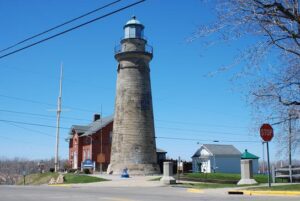
Lighthouse and keeper’s dwelling, erected in 1871 to replace the 1825 structures designed by Jonathan Goldsmith. From the time it guided early settlers into the Western Reserve until it was decommissioned in 1925, this station served Great Lakes shipping for its most important 100 years. The present, well-proportioned tower, constructed of Berea sandstone, is an outstanding engineering achievement.
Administration Building built in 1931. Chapter House built in 1962. Commemorating American Red Cross Centennial, 1881-1981.
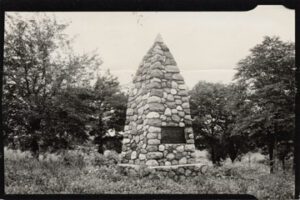
Early Western Reserve burial grounds, 1804-1848. Grave sites of 12 Revolutionary War veterans and Mary Chesney, member of pioneer Warren family and for whom local D.A.R. chapter was named.
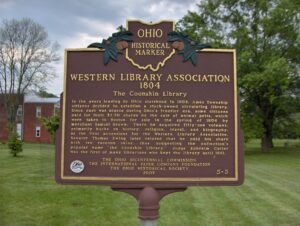
In the years leading to Ohio statehood in 1803, Ames Township citizens decided to establish a stock-owned circulating library. Since cash was scarce during Ohio’s frontier era, some citizens paid for their $2.50 shares by the sale of animal pelts, which were taken to Boston for sale in the spring of 1804 by merchant Samuel Brown. There he acquired fifty-one volumes, primarily books on history, religion, travel, and biography, as the first accessions for the Western Library Association. Senator Thomas Ewing later related that he paid his share with ten raccoon skins, thus suggesting the collection’s popular name “the Coonskin Library.” Judge Ephraim Cutler was the first of many librarians who kept the library until 1861.
During the Indian Wars of 1790-1795, the United States built a chain of forts in the contested area of what is today western Ohio. These forts were built as a result of various tribes of the region attacking the encroaching American population as they moved north of the Ohio River. In October 1791, General Arthur St. Clair, governor of the Northwest Territory, set out on a mission to punish the tribes and on October 12, ordered his forces to build Fort Jefferson, the fourth link in that chain of forts stretching north from Fort Washington (Cincinnati) to Fort Deposit (Waterville). Each fort was generally a hard day’s march of each other, and the site was chosen because of nearness to a supply of fresh water. The fort was named in honor of Secretary of State Thomas Jefferson.
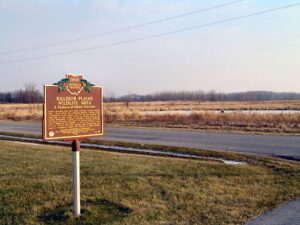
Prairie grasslands were once widely scattered across western Ohio. One of Ohio’s best remaining prairies, Killdeer Plains is dominated by tall grasses such as the big bluestem and plays host to some unique species of wildlife such as the eastern massasauga or swamp rattlesnake. Prairie grasslands are one of the most rare types of wildlife habitats in the state. Named for the killdeer, a shore bird, this is part of a wet prairie that once spanned some 30,000 acres and boasts a tremendous number and diversity of native wildlife.
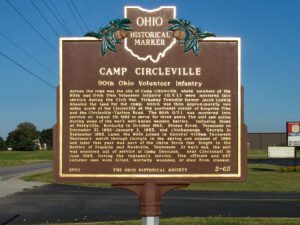
Across the road was the site of Camp Circleville, where members of the 90th and 114th Ohio Volunteer Infantry (O.V.I.) were mustered into service during the Civil War. Pickaway Township farmer Jacob Ludwig donated the land for the camp, which was then approximately two miles south of the Circleville at the southwest corner of Kingston Pike and the Circleville-Tarlton Road. The 90th O.V.I was mustered into service on August 29, 1862 to serve for three years. The unit saw action during some of the war’s well-known western battles, including those at Perryville, Kentucky in October 1862; Stones River, Tennesee on December 31, 1862-January 2, 1863, and Chickamauga, Georgia in September 1863. Later, the 90th joined in General William Tecumseh Sherman’s march through Georgia in the spring and summer of 1864 and later that year was part of the Union force that fought in the Battles of Franklin and Nashville, Tennesee. At war’s end, the unit was mustered out of service at Camp Dennison, near Cincinnati in June 1865. During the regiment’s service, five officers and 247 enlisted men were killed, mortally wounded, or died from disease.
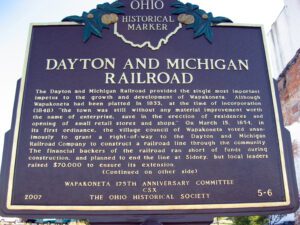
The Dayton and Michigan Railroad provided the single most important impetus to the growth and development of Wapakoneta. Although Wapakoneta had been platted in 1833, at the time of incorporation (1848), “the town was still without any material improvement worth the name of enterprise, save in the erection of residences and opening of small retail stores and shops.” On March 15, 1854, in its first ordinance, the village council of Wapakoneta voted unanimously to grant a right-of-way to the Dayton and Michigan Railroad Company to construct a railroad line through the community. The financial backers of the railroad ran short of funds during construction, and planned to end the line at Sidney, but local leaders raised $70,000 to ensure its extension. (Continued on other side)
SE corner of E Marietta Street and Creamery Street
Woodsfield
, OH
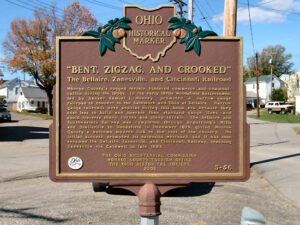
Monroe County’s rugged terrain hindered commerce and communication during the 1800s. In the early 1870s Woodsfield businessmen, led by banker Samuel L. Mooney, promoted a narrow-gauge railroad to connect to the Baltimore and Ohio at Bellaire. Narrow gauge railroads were popular during this boom era because they cost less to build and operate than standard-gauge lines and could traverse sharp curves and steep terrain. The Bellaire and Southwestern Railway was completed through Armstrong’s Mills and Beallsville to Woodsfield in December 1879, giving Monroe County a welcome modern link to the rest of the country. Its initial success prompted its extension westward, and it was soon renamed the Bellaire, Zanesville, and Cincinnati Railway, reaching Zanesville via Caldwell in late 1883.