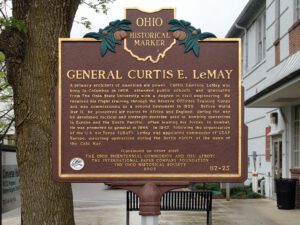
A primary architect of American air power, Curtis Emerson LeMay was born in Columbus in 1906, attended public schools, and graduated from The Ohio State University with a degree in civil engineering. He received his flight training through the Reserve Officers Training Corps and was commissioned as a second lieutenant in 1929. Before World War II, he pioneered air routes to Africa and England; during the war he developed tactical and strategic doctrine used in bombing operations in Europe and the South Pacific, often leading his forces in combat. He was promoted to general in 1944. In 1947, following the organization of the U.S.Air Force (USAF), LeMay was appointed commander of USAF Europe, directing operations during the Berlin Airlift at the dawn of the Cold War. (continued on other side)
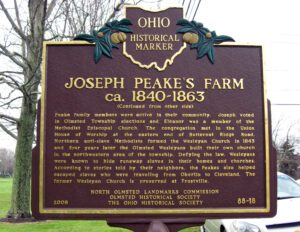
Joseph Peake was born in Pennsylvania in 1792 and came to Ohio in 1809 with his parents and brother. They were the first African Americans to settle permanently in the Cleveland area. He was the son of George Peake, a runaway slave from Maryland, who fought on the British side at the Battle of Quebec in 1759 during the French and Indian War. A man with some means and talent, George Peake invented a stone hand mill for grinding corn, a labor-saving device that endeared the Peakes to their neighbors in western Cuyahoga County. Joseph Peake and his wife Eleanor, an African American from Delaware, bought land in the 1840s on the Mastick Plank Road and built a home near this marker. [Continued on other side]
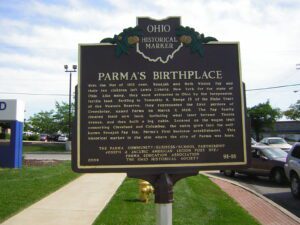
With the War of 1812 over, Benajah and Ruth Wilcox Fay and their ten children left Lewis County, New York for the state of Ohio. Like many, they were attracted to Ohio by the inexpensive, fertile land. Settling in Township 6, Range 13 of the Blake Tract of the Western Reserve, they represented the first settlers of Greenbriar, named Parma on March 7, 1826. The Fay family cleared their new land, including what later became Theota Avenue, and then built a log cabin. Located on the wagon trail connecting Cleveland and Columbus, the cabin grew into the well-known Benajah Fay Inn, Parma’s first business establishment. This historical marker is the site where the city of Parma was born.
NE corner of Broadview Road and Boston Road (across the street from Seves Glass Block Inc., 10576 Broadview Road, Broadview Heights, Ohio 44147)
Broadview Heights
, OH
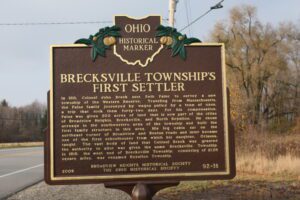
In 1811, Colonel John Breck sent Seth Paine to survey a new township of the Western Reserve. Traveling from Massachusetts, the Paine family journeyed by wagon pulled by a team of oxen, a trip that took them forty-two days. For his compensation, Paine was given 200 acres of land that is now part of the cities of Broadview Heights, Brecksville, and North Royalton. He chose acreage in the southwestern area of the township and built the first family structure in this area. His log cabin sat on the northeast corner of Broadview and Boston roads and later became one of the first schoolhouses from which his daughter, Orianna, taught. The vast body of land that Colonel Breck was granted the authority to allot was given the name Brecksville Township. In 1818, the west end of Brecksville Township, consisting of 21.28 square miles, was renamed Royalton Township.
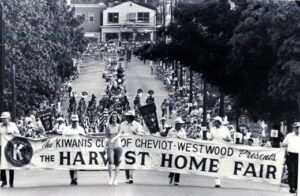
In 1804, Enoch (1764-1817) and Achsah (c.1767-1839) Carson and their seven children journeyd from New Jersey to Cincinnati. In 1805, they settled in the western hills in a large grove near Beech Flats, in what would become Green Township in 1809 and Cheviot in 1818. Game was plentiful and fertile soil yielded abundant crops. By 1806, Carson had cleared and cultivated nearly 20 acres of his land. That fall, he began a tradition that has continued into the 21st century. Echoing the ancient custom of harvest home, Carson brought together a fledging community to celebrate its good fortune and abundant harvests. Each passing year the community gathered in Carson’s grove to give thanks, rejoice, and uphold the tradition of harvest home. (Continued on other side)
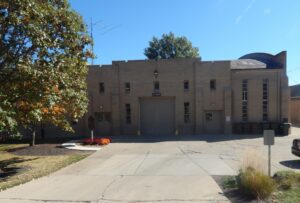
Xavier University Armory. The Xavier University Armory was dedicated in 1948 by the first Secretary of the Army, Kenneth C. Royall. In the following decades, U.S. Army Reserve Officer Training Corps (ROTC) cadets used it as a place to refine their tactical and technical skillsets in preparation to serve as officers in the U.S. Army. Since 1948, Xavier University ROTC commissionees have become General Officers and recipients of the Silver Star Medal, Bronze Star Medal, Purple Heart, and other prestigious awards. (Continued on other side)
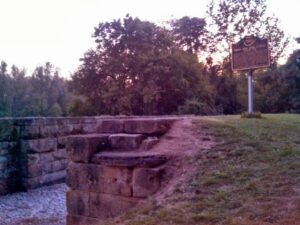
The Ohio and Erie Canal Lock 22, constructed from 1830-1831, is the only canal lock in Groveport. Constructed by W.H. Richardson as part of his $2,937 bid to build section 52 of the canal, the sandstone lock is 117 feet long and ten feet deep and has a sixteen foot wide channel. Its purpose was to raise and lower canal boats to meet the changing terrain. The canal’s presence helped fuel commercial and population growth in Groveport in the 19th century by providing a fast and reliable form of transportation to move people, goods, and services to and from the Ohio frontier. It was also a source of recreation as residents used its waters for fishing, row boating, and ice skating. The canal basin at the western end of Lock 22 was a favorite spot for ice skating parties.
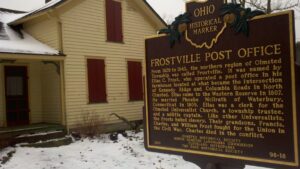
The North Olmsted Historical Society was founded in 1953 and became incorporated as a non-profit association in 1961. A year later, Frostville Museum opened in the Prechtel House. The society took on the challenge of preserving the history of the entire original township and became the Olmsted Historical Society in 1969. The Frostville Museum has grown from one house to a small village. Volunteers are dedicated to preserving the past and the present for the future. In August 2010, First Lady Michelle Obama designated the society as a Preserve America Steward. Frostville is an affiliate of the Cleveland Metroparks.