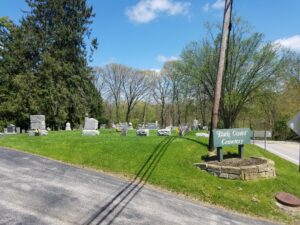
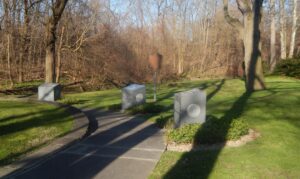
Settlers from New England purchased this land in 1817 for use as a burying ground and to build a meeting house. Located in the center of Bath Township, a part of the Connecticut Western Reserve, the site provided a convenient place for public and religious gatherings and for a cemetery. Out of need, the cemetery was established before the township was founded in 1818. Many of Bath Township’s farming families, as well as both owners and operators of businesses of Bath, are interred in the cemetery. In a tradition originating with Civil War veteran Perry Alexander, the graves of all veterans are marked with an American flag on Memorial Day as a tribute to their service.
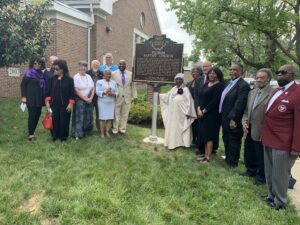
On January 9, 1919, a group of eight men and three women, being led by the Holy Spirit, met at a house on Wallace Street to form a new black Missionary Baptist Church in Hamilton, Ohio. The group quickly raised $150 to make the down payment on a two-story brick building at 333 Chestnut Street being sold for $1,850. The building was occupied on March 25, 1919, and the name Pilgrim Baptist Church was suggested and accepted. On May 11, 1919, a special council requested admittance into the Western Union Baptist Association, a district association now affiliated with the Ohio Baptist General Convention. Requirements for admission were met and Pilgrim Baptist Church was recognized as a Missionary Baptist Church. In 2019, Pilgrim Baptist Church celebrated a centennial of faithfulness in Hamilton.
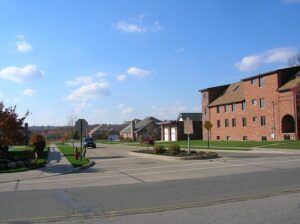
Intersection of DiFranco Boulevard and E. Schaaf Road
Brooklyn Heights
, OH
With its favorable seasons and fertile soils, the northern Ohio frontier attracted settlers to the Western Reserve from the beginning of the nineteenth century. With a well-established agricultural heritage, “truck farming” became popular as wagons hauled produce to stands at the Central Market on Public Square in Cleveland around 1860. Thirty years later, to extend the growing season, Martin Ruetenik, who was inducted into the Ohio Agricultural Hall of Fame, introduced the concept of greenhouse growing by constructing a 550-square foot greenhouse. Following his lead, nearly every farmer along Schaaf Road became a greenhouse farmer making Brooklyn Heights one of the leading greenhouse areas in the United States with over 4 million square feet or 100 acres “under glass.” With its concentration of greenhouse farming, Brooklyn Heights became synonymous with fine, high quality, greenhouse tomatoes.
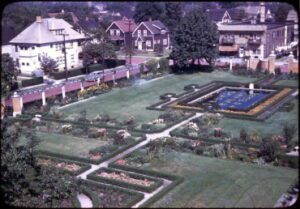
The Village of Collinwood was originally a part of Euclid Township of the Western Reserve and named after the death of railroad chief engineer Charles Collins in 1876. Originally known as “Frogsville,” the population of Collinwood dramatically increased in the 1870s, due partly to repair roundhouses of the Lake Shore & Michigan Southern Railroad. By 1901, the Village has grown to 7,500, and as a result, the schoolhouse, which once housed 200 students and four classrooms, had been enlarged twice to house 350 students in eight classrooms. Constructed in 1901, the Lakeview School was the site of a tragedy that reverberated across the nation and around the world. (Continued on other side)
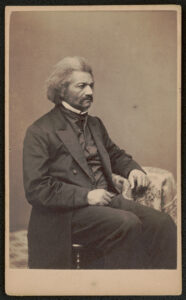
Frederick Douglass, the formerly enslaved man celebrated as one of America’s most powerful abolitionist voices, delivered a historic commencement address at Western Reserve College on July 12, 1854. Invited by the graduating students of the Philozetian and Phi Delta literary societies, Douglass passionately delivered his two-hour speech, “The Claims of the Negro: Ethnologically Considered,” to a gathering of 3,000. Douglass challenged the rising tide of scientific racism and promoted the shared humanity and equality of all people. At a time when few Black Americans were granted such a platform, the moment embodied the spirit of abolition that defined the Western Reserve region. In an era of deep national division, the students’ bold invitation and Douglass’s powerful message affirmed education’s enduring role in advancing truth and justice.
Sylvania was once the headquarters for the Toledo and Western Railway, an electric interurban line that provided service between Toledo and Pioneer with a branch line to Adrian, Michigan. Construction began here in 1900 with planning and specifications set to steam railroad standards. With completion of rails, a powerhouse, maintenance facilities, and offices, the Toledo and Western Railway Company was soon in the business of providing freight and passenger service and was especially competitive as it owned more freight engines than most interurban lines. Operating an electric interurban line also meant that the company had the ability to provide electricity to people living in Sylvania and to other communities and property owners living along the line’s right-of-way. Besides freight, passengers, and electricity, Toledo and Western also provided postal service, one of the first interurban lines to do so. [continued on other side]
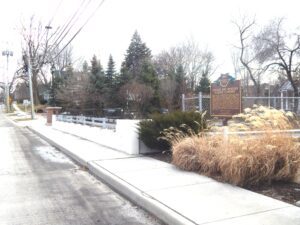
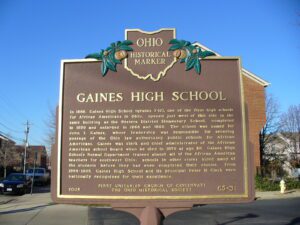
In 1866, Gaines High School (grades 7-12), one of the first high schools for African Americans in Ohio, opened just west of this site in the same building as the Western District Elementary School, completed in 1859 and enlarged in 1866 and 1868. The school was named for John I. Gaines, whose leadership was responsible for securing passage of the Ohio law authorizing public schools for African Americans. Gaines was clerk and chief administrator of the African American school board when he died in 1859 at age 38. Gaines High School’s Normal Department trained almost all of the African American teachers for southwest Ohio; schools in other states hired many of the students before they had even completed their studies. From 1866-1886, Gaines High School and its principal Peter H. Clark were nationally recognized for their excellence.
In 1962, Asian Indian students of Case Western Reserve University started India Association of Cleveland (IAC). In 1967, IAC started a newspaper “LOTUS,” regarded as the first such Asian Indian community newspapers in the United States. In 1978, IAC started a community center to be owned and managed by a new organization: India Community Center (ICC), the first such facility established by Asian Indians in Ohio. In 1980, IAC and ICC merged and formed the Federation of India Community Associations (FICA). Other associations representing the various states and interests in India became Federation members.