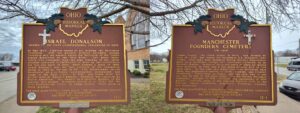
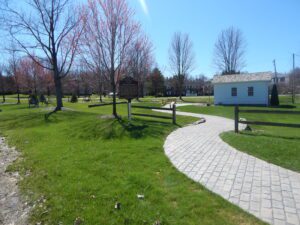
In May 1800, Congress passed an act dividing the Northwest Territory, with the western division becoming Indiana Territory and the eastern called the Territory of the United States northwest of the Ohio River. Two years later, thirty-five delegates from the nine counties of the latter division convened in Chillicothe to draw up the constitution for the new state of Ohio, which became a state in 1803. Israel Donalson was the last survivor of the convention dying in 1860 at the age of 93. This frontiersman served Manchester as a surveyor, schoolteacher, postmaster, and judge in the first court. In 1791, one month after his arrival here at Massie’s Station, Donalson was captured by Native Americans. His memoir is a colorful account of his capture and escape. Donalson served as an Elder for the first Presbyterian church in Adams County, which stood on these grounds.
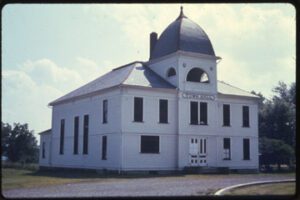
Major buildings dating from 1832 to 1898 surround the village green, the geographic center of Gustavus Township. Built in 1832 on the northwest quadrant, the George Hezlep House features Federal-Greek Revival architecture and has a closet reputedly used on the Underground Railroad. Built in 1840, the Farmers’ Exchange Store was originally a double entrance Greek Revival structure. The Storekeeper’s House, also a Greek Revival structure, was built next to the exchange store in 1840. South of this house is the Fraternal Hall, built in 1870. There were once four churches in Gustavus including the Methodist Church, built in 1856 with a temple front and a belfry, and the Congregational Church, built east of the center in 1854. The eclectic Town Hall was built in 1890 and fronts the southeast quadrant. The Gustavus Centralized School, reported as the first centralized school in the United States, was built in 1898 and was replaced by the current building in 1928.
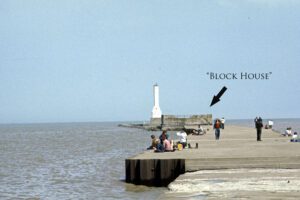
Lake Erie commerce has played a central role in the development of Huron. Important among Huron’s maritime industries were shipbuilding and commercial fishing. The city’s shipbuilding industry dates to the first decades of the nineteenth century. Shipyards were located on the Huron River’s west bank, slightly north of this marker, and also upstream at Fries Landing. Among the vessels built at Huron were the Great Western, constructed in 1838 and the first lake ship to have above-deck cabins, and the Golden Age, which, at 286 feet, was the largest craft on the Great Lakes when built in 1886. Huron shipbuilding declined as the nineteenth century drew to a close. Commercial fishing emerged thereafter, serving as Huron’s economic cornerstone for over fifty years. Huron’s fishing enterprises included the Huron, Kishman, Scott, and Zimmerman fish companies. By 1950, however, polluted lake waters ravished the once-lucrative industry. Although shipbuilding and commercial fishing are no longer a part of Huron’s daily life, they each had a profound effect upon the community’s growth for nearly two centuries.
Ebenezer Sheldon (1754-1825) was born in Suffield, Connecticut. On April 19, 1775, he answered the “Lexington Alarm,” fought in the Revolution, and, in 1789, was appointed a captain in Connecticut’s militia. Following the Revolution, Sheldon, like many others, suffered financial hardships and sought a new beginning in the Western Reserve. In 1799, he established a homestead in Aurora and returned to Connecticut the following year to bring his wife Lovee and their six children to the area. A family legend relates that when Lovee saw the family’s home she “shed a few tears over the cheerless prospects” of her new life in the wilderness.
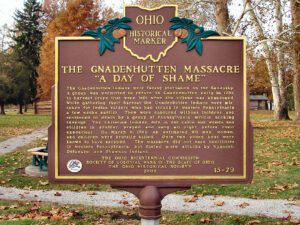
The Moravian Church in America began missionary work among the Delaware and Mohican tribes of North America in the mid-18th century. David Zeisberger, one of the best-known Moravian missionaries, came to the Ohio country with Delaware converts from a mission in western Pennsylvania and founded Schoenbrunn in the Tuscarawas Valley on May 3, 1772. Josua, a Mohican convert and missionary leader, led Mohican and Munsee Christians downriver and settled Gnadenhutten (“Tents of Grace”) on October 9, 1772. Zeisberger served as lead missionary at both villages. By 1775, there was an estimated 200 inhabitants in the village. The British, along with Wyandot and Delaware allies, suspected the Christian Indians of aiding the Americans. To ensure their allegiance to the British, the inhabitants of Gnadenhutten were forcibly removed in 1781 and taken to Captives’ Town on the Sandusky River.
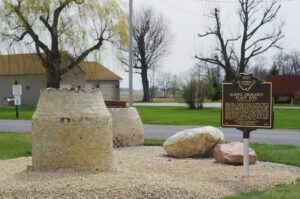
On March 2, 1942, four months after the U.S. entered WWII, farmers living between Marion-Williamsport and Marseilles-Galion Roads and between State Route 98 and the Norfolk & Western Railroad were notified to vacate their farms by the first of May. This displaced approximately 126 farm families from over 12,600 acres so that a munitions factory could be built. The site included the administration area, cafeteria, fire and police stations, and a hospital, in addition to the widely dispersed powder houses and the production lines. Manufacturing began in the fall of 1942. The plant’s operators included U.S. Rubber, Atlas Powder, the Permanente Metals Division of the Kaiser Corporation, Kilgore Manufacturing, and Ferro Enamel, who made bombs until August 14, 1945 — VJ Day. (Continued other side)
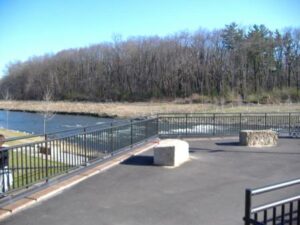
Officially opening on August 4, 1840, the Pennsylvania and Ohio Canal followed the route of present railroad tracks through Munroe Falls approximately one thousand feet south of this marker. This 82-mile long "feeder canal" connected the Beaver Valley canal system at New Castle, Pennsylvania with the Ohio and Erie Canal in Akron, thereby linking Pittsburgh with Cleveland and the western Great Lakes. Many communities along the canal’s path became linked to national and world commerce through their establishment as canal ports. New England investor Edmund Munroe purchased property and water rights along the canal’s proposed route, and in 1837 established the Munroe Falls Manufacturing Company. The village of Munroe Falls grew around the manufacturing company site and was incorporated on October 26, 1838. When this section of the canal closed in 1869, the waterway through Munroe Falls was filled and railroad tracks were laid over its path. A portion of the canal bed is still visible east of State Route 91.
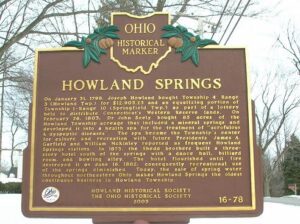
On January 31, 1798, Joseph Howland bought Township 4-Range 3 (Howland Twp.) for $12, 903.23 and an equalizing portion of Township 1-Range 10 (Springfield Twp.) as part of a lottery held to distribute Connecticut’s Western Reserve lands. On February 26, 1803, Dr. John Seely bought 85 acres of the Howland Township acreage that included a mineral springs and developed it into a health spa for the treatment of “scrofulous & dyspeptic diseases”. The spa became the Township’s center for culture and recreation with future Presidents James A. Garfield and William McKinley reported as frequent Howland Springs visitors. In 1873, the Shedd brothers built a three-story hotel south of the springs with a dance hall, billiard room, and bowling alley. The hotel flourished until fire destroyed it on June 16, 1882; consequently recreational use of the springs diminished. Today, the sale of spring water throughout northeastern Ohio makes Howland Springs the oldest continuous business in Howland Township.