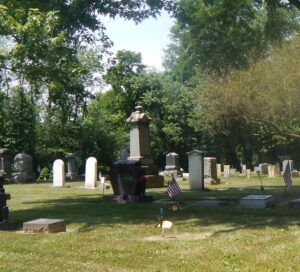
In 1827, noted evangelist Walter Scott came to Canfield and visited with a number of area Baptist families living on Palmyra Road and in the vicinity of Dean Hill. A follower of Alexander Campbell, Scott delivered powerful sermons that persuaded some to establish a new church congregation in the Disciple faith. After meeting in congregation members’ homes, a framed meeting house was erected circa 1830 on land purchased from William and Orsemus Dean. This church stood across from William Dean’s brick residence. A burial ground was provided at the site with existing grave markers dating to 1837. Veterans from all the wars of this nation are buried here, including Benjamin Dean of the 105th Ohio Infantry Regiment who died from wounds suffered in the 1863 Battle of Murfreesboro in Tennessee. (continued on other side)
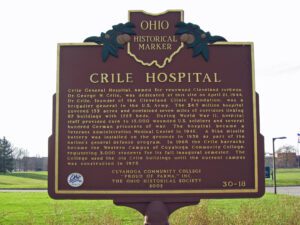
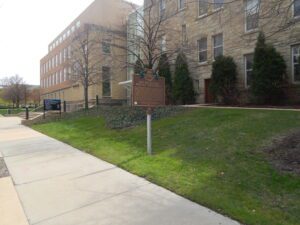
Crile General Hospital, named for renowned Cleveland surgeon, Dr. George W. Crile, was dedicated at this site on April 21, 1944. Dr. Crile, founder of the Cleveland Clinic Foundation, was a brigadier general in the U.S. Army. The $4.5 million hospital covered 153 acres and contained seven miles of corridors linking 87 buildings with 1725 beds. During World War II, hospital staff provided care to 15,000 wounded U.S. soldiers and several hundred German prisoners of war. The hospital became a Veterans Administration Medical Center in 1945. A Nike missile battery was installed on the grounds in 1956 as part of the nation’s general defense program. In 1966 the Crile barracks became the Western Campus of Cuyahoga Community College, registering 3,000 students for its fall inaugural semester. The College used the old Crile buildings until the current campus was constructed in 1975.
On this site stood the home of Elisha and Polly Mygatt Whittlesey and their ten children. Also here was his law office and a records office that was moved in 1965 to Pioneer Village at the Canfield Fairgrounds. Already an attorney in his home state, Elisha (1783-1863) with Polly (1787-1855) emigrated from Danbury, Connecticut in June 1806 to Canfield in the Western Reserve where he was admitted to the Ohio bar and was prosecuting attorney from 1807 to 1823. During the War of 1812, Whittlesey was adjutant to Maj. Gen. Elijah Wadsworth and later a secretary to Gen. William Henry Harrison. Whittlesey opened a law office in Canfield in 1813, specialized in land cases, and was one of the founders of Norwalk, Ohio in 1815. In 1820, he was elected to the first of two terms in the Ohio General Assembly. (Continued on other side)
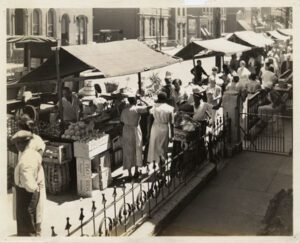
Public markets housing butchers, fish merchants, and produce vendors were once the primary source of perishable foods for residents of America’s cities. Cincinnati operated nine in 1859. Only Findlay Market, built here in 1852, survives. Cincinnati’s lost indoor markets include: Fifth Street Market: 1829 to 1870, Fifth between Vine and Walnut Wade Street Market: 1848 to 1898, corner of Wade and Bauer Avenue Canal Market: 1829 to 1864, Court between Vine and Walnut Court Street Market: 1864 to 1914, replaced Canal Market Jabez Elliott Flower Market: 1890 to 1950, Sixth between Elm and Plum Sixth Street Market: 1895 to 1960, Sixth between Plum and Western Row Pearl Street Market: 1901 to 1934, Market between Sycamore and Broadway
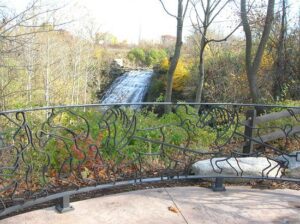
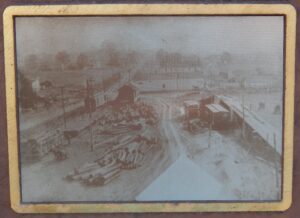
Formed by erosion of Cleveland shale and cascading 48 feet, making it the tallest waterfall in the county, the Cataract Falls of Mill Creek powered the gristmill and sawmill built by William Wheeler Williams and Major Wyatt in 1799. The mills, commissioned by the Connecticut Land Company to encourage settlement of the Western Reserve, attracted people to Newburgh. Cleveland finally outgrew bustling Newburgh by 1830 and eventually annexed most of it. The founding of the Cleveland Rolling Mill in Newburgh, beginning with the firm of Chisholm, Jones, & Company in 1857, precipitated the growth of the steel industry in Cleveland. By 1868, under the management of Henry Chisholm, it became one of the first in the nation to produce steel using the Bessemer process. The Rolling Mill, later the American Steel and Wire Company (a subsidiary of U.S. Steel), purchased the millworks at the falls in 1872.
The earliest improved public road west from Lake Erie to the Indiana border, the Territorial-Indiana Road was built by the U.S. Government in 1834-1835 through the Cottonwood Swamp, then a major obstacle to travel. It ran parallel to the Harris Line, the northern boundary of a narrow strip of land contested by Ohio and Michigan from 1803 until 1836, when Ohio annexed it following the “Toledo War.” Completion of the 110-mile road gave farmers and settlers much improved access to markets and new western lands. It became the Indiana Plank Road in 1848 and later Sylvania-Metamora Road. The Toledo and Western Electric Railway’s parallel right-of-way was completed in 1902.
The Michelson-Morley Experiment, conducted at Western Reserve University in July 1887, provides the earliest direct evidence that would later support Albert Einstein’s theory of relativity. Albert A. Michelson, professor of physics at the Case School of Applied Sciences, and Edward Morley, professor of chemistry at Western Reserve University, tested the prevailing scientific theory that light waves travel faster downwind and slower against an upwind as they travel through a substance once thought to permeate space called aether. Finding no differences in the velocity of light waves traveling in different directions with respect to Earth’s motion around the sun, the experiment’s results baffled a generation of scientists until Einstein solved the riddle by formulating a new understanding of time and space. In 1907, Michelson, then head of the physics department at the University of Chicago, became the first American scientist to earn the Nobel Prize; he did so in physics.
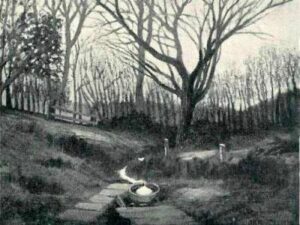
A salt spring, located about a mile west of this site, was the primary attraction for immigrants to the Western Reserve territory in the mid-1700s. Prior to European-American settlement, Indians used the springs, boiling the water to extract the salt and using it for preserving meat among other uses. In 1755, surveyor Lewis Evans underscored the importance of the springs by noting it on his “General Map of the Middle British Colonies in America.” This enticed immigrants from western Pennsylvania to the region. In addition to the salt itself, the abundance of wildlife near the spring ensured good hunting in the area. (Continued on other side)