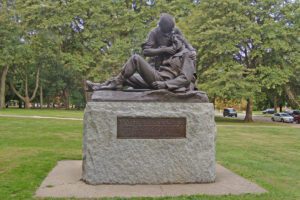
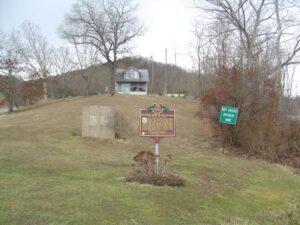
Mary Ann Ball was born in this vicinity in 1817 and began her nursing career at age 20. When the Civil War broke out in 1861, Mary at the age of 45 went to the soldiers’ aid. Ignoring rank, protocol, and allegiance, she pursued fearlessly and with inexhaustible energy her mission to care for the sick and wounded. Rebel, Union, and Negro soldiers all received the same attention. She risked enemy fire, especially through Grant’s Western Campaign and Sherman’s Georgia Campaign, to rescue suffering men, often going out at night to hunt for the fallen. When the victorious armies of the North were reviewed in Washington at the war’s end, “Mother Bickerdyke” road her faithful white horse beside the generals and colonels. Veterans along the line of march gave her the loudest cheers.
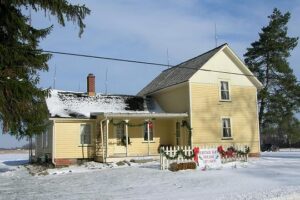
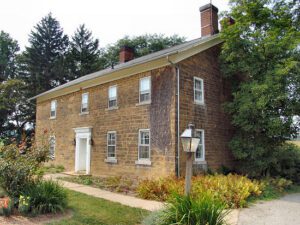
Heritage Farm is a typical mid-19th century farm of the Ohio Western Reserve and has been restored and preserved. The original parcel of land consisted of 325 acres, which was purchased by David Berdan in 1818. The farmstead has been home to Abram and Sarah Berdan, William and Rachel Pitkin, George and Julia Tibbitts, and Peter and Mary Groening. The Heritage Farm Museum site consists of 4 acres with a house, privy, carriage house, corncrib, granary, equipment shed, barn, milk house, and chicken house, and was open to the public on July 1, 2000.
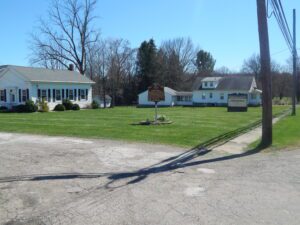
Ephraim Root (1762-1825), a wealthy Connecticut lawyer, was one of 57 investors in the Connecticut Land Company and served as its secretary and agent. In 1795, this group purchased three million acres of land in the Western Reserve. Root held interest in 100,000 acres, including Township 2 in Range VIII, which he named Rootstown. In 1800, Root traveled by horseback with his helper Henry Davenport and surveyor Nathaniel Cook to divide the township into 48 sections, reserving Lot 6 for his own use.
SW corner of W Main Street and S Broadway Street (Public Square)
Greenville
, OH
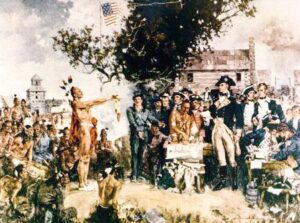
Following General Anthony Wayne’s victory at Fallen Timbers, members of the western tribes assembled at Fort Greene Ville to settle on terms of peace. Representatives of the Wyandot, Delaware, Shawnee, Ottawas, Chippewa, Ottawa, Patawatimi, Miami, Eel River, Wea, Piankeshaw, Kickapoo, and Kaskaskia signed the treaty on August 3, and agreed to cede claims to lands east of the Cuyahoga River to Fort Laurens in Tuscarawas County and south of a line running west to Fort Recovery. In return, the United States offered payment and annuities in the form of goods and ceded claim to most land north and west of the treaty line. This treaty marked the end of the Indian Wars in the Ohio Country, forsaking boundary violations by both parties, and established the official western border of the United States, opening much of Ohio for settlement.
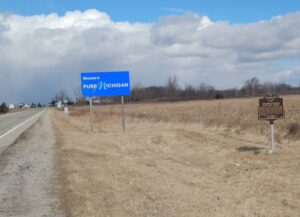
After the War of 1812, the United States Congress proposed two million acres of military bounty land for the Michigan Territory. To survey the land, the meridian had to first be established. U.S. Surveyor General Edward Tiffin created the meridian based on the western line of the Treaty of Detroit (1807). He contracted with Deputy Surveyor Benjamin Hough in April 1815 to begin the survey for $3 per mile. Taking a reading from Polaris (the North Star), Hough, Alexander Holmes, and 11 crew members surveyed the line due north from Fort Defiance. The difficult terrain they encountered temporarily halted all surveys in the territory and ultimately led to the bounty land being transferred to the Illinois and Missouri Territories.
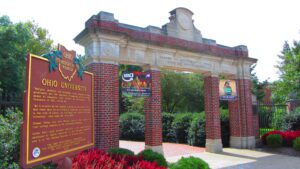
Manasseh Cutler, Rufus Putnam, Winthrop Sargeant, and Benjamin Tupper of the Ohio Company conceived Ohio University, which was encouraged by the Ordinance of 1787 and the Northwest Territorial Legislature in 1799, incorporated as the American Western University in 1802, and chartered by the Ohio State Legislature on February 18, 1804. The university is the first institution of higher learning in the Northwest Territory, second west of the Allegheny Mountains, and the first in the United States to be endowed with land by the government with proceeds used to pay for its operations-revenue from two townships was set aside to support the university. Opened on June 1, 1809, as an academy with three students, Ohio University awarded its first undergraduate degrees in 1815.
Frederick Rice was born on September 29, 1753, near Bethlehem, Northampton County, Pennsylvania and moved to Westmoreland County, Pennsylvania around 1766. During the American Revolution he served under George Washington at Valley Forge and fought in the Battle of Trenton on December 26, 1776, in which American forces surprised and captured 1,000 Hessian mercenaries. He served for two more years as a spy working against Native American tribes in western Pennsylvania. After his service he married Catherine Lauffer, and they raised eleven children to adulthood. Rice chose this 320-acre site, transferred to him in a deed signed by President James Monroe on May 21, 1821, because it offered excellent springs. He assigned the west half to son Simon and the east half to son Barnhart in 1822. Ownership remained in the Rice family until acquired for the Ohio Agricultural Experiment Station in 1891, renamed the Ohio Agricultural Research and Development Center in 1965.
One of the most influential icons of American popular culture in the mid-20th century, Roy Rogers was born Leonard Franklin Sly on November 5, 1911 in Cincinnati. He moved to this farm at age 8 from Portsmouth and lived here with his family until the Great Depression. He went to California in 1930, working as a truck driver, fruit picker, and country musician before signing a movie contract with Republic Pictures in 1937. Immediately popular, the clean-cut singing cowboy appeared in more than 100 western films, often making six or more movies a year during the 1940s. With his nearly equally-famous horse Trigger and his wife and partner Dale Evans-“the Queen of the West”-he subsequently starred in more than 100 television episodes of the family-oriented Roy Rogers Show from 1951 to 1957. A perennial hero and “good guy,” Rogers personified the mythical American cowboy who always fought fairly and lived by a strong moral code. He died in California on July 6, 1998.