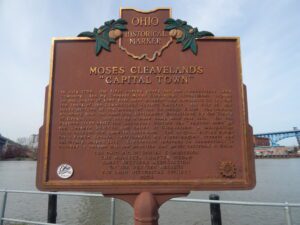
In July 1796, the first survey party for the Connecticut Land Company, led by General Moses Cleaveland (1754-1806), landed on the shore of Lake Erie near present-day Ashtabula to lay out the lands of the Connecticut Western Reserve. On July 22, the party arrived at the mouth of the Cuyahoga River, the western boundary line for American settlement established by the Treaty of Greenville, and set up a base camp near this site. On the eastern river bluff the surveyors platted the “capital town” of the Western Reserve and called it Cleaveland; a misspelling later changed the name to Cleveland. The original survey called for a Public Square, surrounded by right-angled streets and uniformly-shaped lots. Cleaveland returned to Connecticut in October to resume his law practice and never returned to Ohio.
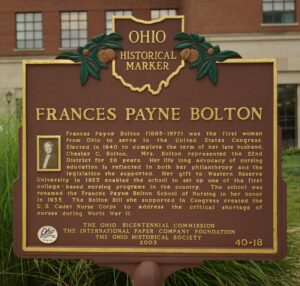
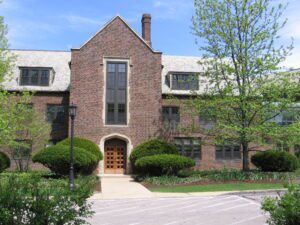
Frances Payne Bolton (1885-1977) was the first woman from Ohio to serve in the United States Congress. Elected in 1940 to complete the term of her late husband, Chester C. Bolton, Mrs. Bolton represented the 22nd District for 28 years. Her life long advocacy of nursing education is reflected in both her philanthropy and the legislation she supported. Her gift to Western Reserve University in 1923 enabled the school to set up one of the first college-based nursing programs in the country. The school was renamed the Frances Payne Bolton School of Nursing in her honor in 1935. The Bolton Bill she supported in Congress created the U.S. Cadet Nurse Corps to address the critical shortage of nurses during World War II.
Florence E. Allen (1884-1966) was nicknamed “first lady of the law” for her many firsts as a woman in the legal profession. After graduating from Western Reserve College for Women, she taught at Laurel School from 1906 to 1909. She then became a crusader for women’s rights, and in 1913 received a law degree from New York University. Allen was appointed as an assistant Cuyahoga County prosecutor in 1919, the first woman in the country to hold such a position. In 1920, she was elected to Cleveland’s Court of Common Pleas, advancing, in 1922, to the Ohio Supreme Court, where she served two terms. In 1934, President Franklin D. Roosevelt appointed Allen to the nation’s second highest tribunal, the United States Sixth Circuit Court of Appeals, where she became its first female member. In 1958, she was elevated to Chief Justice of that body and retired in 1965.
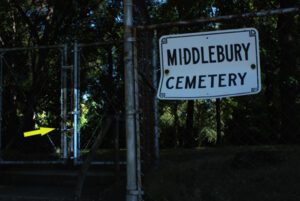
This burying ground was the first public cemetery located within Akron’s boundaries. It was also known as the “Old Cemetery” and the “Newton Street Cemetery.” Deacon Titus Chapman donated this land in 1808 as a burying ground, and he was probably the first person interred here when he died later that year. Early Akron settlers and their descendents, including veterans of the American Revolution, are buried here. Some of the gravestones were among the finest brought to the Western Reserve from Connecticut. The Middlebury Cemetery was used until 1853.
Poland Township Historical Society, 4515 Center Road
Lowellville
, OH
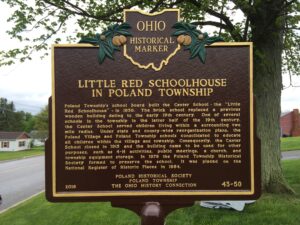
Poland Township’s school board built the Center School- the “Little Red Schoolhouse”- in 1858. The brick school replaced a previous wooden building dating to the early 19th century. One of several schools in the township in the latter half of the 19th century, the Center School served children living within a surrounding two mile radius. Under state and county-wide reorganization plans, the Poland Village and Poland Township schools consolidated to educate all children within the village and township. Consequently, the Center School closed in 1915 and the building came to be used for other purposes, such as 4-H activities, public meetings, a church, and township equipment storage. In 1979 the Poland Township Historical Society formed to preserve the school. It was placed on the National Register of Historic Places in 1984.
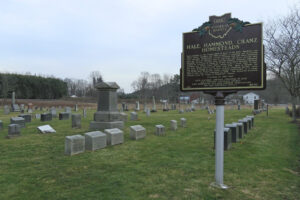
This cemetery is the resting place of many of the Hale, Hammond, and Cranz family members who were integral in founding and developing Bath Township. Connecticut natives Jonathan Hale and Jason Hammond were the first to purchase land in the area that would become Bath Township. In 1810, Jonathan Hale and his nephew, Theodore Hammond, arrived at Township 3, Range 12 of the Connecticut Western Reserve. Jonathan and Mercy Piper Hale’s family built a brick home in 1827. The Hale family lived in this home until 1956, when it became the Hale Farm & Village of the Western Reserve Historical Society. Jason and Rachel Hale Hammond’s family started construction on a frame home in 1818 that was completed in 1836. The Hammond property extended from the valley to Hammond’s Corners. (Continued on other side)
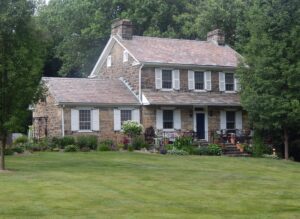
The Kyle-McCollum House, thought to be the oldest continuously inhabited residence still on its original site in Youngstown, was built by War of 1812 veteran Joshua Kyle (c. 1766-1842) and his wife Mary Stewart (c. 1774-1844). The Kyles moved from Westmoreland County, Pennsylvania, to the Mahoning Valley around 1800 and purchased about 1,300 acres of land on a hill above Mill Creek. Using stone quarried from the property, they built a house, completed in 1813. The Federal style of the house is typical of early 19th-century homes built in the Connecticut Western Reserve. The structure is two and a half stories with stone load-bearing walls that are two feet thick. Beside his farm, Kyle built a sawmill on Mill Creek near Slippery Rock, a site now under Lake Glacier. [Continued on other side]
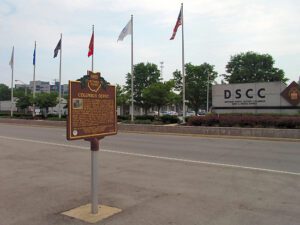
Since 1918, this installation, currently known as the Defense Supply Center, Columbus, has served the federal government as a procurement and distribution point for military supplies and equipment. Originally named the Columbus Quartermaster Reserve Depot, this location was chosen because of its immediate access to three railroad lines. Expansion of the center continued after World War I, and in the years immediately prior to World War II, the center’s mission changed to reconditioning war material for resale. During World War II, the center became the largest military supply installation in the world, employing more than 10,000 civilians and holding over 400 Axis prisoners of war in secured barracks. The installation continues to provide a variety of parts and supplies to all branches of the Armed Forces and other Federal agencies.