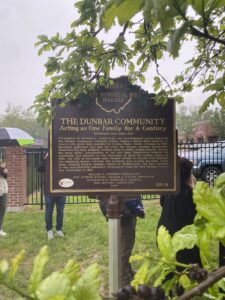
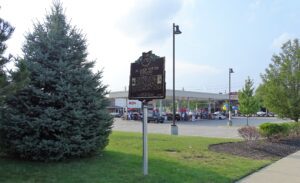
Dunbar, or Corsica Hollow, was an African American neighborhood on the western edge of Madisonville. Its streets and lots were laid out in 1886 after Mahlon and Anna Leonard subdivided their 10-acre tract near Duck Creek and sold lots to African Americans. Many early Dunbar residents were from the South; some born there prior to emancipation. Prominent early citizens included Harriet Deatherage, Elihu Parks, Gandison Embry, Thomas Duett, and James Murphy. Dunbar was home to the New Mission Missionary Baptist Church, founded in 1907. Originally meeting in a one-room building, the extant congregation relocated to Ravenna Street in 1963. By the late 1920s, Dunbar had about forty houses, a grocery run by Henry Lowman, and a hair salon run by Flora Hector. (Continued on other side)
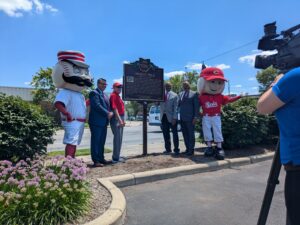
Crosley Field was the home of the Cincinnati Reds for almost 58 years. Opened in 1912 as Redland Field, the ballpark was renamed in 1934 when famed Cincinnati industrialist Powel Crosley Jr. purchased the team. Over its years of service, Crosley Field was home to Reds teams that won National League Championships in 1919, 1939, 1940, and 1961, and World Series titles in 1919 and 1940. The park also played host to the Major League Baseball All-Star Game in 1938 and 1953. Crosley Field famously held what was then acknowledged as the first night game under lights on May 24, 1935. Such visiting legends as “Shoeless” Joe Jackson, Babe Ruth, Joe DiMaggio, Willie Mays, and Jackie Robinson played at Crosley Field. (Continued on other side)
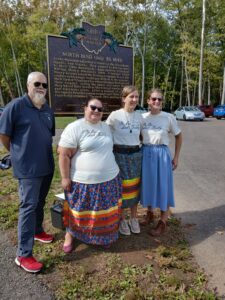
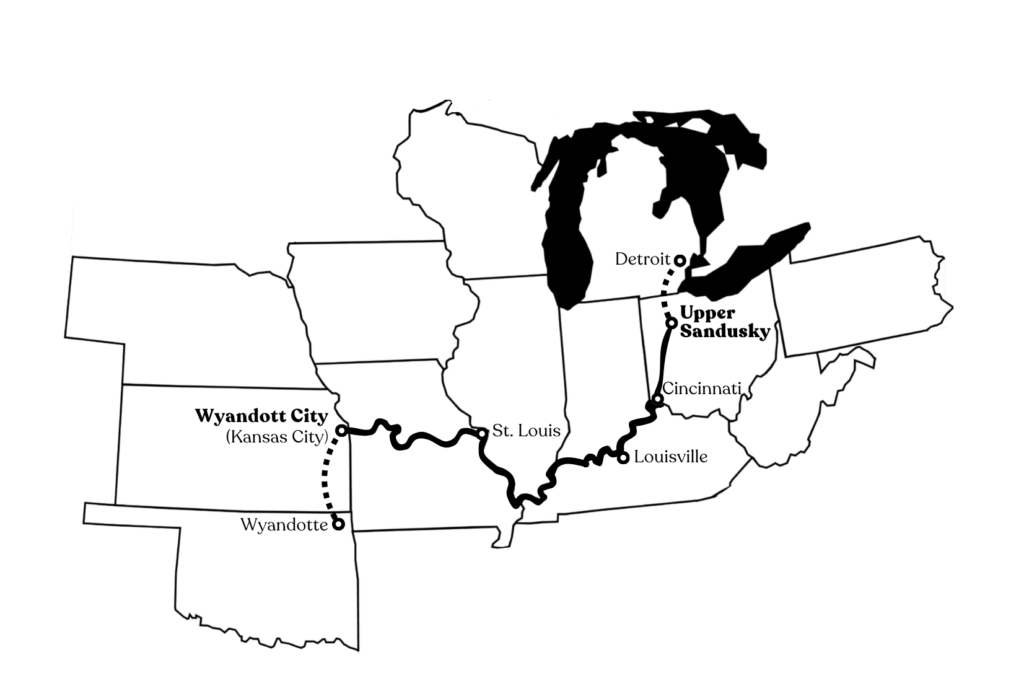
After decades of resistance and failed negotiations, the Wyandot were the last tribe removed from Ohio in 1843. Their removal route began on the Grand Reserve in Upper Sandusky and extended 150 miles to Cincinnati where nearly 700 Wyandots boarded steamboats bound for Kansas Territory. There, new settlers continued to place pressure on Wyandot lands. The Wyandotte Nation is now headquartered in Oklahoma.
Dr. Jared Potter Kirtland was a prominent nineteenth century professor, physician, naturalist and horticulturist. In 1837, Kirtland purchased land in Rockport Township that stretched from Madison Avenue to Lake Erie. Kirtland used that land as a natural laboratory and filled it with gardens, greenhouses and an arboretum where he developed fruit and grape varieties best suited for the region. His success with new varieties inspired area farmers to successfully concentrate on fruit and grape growing. In 1839, he built a home at Detroit and Bunts Roads and lived there unitl his death in 1877. (Continued on other side)
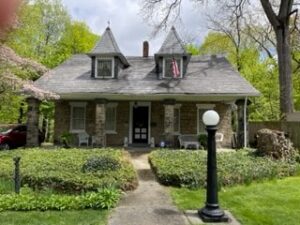
The Curtis-Preyer Stone House takes its name from two families associated with its early history. Richard and Clarissa Dille Curtis purchased 70 acres in the Connecticut Western Reserve from veteran Elias Lee in 1819. The Euclid Township “Turkey Knob” settlement soon thrived around Dugway Brook, springs sites, and an American Indian crossroads. The Curtis, Dille, Lee, and Stillman families, related by marriage, helped each other succeed by harnessing the creek to power their grist and saw mills and selling quarried stone and felled timber. Sometime between 1819 and 1835 Curtis built his stone house using the Berea sandstone quarried on site. The roof was created of ax-hewn “pegged” tree timbers, and the thick stone walls fashioned of uncoursed, chiseled stones. A central chimney fed seven fireplaces and a bake oven.
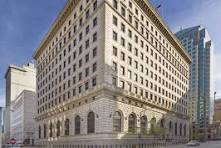
Cleveland was chosen as one of the country’s twelve Federal Reserve cities after a competitive selection process and opened its bank on November 16, 1914. The Federal Reserve Banks promote maximum employment and stable prices as part of the central banking system authorized by the 1913 Federal Reserve Act. Cleveland’s Bank serves the communities of the Fourth Federal Reserve District through supervision and regulation of financial institutions, analyzing and reporting on regional economic trends, and producing research on economic issues of importance to the nation and world. The first woman officer in any of the twelve banks was promoted to her role in 1956 by the Cleveland Fed. In 1982, the first woman in any of the nation’s Federal Reserve Banks served as the sixth President of the Federal Reserve Bank of Cleveland.