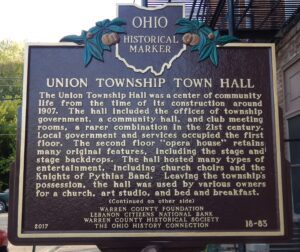
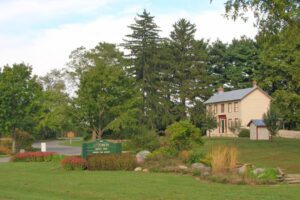
The Union Township Hall was a center of community life from the time of its construction around 1907. The hall included the offices of township government, a community hall, and club meeting rooms, a rarer combination in the 21st century. Local government and services occupied the first floor. The second floor “opera house” retains many original features, including the stage and stage backdrops. The hall hosted many types of entertainment, including church choirs and the Knights of Pythias Band. Leaving the township’s possession, the hall was used by various owners for a church, art studio, and bed and breakfast.(Continued on other side)
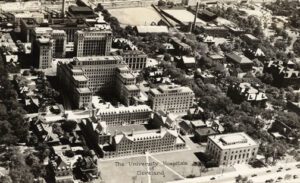
Named for the streetcar turnaround once located at Euclid Avenue and East 107th Street, University Circle is a 600-acre district that is home to many of Cleveland’s major cultural, educational, medical, and service institutions. The area was first settled in 1799 by tavernkeeper Nathaniel Doan and became known as Doan’s Corners. In 1882, Western Reserve College moved here from Hudson, followed in 1885 by the Case School of Applied Science from downtown Cleveland. These two colleges federated in 1967 to become Case Western Reserve University. (continued on other side)
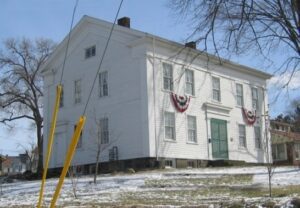
Built circa 1840 by Henry Barnhisel Jr. in the Greek Revival architectural style, the Barnhisel home is one of the oldest remaining structures in Girard. Henry and Eve Anna Barnhisel purchased the land where the house stands in 1813 when they acquired 318 acres in the Connecticut Western Reserve. The couple moved onto the land with their eleven children, and the family lived among a large group of Pennsylvania Germans who settled in Liberty Township. Their son, Henry Jr., took over the farm after his father’s death in 1824. In 1833 he married Susan Townsend. Henry contributed to his community by playing a key role in the building of both the Methodist Church and the first brick school in Girard and Liberty Township. He fathered five daughters, some of whom married into other leading families of the Mahoning Valley, including William Tod, son of the governor. Two granddaughters married into the Wicks and Stambaughs.
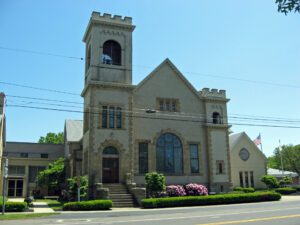
On this site, the Canfield Congregational Church, the first church in Canfield village, was built in 1822. The congregation was organized in 1804 by Joseph Badger and Thomas Robbins, both missionaries from the Connecticut Missionary Society. This was the fifth Congregational Church organized west of the Allegheny Mountains and the fourth organized on the Western Reserve. In 1853, there was a division in the church and a faction split off to form the Canfield Presbyterian Society. In 1837, an antislavery speech was given by Reverend Miller from the Poland Methodist Church. A rowdy group of outsiders protested his words and threw eggs onto the pulpit. They waited for him outside with tar and feathers, but the ladies of the church hastily escorted him out the back door to his horse and buggy, and he made a hasty and safe departure. The Bible with egg on it is displayed in the church.
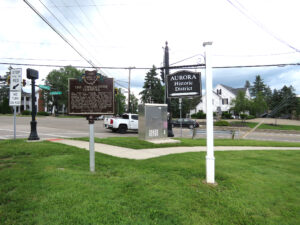
The Chillicothe Turnpike stimulated the growth of Aurora Center, Aurora’s first commercial area. Established in 1802 by Benjamin Tappan, the road also precipitated the development of Kirtland, Chester, Russell and Bainbridge, provided access to landlocked properties, and linked distant towns from Lake Erie to Ohio’s first capital in Chillicothe. In Aurora, the Chillicothe Turnpike turned southwest towards Hudson and continued southward over the boundary of the Western Reserve.
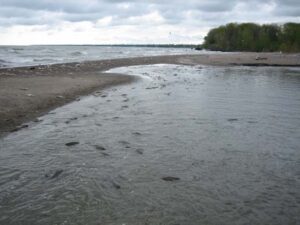
Old Woman Creek is one of the few naturally functioning estuary environments – places where chemically-distinct bodies of water meet and mix – left in the western basin of Lake Erie. This ecosystem features diverse habitats of marshlands, sand beaches, and upland forests, supporting plants and animals unique to natural coastal communities. Nearly 300 bird species (including bald eagles), 40 fish species, and hundreds of native plants have been recorded in this area. Old Woman Creek is Ohio’s only national estuarine sanctuary and became a state nature preserve in 1980.
This area of western Hancock County is a part of the Maumee River Watershed known as “Indian Green.” Wyandot Indians chose this area for hunting and ceremonial grounds along the Blanchard River in the 1700s because it was next to the river, yet high enough to avoid frequent flooding. One-half mile east of this location is a Liberty Township cemetery. It is located upon a sand ridge once used as a burial ground by Indians, hence the name “Indian Green.”
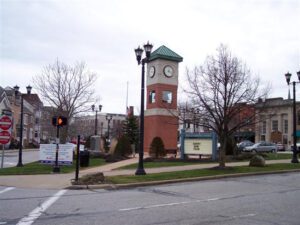
The Triangle, one of the most historic places in Berea, has been the center of the city’s civic life since the mid-19th century. Just beneath lie the solid layers of the famous Berea Sandstone that brought prosperity to Berea during its early years. Quarry owner and Berea Seminary founder John Baldwin obtained much of what is now Berea from Gideon Granger, Postmaster General under President Thomas Jefferson and original owner of Township 6, Range 14 (later Middleburg Township) of the Western Reserve. When the seminary trustees transferred the Triangle tract to the people of Berea in 1847, they designated it by deed as a public promenade. This farsighted stipulation preserved it from commercial development during the 20th century. (continued on other side)