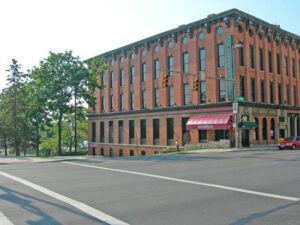
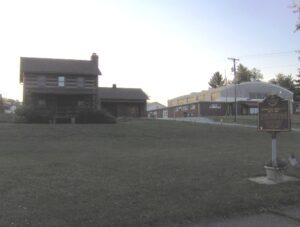
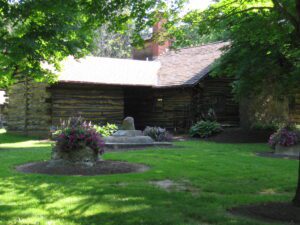
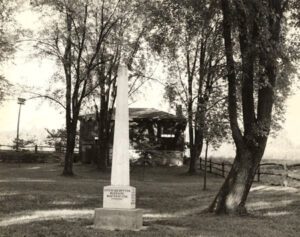
This pioneer village, which was united with its downriver rival, Vistula, to be incorporated as Toledo in 1837, was platted by Cincinnati businessmen in 1817. The “Panic” of 1819 caused the enterprise to default. The village was re-platted in 1832. A two-story log warehouse along Swan Creek was the first important structure. The village was named for Captain James Lawrence, War of 1812 naval hero.
Surgeon and songwriter Brewster Higley VI was born in Rutland in 1823, the grandson of Brewster Higley IV, a veteran of the American Revolution and founder of Rutland. Higley began studying medicine at age 18 and opened his first practice in Pomeroy, moving to Indiana and then to Kansas in 1871. The following year he penned the words to the famous Western song, “Home on the Range.” This perennial favorite became the state song of Kansas in 1947. Oh, give me a home where the buffalo roam, And the deer and the antelope play, Where seldom is heard a discouraging word, And the skies are not cloudy all day.
In recognition of its noteworthy representation of the history, culture, and architecture of the Western Reserve, Burton Village’s Historic District was placed on the National Register of Historic Places in 1974. The Historic District, an area of approximately 20 acres surrounding the Village Green and along streets at the north end of the Green, includes 15 buildings of historical significance built between 1815 and 1891. Preserved within the District are commercial and public buildings and private dwellings that reflect the cultural and architectural development of a village of the Western Reserve of Ohio during the 19th century. Buildings in the predominant architectural styles of the 19th century are all represented in the Historic District, including Western Reserve, Greek Revival, Second Empire, Italianate, and Queen Anne. [Continued on other side]
Following the American Revolution, the new Federal government, in need of operating funds, sold millions of acres of western lands to land companies. One such company, the Ohio Company of Associates, brought settlement to Marietta in 1788. Two years later, despite warnings of Native American hostility, an association of 36 Company members moved north from Marietta to settle “Big Bottom,” a large area of level land on the east side of the Muskingum River. The settlers were acquainted with Native American warfare, but even so, built an unprotected outpost. They did not complete the blockhouse, put pickets around it, or post a sentry. On January 2, 1791, a war party of 25 Delaware and Wyandot Indians from the north attacked the unsuspecting settlers, killing nine men, one woman, and two children. War raged throughout the Ohio Country until August 1794 when the tribes were defeated at the Battle of Fallen Timbers.
Soldier, engineer, and statesman, W.S. Rosecrans was born in Delaware County in 1819 and grew up in Homer. He graduated from West Point in 1842. During the Civil War, Rosecrans commanded the federal Army of the Cumberland. Popular with his troops, who called him “Old Rosy,” he was a cautious commander and, though victorious at, Corinth, Murfreesboro, and Chattanooga, he suffered major defeat at Chickamauga in 1863. A skilled engineer, Rosecrans developed coal properties in western (now West) Virginia before the war and helped design St. Joseph’s Cathedral in Columbus for his brother, Bishop Sylvester Rosecrans. Following the war he served as minister to Mexico and represented California in Congress from 1881 to 1885. He died in 1898 and is interred at Arlington National Cemetery.
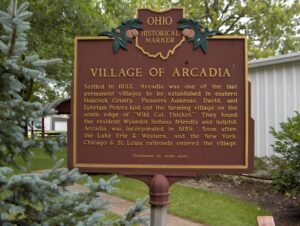
Settled in 1833, Arcadia was one of the last permanent villages to be established in eastern Hancock County. Pioneers Ambrose, David, and Ephriam Peters laid out the farming village on the south edge of “Wild Cat Thicket.” They found the resident Wyandot Indians friendly and helpful. Arcadia was incorporated in 1859. Soon after, the Lake Erie & Western, and the New York Chicago & St. Louis railroads entered the village. (Continued on other side)
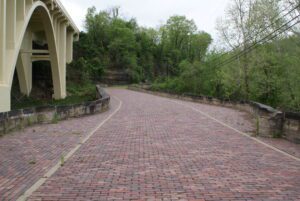
The first Blaine Hill Bridge was constructed in 1828 as part of the National Road, the nation’s first federally funded highway. This three-arch S-shaped structure, 345 feet in length, spans Wheeling Creek (a tributary of the Ohio River) and is the longest original “S” bridge in existence on the old National Road. At a gradient of approximately 6.3 percent from east to west, it significantly eased, for the first time, the arduous 500-foot western climb out of the valley. Crumbling and in poor condition, it was saved from demolition in 1999 and in 2001 was designated Ohio’s official Bicentennial Bridge. Now tucked between the 1933 U.S. 40 viaduct and Interstate 70, it illustrates the earliest of Ohio’s three eras in national highway transportation.
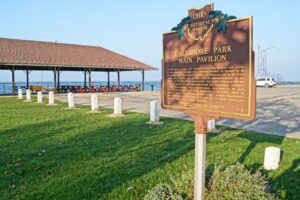
At 440 feet in length, the Lakeshore Park Main Pavilion, now known as the Ashtabula Township Park Lakefront Pavilion, is thought to be the longest and oldest lakefront pavilion in continuous use on the Great Lakes. Built in 1919, the pavilion, with its bandstand/gazebo in the middle, is of steel frame construction, and stood unchanged for the most part except for the swept wing design roof replacement. Extensive Civilian Conservation Corps improvements were made in the park near the pavilion during the Great Depression of the 1930s. Since its founding, people from all over northeast Ohio, western Pennsylvania, and northern West Virginia have chosen this site for family outings and company, union, and political gatherings.