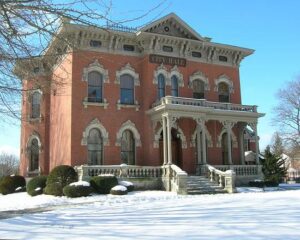
This ornate Victorian/Italianate house was constructed in 1871 as the home of Henry Bishop Perkins, Sr., a civic, business, and political leader of the Western Reserve. During the 19th and early 20th century political figures such as U.S. Grant, James A. Garfield, Rutherford B. Hayes, Benjamin Harrison and William McKinley were visitors to this house.
The Silver Creek Cheese Factory was located in the heart of the tri-county area known during the 19th century as “Cheesedome”. This part of the Western Reserve was best known for the cheese it shipped internationally. The factory contributed to the Aurora processing network, which by 1904 was shipping 4,000,000 pounds of cheese per year. The factory was destroyed by a flood in 1913 as were many other industries which flourished in the Chagrin Valley.
Born at Wallingford, Connecticut. Served during the Revolutionary War. Proprietor, Agent, and Surveyor of the Connecticut Land Company. Appointed Judge of Trumbull County by Territorial Governor Arthur St. Clair, 1800. State Senator, Trumbull County, 1815-1816. Poland Justice of the Peace, twenty years. Moderator of St. James Episcopal Church, Boardman, 1809. First Worshipful Master of Erie Lodge No. 47, Warren, 1803, oldest lodge in the Connecticut Western Reserve and one of six lodges to form the Grand Lodge of Free and Accepted Masons of Ohio, 1809.
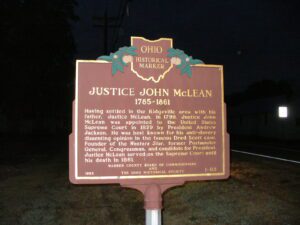
Having settled in the Ridgeville area with his father, Justice McLean, in 1799, Justice John McLean was appointed to the United States Supreme Court in 1829 by President Andrew Jackson. He was best known for his anti-slavery dissenting opinion in the famous Dred Scott case. Founder of the Western Star, former Postmaster General, Congressman, and candidate for President, Justice McLean served on the Supreme Court until his death in 1861.
A group of Freemasons, inspired by the concepts of a new country, of Freedom with Responsibility, Brotherly Love, and Truth, formed Harmony Lodge near this site in 1809, the first Masonic lodge in western Ohio. Meetings were held in the log court house, located on Lot 174, East Court Street, and also in Dayton and Springfield.
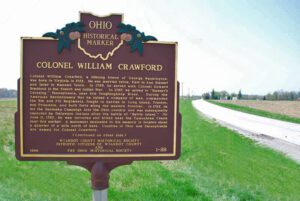
Colonel William Crawford, a lifelong friend of George Washington, was born in Virginia in 1722. He was married twice, first to Ann Stewart and later to Hannah Vance. In 1755, he served with Colonel Edward Braddock in the French and Indian war. In 1767, he moved to “Stewart’s Crossing,” Pennsylvania, near the Youghiogheny River. During the Revolutionary War he raised a company of men, commanded the 5th and 7th Regiments, fought in battles in Long Island, Trenton, and Princeton, and built forts along the western frontier. In 1782, he led the Sandusky Campaign into the Ohio country and was subsequently captured by Delaware Indians after the battle of “Battle Island.” On June 11, 1782, he was tortured and killed near the Tymochtee Creek near this marker. A monument dedicated to his memory is located about a quarter mile north of here. Counties in Ohio and Pennsylvania are named for Colonel Crawford.
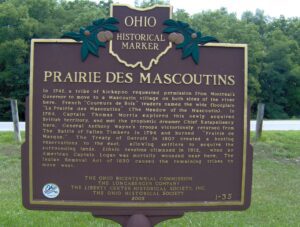
In 1742, a tribe of Kickapoo requested permission from Montreal’s Governor to move to a Mascoutin village on both sides of the river here. French “Coureurs de Bois” traders named the wide floodplain “La Prairie des Mascoutins” (The Meadow of the Mascoutin). In 1764, Captain Thomas Morris explored this newly acquired British territory, and met the prophetic dreamer Chief Katapelleecy here. General Anthony Wayne’s troops victoriously returned from The Battle of Fallen Timbers in 1794 and burned “Prairie de Masque.” The Treaty of Detroit in 1807 created a hunting reservation to the east, allowing settlers to acquire the surrounding lands. Ethnic tensions climaxed in 1812, when an American Captain Logan was mortally wounded near here. The Indian Removal Act of 1830 caused the remaining tribes to move west.
As a member of the Connecticut Land Company, Judge Samuel Hinckley of North Hampton, Massachusetts purchased township 4N Range 13W of the Western Reserve in 1795 for a sum equivalent to 23 cents an acre. The township remained unsettled until Abraham Freeze was commissioned by Judge Hinckley in 1819 to survey the township into 100 plots of 160 acres each. In return for having the township, founded in 1825, named “Hinckley,” the judge gave land for two burying grounds and one-half acre for a public square. In 1919, upon the 101st anniversary of the “Great Hinckley Hunt,” where men from surrounding counties gathered on Christmas Eve to rid the township of wild animals, Judge Amos Webber spoke for the deceased Judge Hinckley: “When I last saw this country, it was a howling wilderness – by industry and frugality you and your ancestors have made these ever lasting hills and pleasant valleys blossom as the rose.”