Major General William Sooy Smith was born in Tarlton on July 22, 1830. He attended Ohio University and supported himself throughout his college undergraduate career, graduating in 1849. He then entered the United States Military Academy at West Point to pursue engineering and graduated 6th in the class of 1853. In 1857, Smith established the private engineering firm Parkinson & Smith and made the first surveys for the international bridge across the Niagara River near Niagara Falls. At the outbreak of the Civil War, Smith joined the 13th Ohio Infantry, winning the commission of colonel in June 1861. After early victories in western Virginia, he was promoted to brigadier general in April 1862 for his gallant and meritorious service at the Battle of Shilo. (continued on other side)
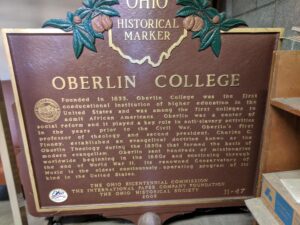
Founded in 1833, Oberlin College was the first coeducational institution of higher education in the United States and was among the first colleges to admit African Americans. Oberlin was a center of social reform and it played a key role in anti-slavery activities in the years prior to the Civil War. Oberlin’s first professor of theology and second president, Charles G. Finney, established an evangelical doctrine known as the Oberlin Theology during the 1850s that formed the basis of modern evangelism. Oberlin sent hundreds of missionaries worldwide beginning in the 1880s and continuing through the end of World War II. Its renowned Conservatory of Music is the oldest continuously operating program of its kind in the United States.
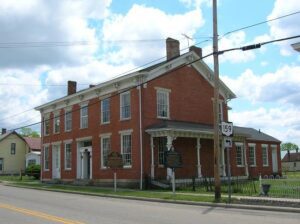
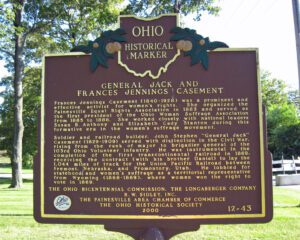
Western Reserve agriculturalist Charles Clement Jennings built the Casement House, also known as the “Jennings Place,” for his daughter Frances Jennings Casement in 1870. Designed by Charles W. Heard, son-in-law and student of Western Reserve master builder Jonathan Goldsmith, it is an excellent example of the Italianate style, featuring ornate black walnut woodwork, elaborate ceiling frescoes, and an innovative ventilation system. It remained in the Casement family until 1953. It was added to the National Register of Historic Places in 1979.
Butternut Ridge Road in front of the North Olmsted Library
North Olmsted
, OH
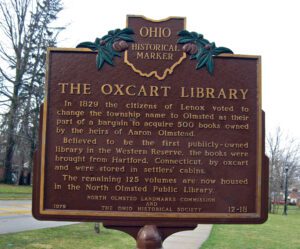
In 1829 the citizens of Lenox voted to change the township name to Olmsted as their part of a bargain to acquire 500 books owned by the heirs of Aaron Olmsted. Believed to be the first public library in the Western Reserve, the books were brought from Hartford, Connecticut, by oxcart and were stored in settlers’ cabins. The remaining 125 volumes are now housed in the North Olmsted Public Library.
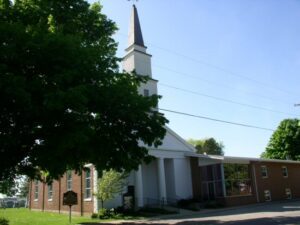
The founders of what would become the Kings Creek Baptist Church first met on June 29, 1805 in the log home of local residents James and Ann Turner. The Baptist congregation continued to meet in people’s homes until 1816 when Taylortown founder John Taylor donated an acre of land to establish a burying site and a meetinghouse. Constructed of logs, this meetinghouse is considered to be the third Baptist church built in Ohio and the Northwest Territory. The original structure was replaced by a more substantial brick building in 1832, and the present Kings Creek Baptist Church was built on the original foundation in 1849. The church features classic Greek design and a grand steeple inspired by the work of the English architect Sir Christopher Wren. An educational wing was added in 1969. (continued on other side)
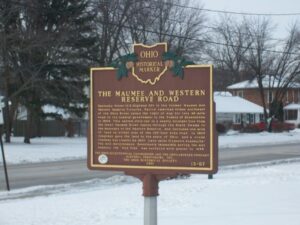
Sandusky Street (U.S. Highway 20) is the former Maumee and Western Reserve Turnpike. Native American tribes northwest of the Ohio River ceded the right of way for this 46-mile road to the federal government in the Treaty of Brownstown in 1808. This narrow strip ran in a nearly straight line from the lower Maumee River rapids through the Black Swamp to the boundary of the Western Reserve, and included one mile of land on either side of the 120-foot wide road. In 1823 Congress gave the land to the state of Ohio, and a crude roadway was cleared by 1827. Land sales financed roadbuilding and maintenance. Notoriously impassible during the wet seasons, the “Mud Pike” was surfaced with gravel in 1838.
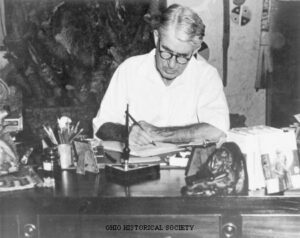
Born Pearl Zane Grey in 1872 at this site and raised in Zanesville, author Zane Grey established the western novel as a twentieth century American literary genre. Trained as a dentist and practicing in New York City, Grey began writing full time following his marriage in 1905 to Lina Elise “Dolly” Roth, who served as his editor and agent. Grey’s novels featured rich western imagery and highly romanticized plots with often pointed moral overtones, inspiring scores of imitators. Of his more than 60 books, Riders of the Purple Sage (1912) is his best know work. Many of Grey’s novels were made into movies in 1920s and ’30s. In addition, Grey was the holder of ten world records for large game fishing, an avocation he pursued when not writing. He died in 1939 at his home in Altadena, California.
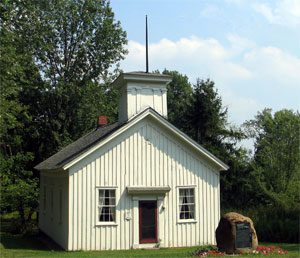
Called the “Cradle of Equal Suffrage” and “Free Speech Chapel,” Union Chapel was to be “…open and free for all denominations, but to be monopolized by no one or to the exclusion of anyone.” Built in 1858 or 1859 on land donated by Anson Matthews, the chapel reputedly exists in response to incident triggered by James A. Garfield, then principal of the Western Reserve Eclectic Institute (now Hiram College) and later president of the United States. He was scheduled to speak at the Congregationists’ “Brick Church” in December 1857. Because of the supposed controversial nature of Garfield’s speech, however, the invitation was withdrawn. (Continued on other side)