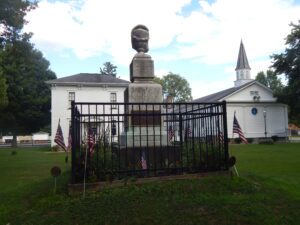
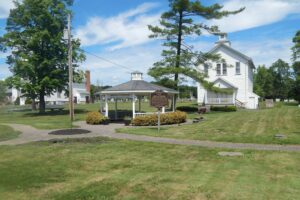
With the outbreak of the Civil War in 1861, many young men of Bristol Township enlisted in the army when President Abraham Lincoln issued his call to defend the Union cause. The death toll of some of these men at the Battle of Shiloh in Tennessee in April 1862 touched the local community as did the loss of Bristol Township lives at the Battle of Perryville in Kentucky, the Battle of Cedar Mountain in Virginia, and other theaters of war later in the year. The local citizenry responded to a plan for a lasting public memorial at the Town Park through a fund raising campaign. In 1863 the town square was transformed with a marble monument placed on an elevated mound at its center. The monument was designed by local artist Frank J. Hammond and manufactured by Myers, Uhl & Company of Cleveland at a cost of $500. [continued on other side]
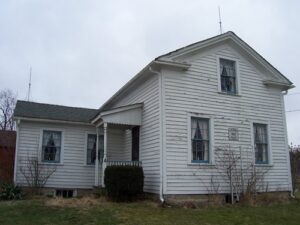
This 48-acre farm is the last remnant of an agricultural way of life that characterized Parma Township well into the 20th century. The farmhouse, built circa 1855 by Western Reserve settler Lyman Stearns, is representative of the Greek Revival style of architecture popular in this region prior to the Civil War. The “Yankee” style barn predates the house. Suburban development following World War II engulfed virtually all of this area by the 1950s. The Stearns Homestead was added to the National Register of Historic Places in 1981. (continued on other side)
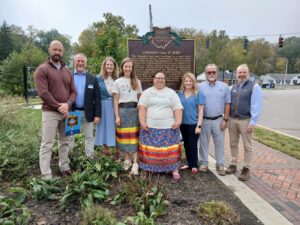
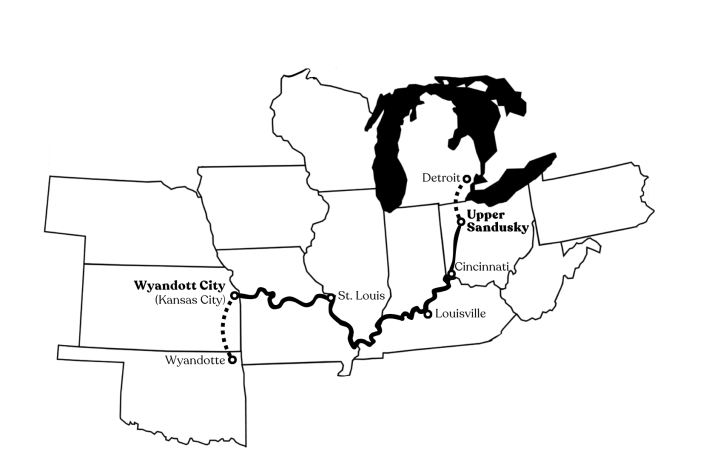
After decades of resistance and failed negotiations, the Wyandot were the last tribe removed from Ohio in 1843. Their removal route began on the Grand Reserve in Upper Sandusky and extended 150 miles to Cincinnati where nearly 700 Wyandots boarded steamboats bound for Kansas Territory. There, new settlers continued to place pressure on Wyandot lands. The Wyandotte Nation is now headquartered in Oklahoma.
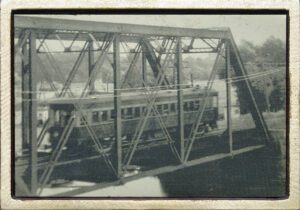
At this site the Lake Shore Electric Railway crossed a bridge that spanned the Vermilion River. The western abutment of the former bridge is plainly visible just below along the river bank. Widely known as the “Greatest Electric Railway in the United States,” the flaming orange trolley cars of the Lake Shore Electric Railway transported people and freight for thirty-seven years (1901-1938) along the southern Lake Erie shores from Cleveland to Toledo often reaching speeds of sixty miles per hour. The interurban line played a primary role in the development of the western Cleveland suburbs and also carried throngs of summer visitors to Lake Erie recreation facilities at Avon Beach Park, Linwood Park, Crystal Beach, Mitiwanga, Ruggles Grove, Rye Beach, and Cedar Point. The power lines still standing along the system’s right-of-way attest to the fact that it also assisted in bringing electric power to the entire region.
Cincinnati Museum Center at Union Terminal, 1301 Western Avenue
Cincinnati
, OH
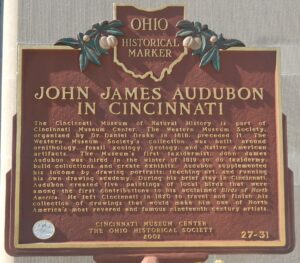
The Cincinnati Museum of Natural History is part of Cincinnati Museum Center. The Western Museum Society, organized by Dr. Daniel Drake in 1818, preceded it. The Western Museum Society’s collection was built around ornithology, fossil zoology, geology, and Native American artifacts. The Museum’s first taxidermist, John James Audubon was hired in the winter of 1819 to do taxidermy, build collections, and create exhibits. Audubon supplemented his income by drawing portraits, teaching art, and running his own drawing academy. During his brief stay in Cincinnati, Audubon created five paintings of local birds that were among the first contributions to his acclaimed Birds of North America. He left Cincinnati in 1820 to travel and finish his collection of drawings that would make him one of North America’s most revered and famous nineteenth century artists.
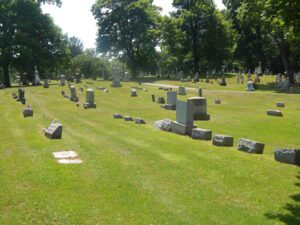
For more than two centuries, this burial ground has been a final resting place for those individuals whose lives represented the community history of Canfield. The earliest existing tombstone marks the death of Huldah Tanner in 1803. Seven earlier deaths in Canfield Township are recorded from 1798 to 1803, but the gravesites are unknown. Elijah and Rhoda Hopkins Wadsworth formally deeded the cemetery to the citizens of Canfield in 1810 with a first edition of land donated by Matthew B. Whittlesey in 1811. In 1862-1863, the graveyard was again enlarged. For seventy years the cemetery and fencing were maintained on a volunteer basis. When the Village of Canfield was incorporated in 1869, the care and management was vested in a board of trustees. (continued on other side)
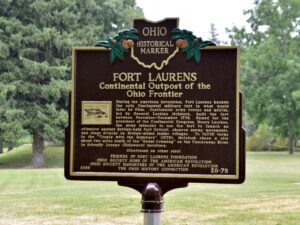
During the American Revolution, Fort Laurens became the only Continental military fort in what would later be Ohio. Continental army troops and militia, led by General Lachlan McIntosh, built the fort between November-December 1778. Named for the president of the Continental Congress, Henry Laurens, the army intended to use the fort to launch an offensive against British-held Fort Detroit, observe enemy movements, and stage attacks on British-allied Indian villages. To fulfill terms in the “Treaty with the Delaware” (1778), McIntosh chose a site about two miles south of the “Great Crossing” on the Tuscarawas River in friendly Lenape (Delaware) territory. (Continued on other side)
The Connecticut Land Company surveyed Vienna Township as Township 4, Range 2, in 1798. The Township’s proprietors were Ephraim Root, Uriel Holmes, Jr., and Timothy Burr. Survey members Dennis Clark Palmer, Isaac Flower, and Samuel Hutchins and their families were the first to settle here in 1799. Between 1810 and 1840, Vienna was a center for the wooden works clock industry in Trumbull County and the Connecticut Western Reserve, with six factories located amid farms, sawmills, and quarries. After coal was discovered in 1866, over twenty mines were opened, bringing boom times for two decades. Vienna’s miners helped to bring about Ohio’s first mining safety law in 1874. Vienna was the birthplace of abolitionist and attorney John Hutchins (1812-1891), who represented Trumbull and Ashtabula counties in the United States Congress (1859-1863) and raised troops during the Civil War.