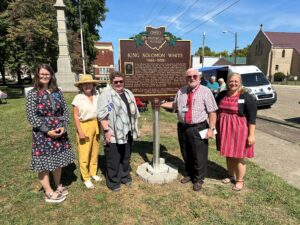
King Solomon “Sol” White was born in Bellaire on June 12, 1868. A Baseball legend, he was an all-around player, manager, and organizer in the Pre-Negro Leagues (1887-1912) and the Negro Leagues (1920-1926). White first played with integrated baseball clubs the Bellaire Globes (1884-1886) and Wheeling Green Stockings (1887). After 1887-1888 color barriers were imposed on baseball, White played on segregated minor league teams. They included: the Pittsburgh Keystones, Cuban Giants, York Colored Monarchs, Cuban X-Giants, Page Fence Giants, and Chicago Columbia Giants. As a coach, he helped organize and lead the powerhouse Philadelphia Giants to their 1904-1907 championships. White died on August 26, 1955, and was buried in an unmarked grave in Staten Island’s Frederick Douglas Memorial Cemetery. In 2006, “Sol” White was posthumously inducted into the Baseball Hall of Fame.
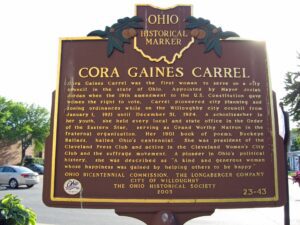
Cora Gaines Carrel was the first woman to serve on a city council in the state of Ohio. Appointed by Mayor Josiah Jordan when the 19th amendment to the U.S. Constitution gave women the right to vote, Carrel pioneered city planning and zoning ordinances while on the Willoughby city council from January 1, 1921 until December 31, 1924. A schoolteacher in her youth, she held every local and state office in the Order of the Eastern Star, serving as Grand Worthy Matron in the fraternal organization. Her 1901 book of poems, Buckeye Ballads, hailed Ohio’s centennial. She was president of the Cleveland Press Club and active in the Cleveland Women’s City Club and the suffrage movement. A pioneer in Ohio’s political history, she was described as “A kind and generous woman whose happiness was gained by helping others to be happy.”
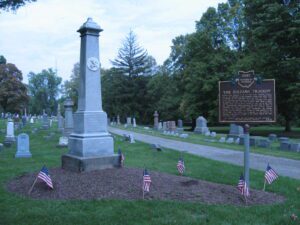
Soldiers from Company F of the 115th Ohio Volunteer Infantry died in the explosion of the steamboat Sultana seven miles north of Memphis on the Mississippi River on April 27, 1865. The Sultana reportedly carried more than 2,400 passengers–six times its capacity of 376. The vast majority were Union soldiers recently freed from Southern prisons at the end of the Civil War. Approximately 1,800 passengers and crew died in what is considered the worst maritime disaster in American history. Company F was organized in Stark, Columbiana, and Portage Counties and was mustered into service at Camp Massillon in the fall of 1862. This marker is a memorial to the soldiers of Company F who died as a result of the Sultana tragedy and other war-related causes.
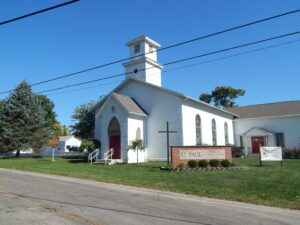
On July 30, 1816, the year before the establishment of Butler Township, a group of farmers of German background founded the Stillwater Church. The log structure with adjoining cemetery was located on three acres between Dog Leg Road and Frederick Pike. In 1842, the congregation replaced the log building with a brick one. In 1873, they moved the building to the northeast corner of Dog Leg and Little York Roads and renamed it St. Paul Lutheran Church. With a fruitful history of sharing God’s love, St. Paul celebrated it’s 200th anniversary on Sunday, July 31, 2016.
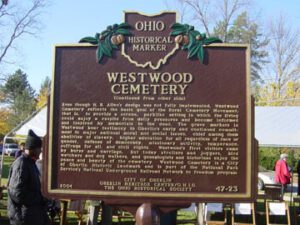
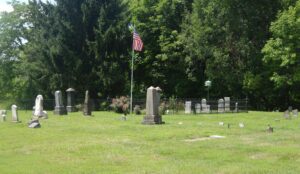
Shortly after Oberlin Colony was established in 1833, a two-acre burying ground was set aside south of Plum Creek in the area bounded by Main, Morgan, and Professor streets. By 1861, however, with the town and Oberlin College growing and the Civil War escalating, the need for a larger cemetery became clear. After an extensive search, 27.5 acres of land belonging to Henry Safford were acquired one mile west of the center of Oberlin. H.B. Allen was hired to create a design in the style of the Rural Cemetery Movement, and in July 1864 Westwood Cemetery was formally dedicated. Burials in Westwood had actually begun in August 1863, and over the next few years hundreds of remains were reinterred from Oberlin’s “Old Cemetery” and from burying grounds in surrounding communities. In the mid-1860s the cemetery was enlarged to its present 47 acres, and in 2004 burials and memorials were estimated to number almost ten thousand. (Continued on other side)
Originally part of the Casterline farm, this cemetery was once the site of the 1824 Bazetta Presbyterian Church, the first church in Bazetta Township. Ziba Casterline deeded .75 acres for the cemetery to the church in 1829 for five dollars. When the small log structured church was relocated to Lot 55 in the township, the cemetery remained. Buried in the cemetery are several early settlers, including Moses Hampton, Joseph Headley, Joseph Pruden, and John Hulse, the first white child born in the township. [continued on other side]
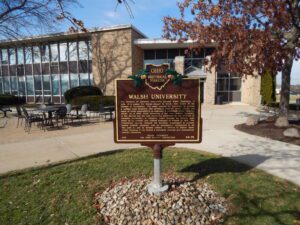
The Brothers of Christian Instruction founded Walsh University in 1958. It is named for Bishop Emmett M. Walsh, then leader of the Diocese of Youngstown. The order created the institution to provide a college-level education that developed students’ moral virtues and sense of social responsibility as embodied in traditional Judeo-Christian values. As of 2015, Walsh University is the only Catholic university in the diocese and the only university sponsored by the Brothers of Christian Instruction, a religious order founded by the Fathers Jean Marie de la Mennais and Gabriel Deshayes in France in 1819. The University’s mission reflects the Brothers’ commitment to provide quality Catholic education with an international perspective to all who seek it, and to develop leaders in service to others. Since Walsh’s founding, it has become a successful regional and international Catholic university.
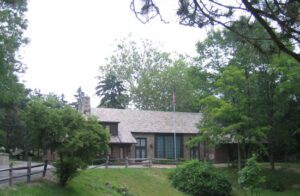
Envisioned by Fairview Village Mayor, David R. Bain, this community center was originally completed in 1937 as a project of the Works Progress Administration (WPA), a Depression-era work relief program initiated by the Federal Government in 1935. A fire destroyed the original log cabin on December 14, 1937, just four days before the planned dedication. With the support of the community, Mayor Bain turned again to the WPA for funding and labor to rebuild the structure. This cabin, constructed of bricks on the original foundation, features an 8’x12′ mural painted by artists of the WPA’s Federal Art Project and which depicts Fairview’s history through the 1930s. The new cabin was dedicated on January 15, 1940, and was named in honor of Mayor Bain in 1957, four years after his death.