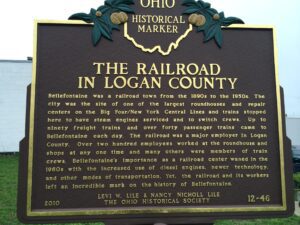
Bellefontaine was a railroad town from the 1890s to the 1950s. The city was the site of one of the largest roundhouses and repair centers on the Big Four/New York Central Lines and trains stopped here to have steam engines serviced and to switch crews. Up to ninety freight trains and over forty passenger trains came to Bellefontaine each day. The railroad was a major employer in Logan County. Over two hundred employees worked at the roundhouse and shops at any one time and many others were members of train crews. Bellefontaine’s importance as a railroad center waned in the 1960s with the increased use of diesel engines, newer technology, and other modes of transportation. Yet, the railroad and its workers left an indelible mark on the history of Bellefontaine.
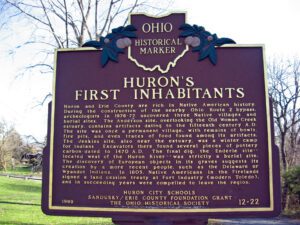
Huron and Erie County are rich in Native American history. During the construction of the nearby Ohio Route 2 bypass, archeologists in 1976-77 uncovered three Native villages and burial sites. The Anderson site, overlooking the Old Woman Creek estuary, contains artifacts dating to the fifteenth century A.D. The site was once a permanent village, with remains of bowls, fire pits, and even traces of food found among its artifacts. The Jenkins site, also near the estuary, was a winter camp for Indians. Excavators there found several pieces of pottery carbon-dated to 1470 A.D. The final dig, the Enderle site — located west of the Huron River — was strictly a burial site. The discovery of European objects in its graves suggests its creation by a more recent people, such as the Delaware or Wyandot Indians. In 1805, Native Americans in the Firelands signed a land cession treaty at Fort Industry (modern Toledo), and in succeeding years were compelled to leave the region.
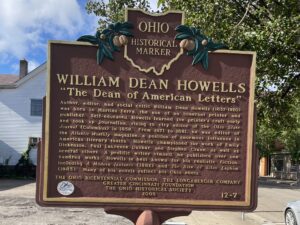
Author, editor, and social critic William Dean Howells (1837-1920) was born in Martins Ferry, the son of an itinerant printer and publisher. Self-educated, Howells learned the printer’s craft early and took up journalism, rising to city editor of the Ohio State Journal (Columbus) in 1858. From 1871 to 1881, he was editor of the Atlantic Monthly magazine, a position of enormous influence in American literary tastes. Howells championed the work of Emily Dickenson, Paul Laurence Dunbar, and Stephen Crane, as well as several others. A prolific writer himself, he published over one hundred works. Howells is best known for his realistic fiction, including A Modern Instance (1882) and The Rise of Silas Lapham (1885). Many of his novels reflect his Ohio roots.
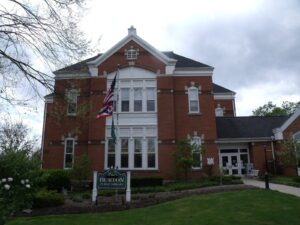
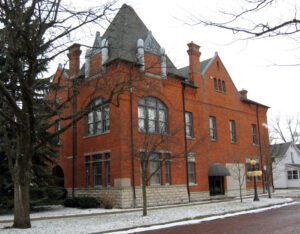
This Queen Anne style building with segmental-arched windows and steep hipped roof was Burton’s second high school. Completed in 1885 at a cost of $12,500, it is wood framed with a brick and stone exterior, modeled after an academy in River Falls, Wisconsin. Its basement and two upper floors contained 12,720 square feet of space, enough for all twelve grades. There were two separate entrances; girls entered on the left and boys on the right. Electricity was installed in 1921 by the superintendent and students. Classes met here until 1936. During its history, the building housed various organizations, including the Red Cross, Opportunity School of Geauga County (later Metzenbaum), Geauga County Historical Society, American Legion, and County Extension Office. In 1937, it became the home of the Burton Public Library and in 1983 was expanded with a north wing designed to be architecturally consistent with the original 1885 structure.
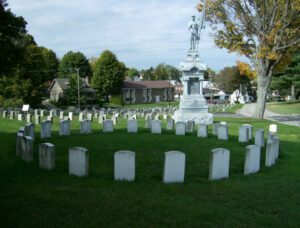
Envisioned as a rural cemetery with careful attention to landscaping design and symmetrical lots, the Riverview Cemetery was established in 1883 on forty acres of land. The chapel was a gift to Riverview from the Grand Army of the Republic, mostly Civil War veterans, and was dedicated on Memorial Day 1899. Plaques inside the chapel list 702 men from Ohio, Pennsylvania, and West Virginia who served in the Civil War, including 311 who are memorialized or buried at Riverview. There are also plaques listing soldiers killed in World Wars I and II, Korea, and Vietnam. The rich history of East Liverpool and Columbiana County is documented in the burials at Riverview Cemetery.
Completed in 1892 at the height of the region’s oil boom, the Pemberville Town Hall followed a late-1800s municipal trend to house many civic functions under one roof. The fire station, jail, and council chambers occupied the ground level, while the entire second floor hosted a public auditorium, or “opera house,” that seated 250. The 1897 debut of The Mikado featured new electric lighting. The ornate Opera House was the center of Pemberville’s social activities for decades, hosting dances, plays, socials, graduation ceremonies, political meetings, lectures, and husking bees. Traveling companies performed concerts, vaudeville, minstrel, and medicine shows. Following World War II the Opera House fell into disuse. It was restored in 1999 to both its former grandeur and its place in Pemberville’s cultural life.
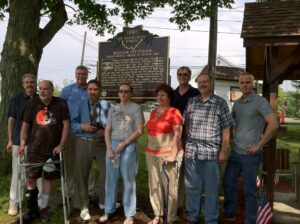
The General at Union Station in Chattanooga, Tennessee (circa 1907). Born in Knoxville in 1840 and reared at a farm in New Somerset, William Pittenger mustered into the 2nd Ohio Volunteer Infantry, under a 90-day enlistment, in 1861. He fought at the First Battle of Bull Run and was the war correspondent for the Steubenville Herald. After reenlisting, he participated in the ill-fated Andrews Raid of 1862. While attempting to disrupt enemy supply lines, the raiders stole the Confederate locomotive “The General.” After being chased north, they were captured. (Continued on other side)
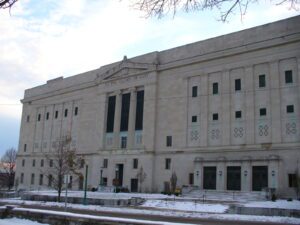
The first Masonic Lodge in Dayton was founded in 1808, located in the first Montgomery County Courthouse. Various other locations were home to Masons in Dayton, but by World War I, rapid growth of the Masonic community called for the creation of a new Lodge building. Masons of the time, including civic and business leaders of Dayton, conceived the idea of a new Masonic Center located on the hill at Belmonte Park North and Riverview Avenue. Ground was broken and construction of the $2.5 million Masonic Temple began on July 20, 1925. Through contributions from the Masonic community, the tremendous task of raising a majority of the building cost, $1.5 million, was accomplished in merely ten days in 1924. It is doubtful that the Temple could be duplicated given the fact that the large quantities of marble and mahogany and cherry woods used in construction would be difficult to procure today.