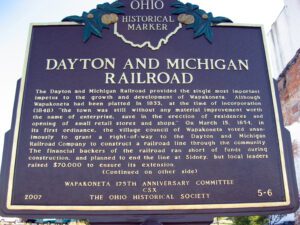
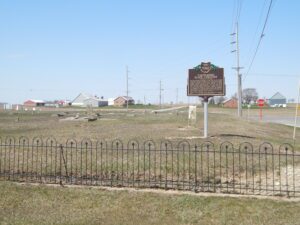
The Dayton and Michigan Railroad provided the single most important impetus to the growth and development of Wapakoneta. Although Wapakoneta had been platted in 1833, at the time of incorporation (1848), “the town was still without any material improvement worth the name of enterprise, save in the erection of residences and opening of small retail stores and shops.” On March 15, 1854, in its first ordinance, the village council of Wapakoneta voted unanimously to grant a right-of-way to the Dayton and Michigan Railroad Company to construct a railroad line through the community. The financial backers of the railroad ran short of funds during construction, and planned to end the line at Sidney, but local leaders raised $70,000 to ensure its extension. (Continued on other side)
The Carthagena Black Cemetery (Union Cemetery) is a remnant of approximately 70 documented rural black and mulatto settlements established in Ohio before the Civil War. In the charged atmosphere following race riots in Cincinnati in 1829, Quaker abolitionist Augustus Wattles led 15 black families north in 1835. In 1837 Wattles purchased 189 acres where the cemetery is located. Headstones date from 1840, the year mulatto Charles Moore, platted the Village of Carthagena. Wattles and mulatto clergymen Sam Jones and Harrison Lee were Underground Railroad conductors. Wattles moved to Kansas in 1855. By 1860, more than 100 black and mulatto families, totaling 600 people, owned over 10,000 acres. (Continued on other side)
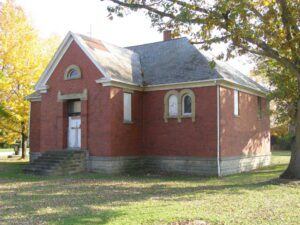
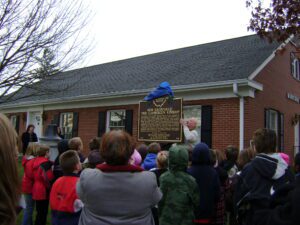
This Little Red Schoolhouse served children from Berea, Brookpark, and Middleburg township. The first mayor and council of Middleburgh Heights were elected here. During its colorful history, the schoolhouse has been a City Hall where town meetings were held, a speak-easy, a railroad way station, and a private residence.
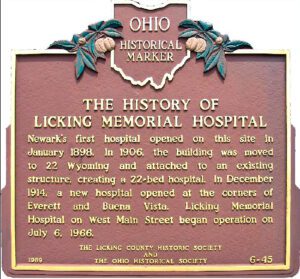
Newark’s first hospital opened on this site in January 1898. In 1906, the building was moved to 22 Wyoming and attached to an existing structure, creating a 22-bed hospital. In December 1914, a new hospital opened at the corners of Everett and Buena Vista. Licking Memorial Hospital on West Main Street began operation on July 6, 1966.
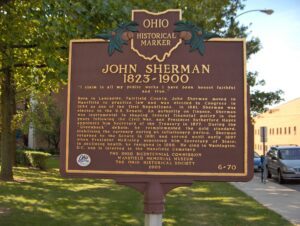
Born in Lancaster, Fairfield County, John Sherman moved to Mansfield to practice law and was elected to Congress in 1854 as one of the first Republicans. In 1861, Sherman was elected to the U.S. Senate. An authority on finance, Sherman was instrumental in shaping federal financial policy in the years following the Civil War, and President Rutherford Hayes appointed him Secretary of the Treasury in 1877. During the “Greenback” debate, he re-implemented the gold standard, stabilizing the currency during an inflationary period. Sherman returned to the Senate in 1881 and served until early 1897 when President McKinley appointed him Secretary of State; in declining health, he resigned in 1898. He died in Washington, D.C. and is interred in the Mansfield Cemetery.
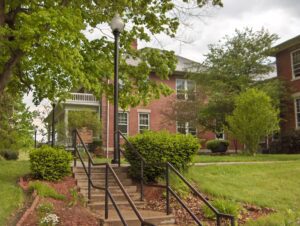
In the first quarter of the nineteenth century, when the general public believed that the insane and paupers could be rehabilitated into productive citizens, the Ohio Legislature gave authorization to county commissioners to establish county “poor houses.” The Athens County Home, formerly known as the Athens County Infirmary, opened on this site in 1857 to provide care for indigent citizens of Athens County. When fire destroyed the original building in 1903, a new building was constructed from 1904-1905, designed with the capacity to house up to one hundred people. When it was built, it was considered to be one of the finest and most modern charitable institutions of its time. The facility continued to provide housing for indigent and elderly residents until 1997 when the County Commissioners closed the home and it became a primary location for the delivery of social services in Athens County. (continued on the other side)
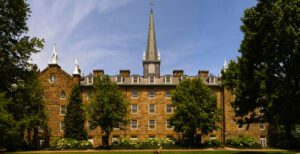
The state’s oldest private institution of higher education, Kenyon College was founded in 1824 in Worthington by Philander Chase, first Episcopal bishop of Ohio, and relocated to Gambier four years later. Both college and village are named for British benefactors, statesman Lord Kenyon and naval hero Lord Gambier. Throughout its history, Kenyon has prepared men and women for leading roles in society, including nineteenth-century graduates Edwin M. Stanton, Abraham Lincoln’s secretary of war, and Rutherford B. Hayes, Ohio governor and U.S. president. In the twentieth century, Kenyon educated such literary luminaries as poet Robert Lowell and novelist E.L. Doctorow. Kenyon has also been an innovator in education-the Advanced Placement Program began as the Kenyon Plan in the 1950s.
The history of New Knoxville provides one of the best examples of chain migration to America. After the Shawnee were removed from what would become Auglaize County, James Knox Lytle, cousin to James Knox Polk, purchased land in Washington Township. Lytle platted a village of 102 lots in 1836, calling it Knoxville to honor his mother’s family. Meanwhile, newly married Wilhelm and Elisabeth Fledderjohann Kuckhermann (later Kuck) immigrated from Ladbergen in northwest Germany. Having missed their boat to St. Louis, the couple lived briefly in Stallostown (Minster) and Bremen (New Bremen). They wrote home, encouraging others to emigrate; in the summer of 1835 the Fledderjohanns (Elisabeth’s family), Meckstroths, and Lutterbecks arrived. The families bought land near the site of Knoxville. (continued on other side)