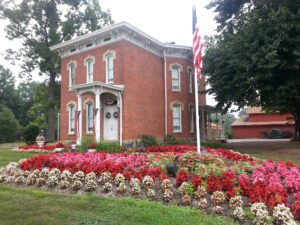
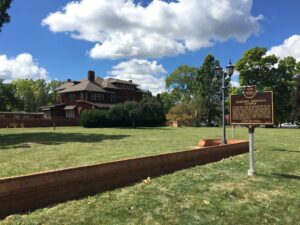
The Clague House and barn serve the community as a museum, history library, and a community theater. It is also a reminder of the area’s agrarian past and is a memorial to the philanthropic generosity of the Clagues. Robert Clague first came to Dover Township from the Isle of Man in 1829. Clague briefly returned to his native land; in 1837 he arrived back in Dover with his wife and infant. The couple raised nine children on the 78 acre farm. The Italianate structure, built in 1876, is the third home constructed on the Clague property. In 1926, surviving children Walter and Sophronia donated the farm to Dover Township for the creation of Clague Memorial Park.
The Clague House and barn serve the community as a museum, history library, and a community theater. It is also a reminder of the area’s agrarian past and is a memorial to the philanthropic generosity of the Clagues. Robert Clague first came to Dover Township from the Isle of Man in 1829. Clague briefly returned to his native land; in 1837 he arrived back in Dover with his wife and infant. The couple raised nine children on the 78 acre farm. The Italianate structure, built in 1876, is the third home constructed on the Clague property. In 1926, surviving children Walter and Sophronia donated the farm to Dover Township for the creation of Clague Memorial Park.
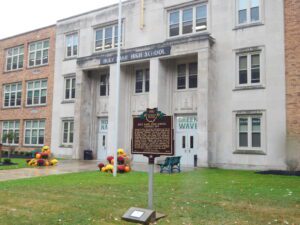
Founded in 1914, Holy Name High School was one of the first co-educational Roman Catholic high schools in Cleveland. Originally located at Harvard and Broadway Avenues, the school opened under the direction of Holy Name Parish with educational leadership of the Sisters of Charity from Cincinnati. In 1978, Holy Name High School moved to its present location in Parma Heights, the former home of Nazareth Academy. Throughout its history, Holy Name High School has served the community by providing a Catholic, college-preparatory education. The Holy Name spirit lives on through its alumni, who have made a difference around the world.
In 1798, Articles of Confederation Congress provided land to British Canadians who lost property because of loyalty to American revolutionaries during the American War of Independence (1775-1783). This land was part of the Refugee Tract and the present-day Truro Township. In 1850, Henry Stanbery, first Attorney General of Ohio, purchased a portion of this land. In 1923, Charles Johnson bought a section of this land and had it platted as the Eastmoor Addition by the Jennings-Lawrence Company with the polo field at the center. Eastmoor has houses ranging in age from the 1920s to the early 21st century, including Lustron homes built after WWII.
Dr. Jared Potter Kirtland was a prominent nineteenth century professor, physician, naturalist and horticulturist. In 1837, Kirtland purchased land in Rockport Township that stretched from Madison Avenue to Lake Erie. Kirtland used that land as a natural laboratory and filled it with gardens, greenhouses and an arboretum where he developed fruit and grape varieties best suited for the region. His success with new varieties inspired area farmers to successfully concentrate on fruit and grape growing. In 1839, he built a home at Detroit and Bunts Roads and lived there unitl his death in 1877. (Continued on other side)
The Harding Hospital, initially called the Columbus Rural Rest Home, was founded in 1916 by George T. Harding II, MD (1878-1934) and his associates, many of whom shared his commitment to service and his Seventh-day Adventist Christian faith. The psychiatic treatment center moved to Worthington in 1920. The hospital’s goal was to provide treatment with attention to the person’s physical, mental, social and spiritual needs. The program, with its emphasis on relational issues and psychotherapy, drew patients from across Ohio and beyond. In 1936 a residency program in psychiatry for physicians was started and educational programs for other mental health professionals followed. The campus’ beauty contributed to its being a place of healing for many. Since 1999, Harding Hospital has been a part of The Ohio State University’s Wexner Medical Center.
Aminah Brenda Lynn Robinson (1940-2015) and her son Sydney moved into this home in 1974. The artist, a visual historian, lived and worked here in the Shepard community until her passing. Raised in Columbus’s Poindexter Village and educated in the local public schools, Robinson also studied at Columbus College of Art and Design and The Ohio State University. Her art reflected stories handed down from her elders, experienced within her community, and the local history she researched while working at the Columbus Metropolitan Library. She received a 2004 MacArthur Award for her celebration of “family, ancestry, and the grandeur of simple objects in drawings, paintings, and large-scale, mixed-media assemblages.” (Continued on the other side)
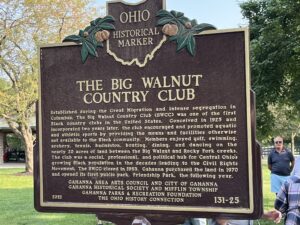
Established during the Great Migration and intense segregation in Columbus, The Big Walnut Country Club (BWCC) was one of the first Black country clubs in the United States. Conceived in 1925 and incorporated two years later, the club encouraged and promoted aquatic and athletic sports by providing the means and facilities otherwise not available to the Black community. Members enjoyed golf, swimming, archery, tennis, badminton, boating, dining, and dancing on the nearly 20 acres of land between the Big Walnut and Rocky Fork creeks. The club was a social, professional, and political hub for Central Ohio’s growing Black population in the decades leading to the Civil Rights Movement. The BWCC closed in 1963. Gahanna purchased the land in 1970 and opened its first public park, Friendship Park, the following year.