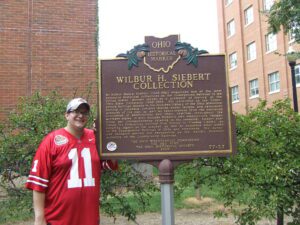
Dr. Wilbur Henry Siebert (1866-1961) organized one of the most extensive historical collections on the Underground Railroad in the United States. Siebert served as a professor of history at the Ohio State University, 1893-1935. His collection on the Underground Railroad, housed in the Archives/Library of the Ohio Historical Society in Columbus, contains diaries, books, letters, and newspaper accounts of the day, as well as reminiscences from the dwindling population of abolitionists and their families throughout the northern states. It also includes Siebert’s own manuscripts, images, notes, and correspondence relating to his research. Siebert published The Underground Railroad from Slavery to Freedom (1898), an enduring classic on the subject, as well as numerous other books on the Underground Railroad in Ohio and elsewhere. His extensive research earned him recognition as the world’s foremost authority on the Underground Railroad.
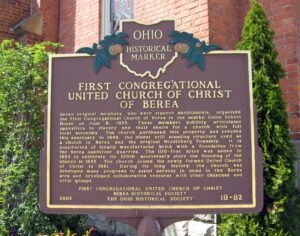
Seven original members, who were staunch abolitionists, organized the First Congregational Church of Berea in the nearby Union School House on June 9, 1855. These members publicly articulated opposition to slavery and their desire for a church with full local autonomy. The church purchased this property and erected this sanctuary in 1869, the oldest still standing structure used as a church in Berea and the original Middleburg Township. It is constructed of locally manufactured brick with a foundation from the Berea sandstone quarries. The 100-foot spire was added in 1954 to celebrate its 100th anniversary since the founding of the church in 1855. The church joined the newly formed United Church of Christ in 1961. During its long history, the church has developed many programs to assist persons in need in the Berea area and developed collaborative ventures with other churches and civic groups.
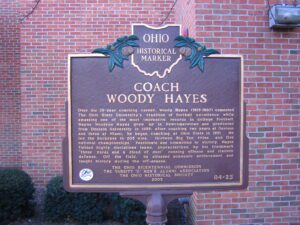
Over his 28-year coaching career, Woody Hayes (1913-1987) cemented The Ohio State University’s tradition of football excellence while amassing one of the most impressive records in college football. Wayne Woodrow Hayes grew up in Newcomerstown and graduated from Denison University in 1935; after coaching two years at Denison and three at Miami, he began coaching at Ohio State in 1951. He led the Buckeyes to 205 wins, thirteen Big Ten titles, and five national championships. Passionate and committed to victory, Hayes fielded highly disciplined teams, characterized by his trademark “three yards and a cloud of dust” running offense and staunch defense. Off the field, he stressed academic achievement and taught history during the off-season.
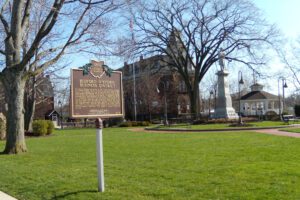
The town of Bedford was settled in 1837. Early residents, Hezekiah and Clarissa Dunham donated the land that serves as Bedford Public Square. The Dunhams built one of the area’s first homes in 1832, which stands at 729 Broadway with the letters H & D above the doorway. Early settlers were attracted to the area by the abundance of natural resources and a large waterfall for mill sites. Bedford also served as a stagecoach stop on the route from Cleveland to Pittsburgh. The road or Turnpike Road as it was called was originally part of the Mahoning Indian Trail. By 1895 the road was renamed Main Street (and later Broadway) when the Akron, Bedford, and Cleveland Railway Company (ABC) traversed the middle of the street carrying passengers. The interurban is called “America’s first high speed long distance electric interurban” with speeds in excess of 60 miles per hour. [continued on other side]
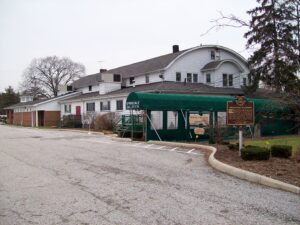
Springvale Ballroom is located on part of the one hundred and forty acre tract that English immigrant John Biddulph bought in 1840. Fred Biddulph, John Biddulph’s grandson, was born near this site in 1887. Fred and his wife, Clara, built the five thousand square foot Springvale Ballroom. On May 19, 1923, they paid fifteen dollars for the right to open the dancing pavilion. The first dance at Springvale Ballroom was held on May 23rd. A five hole golf course was added to the property in 1928. Later changes to Springvale included renovation of the ballroom, the addition of a golf office, and an upgrade to a full eighteen hole course.
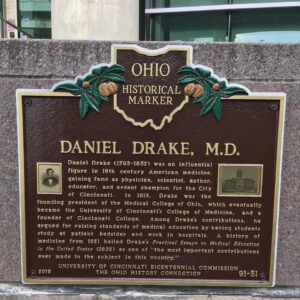
Daniel Drake, M.D.. Daniel Drake (1785-1852) was an influential figure in 19th century American medicine, gaining fame as physician, scientist, author, educator, and ardent champion for the City of Cincinnati. In 1819, Drake was the founding president of the Medical College of Ohio, which eventually became the University of Cincinnati’s College of Medicine, and a founder of Cincinnati College. Among Drake’s contributions, he argued for raising standards of medical education by having students study at patient bedsides and work in hospitals. A history of medicine from 1921 hailed Drake’s Practical Essays on Medical Education in the United States (1832) as one of “the most important contributions ever made to the subject in this country.”
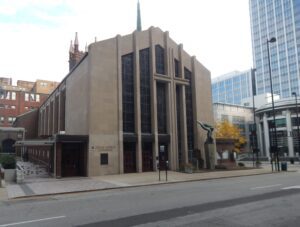
In 1817 twenty-two men, including future President William Henry Harrison, chartered Cincinnati’s first Episcopal parish, Christ Church. In 1835 members erected a Gothic Revival-style church on this site. The neighborhood evolved as the city grew with the influx of immigrants. Parish women raised funds to teach, feed, clothe, and shelter tenement families, and alleviate suffering during floods and disease outbreaks. In 1883 the women helped establish what became Cincinnati Children’s Hospital. In 1909 members opened the Late Gothic-style Parish House, a community center with kitchen, classrooms, library, auditorium, clinic, gymnasium, and bowling alley. By the parish’s centennial in 1917, music had expanded beyond worship to public concerts. In 1940 the annual Boar’s Head Festival of music and pageantry began. Since the 1960s, members have collaborated with local agencies to advocate for social and economic justice, a mission continuing into the 21st century. (Continued on other side)
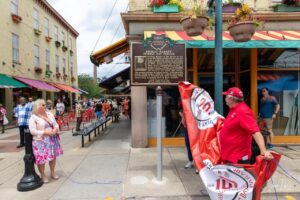
Findlay Market is the heart of the Over-the-Rhine neighborhood and has been a gathering place for political, religious, and social events since opening in 1855. Inspired by the Cincinnati Reds World Championship in 1919, a group of fans –“rooters” – from Findlay Market organized a parade to celebrate the start of the team’s 1920 season. The parade became an annual event, with marching bands, horse-drawn “Tally-Ho” wagons and rooters processioning to Redland and later Crosley Field, where they presented gifts to Reds officials. (Continued on other side)