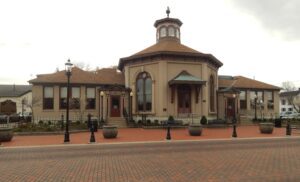
Clark Lane (1823-1907), industrialist and philanthropist, was a son of John Lane (1793-1880) and Rosanah Crum (1795-1877). John came with his family to the Ohio Country when it was still part of the Northwest Territory. As a young man, Clark worked in his family’s blacksmith shop, and eventually helped found Owens, Lane & Dyer Machine Company in 1854. It built agricultural machinery, sawmills, papermaking machines, and other products, initiating Hamilton’s prominence in metals manufacturing. Lane funded the Butler County Children’s Home, an orphanage for over a century, and constructed an octagon house as his residence on Third Street. He built this library in 1866, also as an octagon, and donated it to the people of Hamilton. A 19th century admirer wrote, “The name and generous deeds of Clark Lane will never fade from the memories of a grateful people who have been recipients of his favor.”
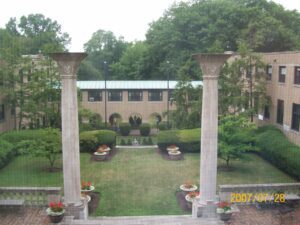
Elm Court, designed by Howard Van Doren Shaw of Illinois, was built in 1912 for Arthur Hudson Marks. The original mansion exemplifies the Italian Renaissance Revival style. Elm Court included the mansion, barn, stables, carriage house, pond, and a variety of trees, especially elms, on 33 acres. Arthur Marks was the inventive genius in chemistry and business who revolutionized the rubber industry in Akron. He was best known for inventing the alkaline-recovery vulcanization process in 1899, the cord tire, the chemical research laboratory system, and placing rubber research on a scientific basis. In World War I he served as director of chemical warfare services. Marks served as vice-president of B.F. Goodrich Company and Curtis Airplane and Engine Company and president of other rubber companies and the Aeolian Skinner Organ Company.
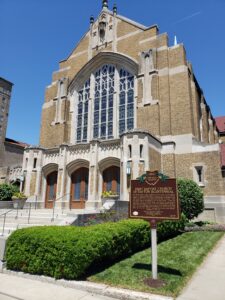
First Baptist Church of Dayton organized on May 29, 1824. A council met on the porch of William Huffman’s home at Third and Jefferson and approved 9 members as a congregation. The next day Lydia Huffman was baptized in the Great Miami River, the first recorded Baptist immersion in the city. Their first church building was erected in 1827 on Main Street. In 1829 the congregation suffered a Campbellite schism. Those resolved to remain Baptist incorporated on February 25, 1837, as The First Regular Baptist Church of Dayton, Ohio. The foundations for the Monument Avenue building were begun prior to the 1913 Dayton flood and the cornerstone was laid May 31, 1914. The building was completed, furnished, and ready for worship on June 26, 1915. (Continued on other side)
Born in Rhode Island, John Pray (1783-1872) moved to the Maumee River Valley from New York shortly after serving in the War of 1812 and completing a prospecting tour in Ohio. He built a dam across the river to Granger Island and in 1821 constructed a water-powered gristmill, the first on the lower Maumee. In 1831, he laid out the Village of Waterville with the first 50 lots. The Columbian House, a stagecoach inn constructed by Pray in 1828 and expanded in 1837, was for years the commercial and social center of Waterville and accommodated travelers from cities such as Detroit and Cincinnati. From this building, he operated the village’s post office. When Wood County was organized in 1820, Pray became a commissioner until Lucas County was formed from part of Wood in 1835. For nine years he served as Justice of the Peace in Waterville. He and his wife Lucy raised eleven children to adulthood. Circa 1854 he constructed his home, which today overlooks Pray Park.
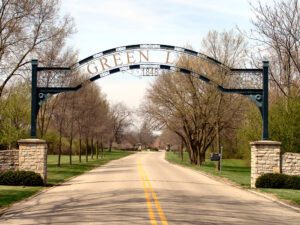
Landscape architect Howard Daniels designed the original portion of Green Lawn Cemetery in 1848. Noted Columbus architect Frank Packard designed Green Lawn’s Chapel mausoleum, the Hayden family mausoleum, and the Packard mausoleum. Spanning over 360 acres, the cemetery’s wooded setting provides a habitat for a variety of birds and other wildlife. The Chapel contains stunning stained glass windows and mosaic artwork by Tiffany & Company of New York. The monuments, obelisks, and memorials throughout the cemetery represent a wealth of artwork and a history of Columbus. As one of the oldest and largest cemeteries in Ohio, Green Lawn is the resting-place of many noted individuals who have made significant contributions to Columbus, Franklin County and the nation.
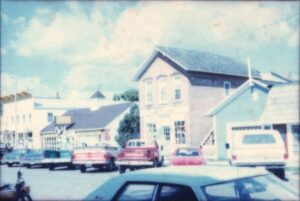
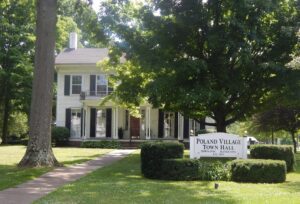
The Village of Poland officially incorporated in August 1866, a year after the end of the Civil War. In April 1867, the citizens elected John Leslie as mayor. As of 1880, Poland’s population exceeded 400. Through its history, the village has consisted of a four-acre village green, churches, schools, hotels, a sawmill, gristmill, post office, tannery, and foundry, as well as carriage, tin, and cabinet shops; drug, dry goods, and hardware stores, and doctors, blacksmiths, and shoemakers. Residents swam in and skated on Yellow Creek. The Poland Municipal Forest was established in 1938 and annexed later as the Village continued to grow. In 1966, the residents held a three day Centennial Celebration, featuring an address by Governor James Rhodes. The centennial year also saw the publication of a history of Poland and the restoration of Centennial Gardens.
Dr. Jacob Rader Marcus (1896-1995), pioneering historian of the American Jew, founded the American Jewish Archives (AJA) in Cincinnati in 1947. In the aftermath of World War II and the brutal destruction of European Jewry, Marcus anticipated the need to establish a central repository dedicated to preserving the history of North American Jewry. The AJA, which began with a few boxes of documents, has become one of the world’s largest catalogued collections of primary source material on the history of American Jewry. An international community of scholars, researchers, and students utilizes the AJA’s vast archival holdings.
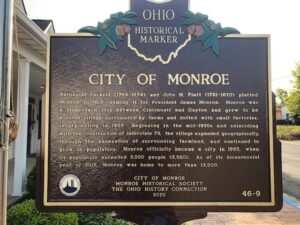
Nathanial Sackett (1768-1854) and John H. Piatt (1781-1820) platted Monroe in 1817, naming it for President James Monroe. Monroe was a stagecoach stop between Cincinnati and Dayton and grew to be a rural village surrounded by farms and dotted with small factories, incorporating in 1907. Beginning in the mid-1950s and coinciding with the construction of Interstate 75, the village expanded geographically, through the annexation of surrounding farmland, and continued to grow in population. Monroe officially became a city in 1995, when its population exceeded 5,000 people (5,380). As of its bicentennial year of 2017, Monroe was home to more than 13,000.