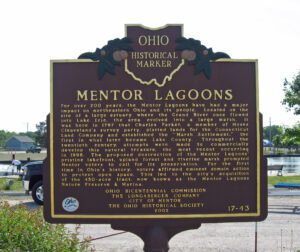
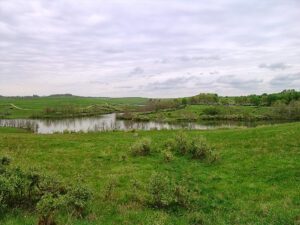
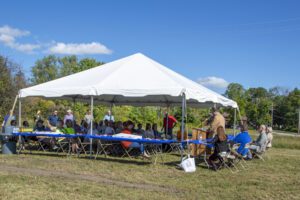
For over 200 years, the Mentor Lagoons have had a major impact on northeastern Ohio and its people. Located on the site of a large estuary where the Grand River once flowed into Lake Erie, the area evolved into a large marsh. It was here in 1797 that Charles Parker, a member of Moses Cleaveland’s survey party, platted lands for the Connecticut Land Company and established the “Marsh Settlement,” the first in what later became Lake County. Throughout the twentieth century, attempts were made to commercially develop this natural treasure, the most recent occurring in 1996. The proposed destruction of the Mentor Lagoons’ pristine lakefront, upland forest and riverine marsh prompted Mentor voters to call for its preservation. For the first time in Ohio’s history, voters affirmed eminent domain action to protect open space. This led to the city’s acquisition of the 450-acre tract, now known as the Mentor Lagoons Nature Preserve & Marina.
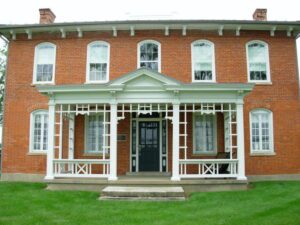
Known as the “Halfway House,” the Gooding House and Tavern was built by George B. Gooding halfway between the towns of Worthington and Delaware in 1827. Its location was influenced by construction of the Columbus and Sandusky Turnpike that was chartered by the State of Ohio the year before. Also known as the “Mud Pike,” the turnpike was slow and difficult for travelers and could take nearly a day to travel 10 miles. The Gooding House was the perfect place for stagecoach drivers to change teams of horses and for travelers to rest and have refreshments. George Gooding also prospered as a farmer with over 1,000 acres of land. This stately brick farmstead remained in the Gooding family for 175 years with each succeeding generation adding its imprint on the property. The Gooding House and Tavern was listed on the National Register of Historic Places in 2005 and restored in 2007.
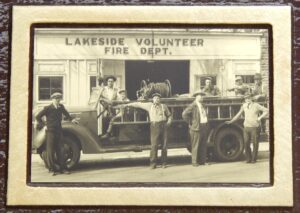
The Lakeside Volunteer Fire Protective Association responded to both fire and medical emergencies on the Marblehead Peninsula for more than 100 years. It was founded in 1905, after a devastating fire destroyed Lakeside’s business district. In 1946, the Association began providing emergency medical aid. During their service, the Lakeside Volunteer Fire Protective Association progressed from hand-drawn chemical carts to the area’s first heavy-duty fire and rescue truck. In 2013, the Association donated its assets to the newly-formed Danbury Township Volunteer Fire Department and passed into history.
Near this location stood the settlement of African American families known as “The Lett Settlement.” The Lett Settlement was a self-sustaining community of mixed race families, including the Caliman, Guy, and Lett families. The families had formed ties through marriage and common background during the mid-1700s in Virginia and Maryland. These early African American pioneer families came to Ohio as “free people of color,” and began acquiring land in Meigs Township, Muskingum County, and surrounding townships in adjacent counties during the 1820s. They were soon joined by the Brown, Clifford, Earley, Simpson, Tate, and Pointer families. The families of the Lett Settlement were land owners and tax payers in Ohio before the Civil War and challenged the State of Ohio for the right to vote and for access to education during the 1840s, 1850s, and 1860s. (Continued on other side)
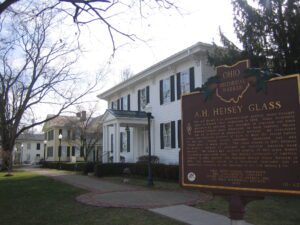
The A.H. Heisey & Co. produced high quality, hand-wrought glass in Newark, Ohio beginning in 1896. Glass originally produced by pressing was intended to simulate cut glass making elegant glass affordable to more families. Heisey was an innovator in production methods. He introduced colors and different patterns of glass to meet the social habits of the era. Highly skilled craftsmen produced, cut, and etched glass in many styles. The plant closed in 1957 because of Heisey’s refusal to produce an inferior machine-made product. The beauty and superior quality of this glass makes it a highly collectable item. The Heisey Collectors of America, founded in 1971, opened The National Heisey Glass Museum in 1974. The Museum stands as a historical reminder and an educational resource to the heritage of the A.H. Heisey & Co.
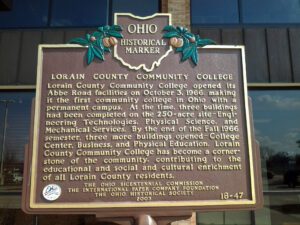
Lorain County Community College opened its Abbe Road facilities on October 3, 1966, making it the first community college in Ohio with a permanent campus. At the time, three buildings had been completed on the 250-acre site-Engineering Technologies, Physical Science, and Mechanical Services. By the end of the Fall 1966 semester, three more buildings opened-College Center, Business, and Physical Education. Lorain County Community College has become a cornerstone of the community, contributing to the educational and social and cultural enrichment of all Lorain County residents.
801 E. Pete Rose Way, Bicentennial Commons at Sawyer Point
Cincinnati
, OH
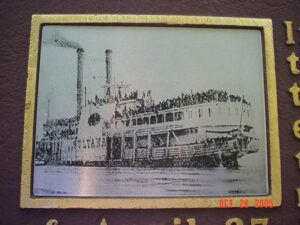
In 1862, less than a mile upriver from this marker, the John Lithoberry Shipyard in Cincinnati constructed the Sultana, a 260-foot, wooden steam transport. At the end of the Civil War, the U.S. Government contracted the Sultana to transport recently freed Federal prisoners north from Confederate stockades. During the night of April 27, 1865, while carrying over 2,300 Union soldiers – over six times its capacity of 376 passengers – a steam boiler aboard the Sultana exploded. The ship erupted in a massive fireball and sank in the cold, flood-swollen Mississippi River ten miles north of Memphis, Tennessee. Over 1,700 individuals died – some 200 more than those lost aboard the Titanic in 1912 – in what remains the worst maritime disaster in American history. Of the total casualties, Ohio lost the most of any state, with 791 dead. Indiana lost 491 persons, with Kentucky suffering 194 dead. It is estimated that, of the Ohio casualties, over fifty were Cincinnatians.
Near this location on May 15, 1823, the first murder trial in Geauga County concluded with the public execution of Benjamin Wright, Jr. On February 1, 1823, Wright stabbed Zophar Warner over a financial dispute, wounding him mortally. The following month, a jury found Wright guilty of murder and ordered that “he be hung by the neck until he be dead.” At the time, executions in Ohio were carried out locally and public hangings were seen by some as social events. The “hanging bee” drew more than 4,000 people, some of whom traveled from upwards of 50 miles to witness the spectacle. One witness wrote, “I felt that he deserved to be hung…but it was an awful site I hope to never the like see again.” Wright’s body was taken to nearby LeRoy for burial and the gallows was dismantled.