Cincinnati Museum Center at Union Terminal, 1301 Western Avenue
Cincinnati
, OH
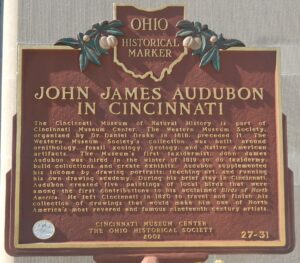
The Cincinnati Museum of Natural History is part of Cincinnati Museum Center. The Western Museum Society, organized by Dr. Daniel Drake in 1818, preceded it. The Western Museum Society’s collection was built around ornithology, fossil zoology, geology, and Native American artifacts. The Museum’s first taxidermist, John James Audubon was hired in the winter of 1819 to do taxidermy, build collections, and create exhibits. Audubon supplemented his income by drawing portraits, teaching art, and running his own drawing academy. During his brief stay in Cincinnati, Audubon created five paintings of local birds that were among the first contributions to his acclaimed Birds of North America. He left Cincinnati in 1820 to travel and finish his collection of drawings that would make him one of North America’s most revered and famous nineteenth century artists.
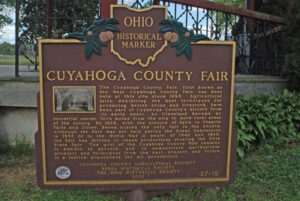
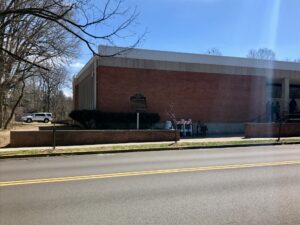
The Cuyahoga County Fair, first known as the West Cuyahoga County Fair, has been held at this site since 1895. Agricultural fairs, exhibiting the best techniques for producing better crops and livestock, have been part of Cuyahoga County’s history from its early years. As Cleveland became an industrial center, fairs moved from the city to more rural areas of the county. By 1928, with the closure of fairs in Chagrin Falls and Dover, Berea hosted the only fair in the county. Although the Fair was not held during the Great Depression in 1932 or in the World War II years of 1942 and 1943, the Fair has thrived to reach proportions rivaling the Ohio State Fair. The goal of the Cuyahoga County Fair remains to exhibit, to educate, and to demonstrate agribusiness products and techniques from the past, present, and future in a festive atmosphere for all generations.
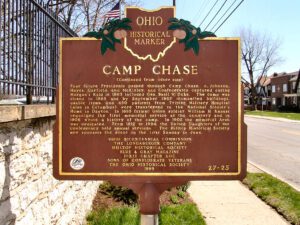
Camp Chase was a Civil War camp established in May 1861, on land leased by the U.S. Government. Four miles west of Columbus, the main entrance was on the National Road. Boundaries of the camp were present-day Broad Street (north), Hague Avenue (east), Sullivant Avenue (south), and near Westgate Avenue (west). Named for former Ohio Governor and Lincoln’s Secretary of the Treasury Salmon P. Chase, it was a training camp for Ohio soldiers, a parole camp, a muster-out post, and a prisoner-of-war camp. As many as 150,000 Union soldiers and 25,000 Confederate prisoners passed through its gates from 1861-1865. By February 1865, over 9,400 men were held at the prison. More than 2,000 Confederates are buried in the Camp Chase Cemetery.
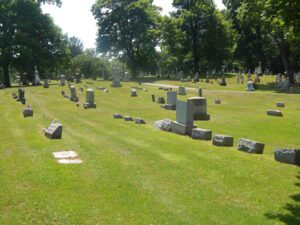
For more than two centuries, this burial ground has been a final resting place for those individuals whose lives represented the community history of Canfield. The earliest existing tombstone marks the death of Huldah Tanner in 1803. Seven earlier deaths in Canfield Township are recorded from 1798 to 1803, but the gravesites are unknown. Elijah and Rhoda Hopkins Wadsworth formally deeded the cemetery to the citizens of Canfield in 1810 with a first edition of land donated by Matthew B. Whittlesey in 1811. In 1862-1863, the graveyard was again enlarged. For seventy years the cemetery and fencing were maintained on a volunteer basis. When the Village of Canfield was incorporated in 1869, the care and management was vested in a board of trustees. (continued on other side)
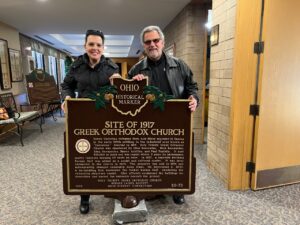
Greek Christian refugees from Asia Minor migrated to Canton in the early 1900s settling in the industrial area known as “Carnahan.” Erected in 1917, Holy Trinity Greek Orthodox Church was chartered by Elies Korosedes, Nick Kessenides, Alex Heropoulos, Harry Achilles, and Paul Paulidis. It cost $50,000 to build and was repaid within 3 years by parishioners, mostly laborers earning 30 cents an hour. In 1927, a separate building Koraes Hall was added as a social and cultural center. It was later connected to the church in 1934. The property was sold in 1976 and subsequently changed ownership many times. On September 2, 2020, a devastating fire destroyed the former Koraes Hall, rendering the remaining structure unsafe. City officials condemned the buildings for demolition and buried the remnants beneath the ground.
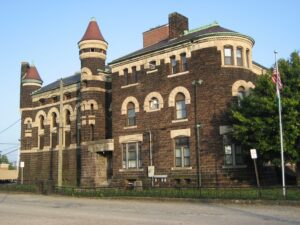
Designed by J. W. Yost, a renowned Ohio architect, the jail first opened for use in 1889. The Richardsonian Romanesque structure cost $120,000 to build. It was constructed of pink sandstone known as “brownstone,” which was quarried near Millersburg, Ohio. The front three levels were built to house the families of the sheriff and the jail matron. Sheriff Andrew Crilly was the first to occupy the sheriff’s quarters when the jail opened. The rear portion of the building was used for the incarceration of male and female prisoners on separate floors. The 32 cells, each a minimum of 8′ x 8′ in size, had an official total capacity of 68 prisoners. However, well over that number were housed here at times. The jail building was last used for incarcerations in 1987. (Continued on/from other side)
Virginia Hamilton was an author who was born in Yellow Springs in 1934, living and writing here for much of her life. She referred to her works as “Liberation Literature.” focusing on the struggles and journeys of African Americans. Hamilton published more than forty books in a variety of genres, including realistic novels, science fiction, picture books, folktales and mysteries. Some of her most beloved titles include The House of Dies Drear, M.C. Higgins the Great, Her Stories and The People Could Fly. Her books have had a profound influence on the study of race throughout American history, the achievements of African Americans, and the ramifications of racism. Hamilton received numerous awards for her writing before passing away in 2002. Her work is enshrined at the Library of Congress in Washington, D.C.
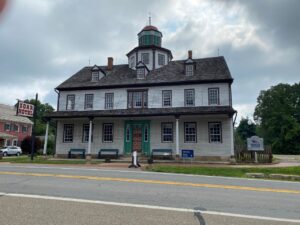
Zoar Separatists built the hotel in 1833 to accommodate overflow travelers from their original Ohio & Erie Canal inn. The hotel proved an economic boon to the Zoar community, but, by bringing the outside world into Zoar, ultimately became a source of discontent for members. During its heyday, the Zoar Hotel catered to curiosity-seekers, visiting artists, and families escaping the summer heat of nearby cities. Notable guests included Marcus Hanna and President William McKinley. The original structure was enlarged several times, including the now demolished 1892 Queen Anne addition which doubled the accommodations. By the mid-twentieth century, the hotel remained open as a popular restaurant with Rathskeller bar until closing to the public in July 1983. The exterior was restored by the Ohio History Connection in 2001-2002.