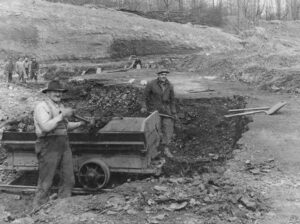
Agriculture dominated the economy of southeastern Ohio’s Morgan County until the 1940s when harvests dwindled, the population declined, and land values dropped. Surface mining the area’s rich underground coal deposits replaced agriculture as the major industry and revitalized the declining local economy. As the nation’s demand for electricity grew over the next half-century, so did the demand for coal as fuel for nearby power generation plants. During mining’s heyday in the 1960s to the late 1980s, American Electric Power’s former Central Ohio Coal Company subsidiary employed nearly 1,000 people. Nearby communities-such as Cumberland, Caldwell and Chandlersville-thrived. As time passed, however, the robust coal industry was hit hard by environmental regulations that reduced the market for the area’s high-sulfur coal. In turn, mine work forces shrank considerably and local businesses closed. (continued on other side)
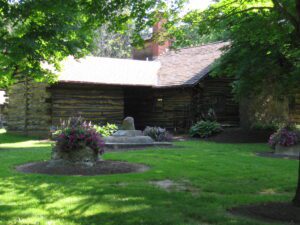
In recognition of its noteworthy representation of the history, culture, and architecture of the Western Reserve, Burton Village’s Historic District was placed on the National Register of Historic Places in 1974. The Historic District, an area of approximately 20 acres surrounding the Village Green and along streets at the north end of the Green, includes 15 buildings of historical significance built between 1815 and 1891. Preserved within the District are commercial and public buildings and private dwellings that reflect the cultural and architectural development of a village of the Western Reserve of Ohio during the 19th century. Buildings in the predominant architectural styles of the 19th century are all represented in the Historic District, including Western Reserve, Greek Revival, Second Empire, Italianate, and Queen Anne. [Continued on other side]
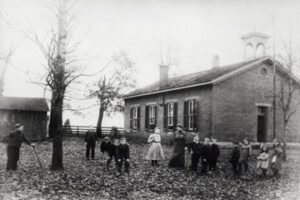
In 1854, Samuel and Rebecca McClellan Collins deeded 1.28 acres to Beavercreek Township, Greene County, for the purpose of building a schoolhouse. The first two schoolhouses were constructed of stone with fireplaces for heat. Collins neighborhood children in first through eighth grade were educated in the present red brick building until 1944, when decreased enrollment forced Xenia Township to close the school. Virgil and Helen Bryson Brantley, great-granddaughter of Samuel and Rebecca Collins, purchased the school property in 1982 and began the restoration of the vandalized and deteriorated schoolhouse. The pony/coal shed and privies were rebuilt on their foundations. (Continued on other side)
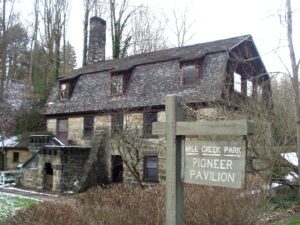
Pioneer Pavilion, one of the oldest structures in Youngstown, is a rare surviving example of early nineteenth-century industry. James Heaton constructed this sandstone building in 1821 as a mill for carding and fulling wool. A millrace from Mill Creek and a waterwheel on the west side supplied the power. In the 1830s and 1840s, the woolen mill was converted to a storage facility for the nearby Mill Creek Furnace and later served as a cattle barn. In 1891, Youngstown attorney Volney Rogers purchased the property for Mill Creek Park, renovating the building in 1893 as a dining and dancing facility, and naming it Pioneer Pavilion. Generations of area residents spanning three centuries have celebrated social events in this historic landmark.
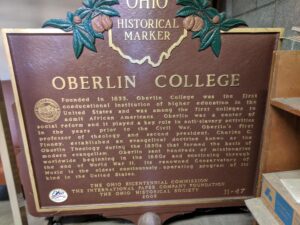
Founded in 1833, Oberlin College was the first coeducational institution of higher education in the United States and was among the first colleges to admit African Americans. Oberlin was a center of social reform and it played a key role in anti-slavery activities in the years prior to the Civil War. Oberlin’s first professor of theology and second president, Charles G. Finney, established an evangelical doctrine known as the Oberlin Theology during the 1850s that formed the basis of modern evangelism. Oberlin sent hundreds of missionaries worldwide beginning in the 1880s and continuing through the end of World War II. Its renowned Conservatory of Music is the oldest continuously operating program of its kind in the United States.
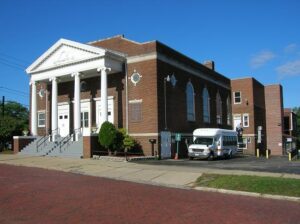
This church, founded in 1866, is the oldest Black congregation in Akron. After worshiping in several locations, the congregation held a fund-raiser to help finance the construction of a permanent home. The person collecting the most money had the privilege of renaming the church. That honor went to Mrs. Belle (Smith) Wesley. Completed in 1928, the current structure is a Neo-Classical Revival style building, featuring a classical pedimented portico, or porch, and four distinctive ionic columns. An education wing was added in 1963 by the late Rev. Dr. E. E. Morgan, Jr. Akron Black architects Herbert L. Wardner and John O. Somerville designed the church, and then a Black contractor, Samuel Plato, completed the structure. The church has long been a vital religious and social focal point for Akron’s Black community. The local chapter of the National Association for the Advancement of Colored People (NAACP) was organized at Wesley Temple. Placed on the National Register of Historic Places 3/19/94.
St. Mary of the Assumption parish — Ohio’s second and Fairfield County’s first — was founded circa 1817-1820 by Father Edward Dominic Fenwick. Dominican priests from Somerset began ministering regularly to Lancaster faithful and a small church was dedicated during Easter 1819. Construction on the parish’s third church building, The Basilica of St. Mary of the Assumption, began in February 1854 under the pastorate of Rev. Henry Lange. On August 15, 1859, the Very Rev. John Purcell, Bishop of Cincinnati, laid the cornerstone and it was blessed by former pastor Rev. Josue M. Young, Bishop of Erie, Pennsylvania. Construction proved slow as the Civil War depleted both parish funds and available workers. Father Lange rallied his parishioners, enlisted local contracters Guy and George Blair, and continued the work until his death in February 1864. (Continued on other side)
One of Ohio’s earliest proponents of women’s rights, Frances Dana Gage (1808-1884) was born in Marietta and married McConnelsville attorney James L. Gage in 1829. She immersed herself in the major social issues of the day – temperance, abolition, and universal suffrage – while raising eight children. At a women’s rights convention in 1850, Gage gained national attention by proposing that the words “white” and “men” be removed from Ohio’s constitution. She later served as the editor of an Ohio agricultural journal, as an educator for newly emancipated African Americans, and wrote children’s tales under the pen name “Aunt Fanny.” An enormously influential woman, Gage led the way for Ohio’s next generation of social activists.