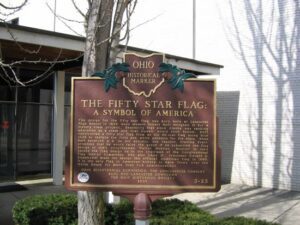
The design for the fifty star flag was born here at Lancaster High School in 1958 when student Robert Heft designed it for a history class project. Reasoning that since Alaska was seeking admission as a state and that Hawaii would soon follow, Heft constructed a fifty star flag from an old 48-star flag using blue cloth to replace the field and white adhesive for the stars. When Heft received a B- on his project, his teacher, Stanley Pratt, promised that he would raise the grade if he submitted the flag design to their congressman, Walter Moeller. Moeller in turn passed the flag design on to the chairman of the Congressional Flag Design Committee, who also liked it. President Dwight D. Eisenhower made the design the official American flag in 1960. It is the only flag in American history to have flown over the White House for more than five administrations.
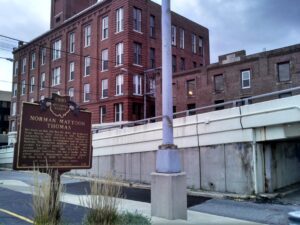
Was born on this site Nov. 20, 1884. He graduated from Marion High School in 1901, Princeton University in 1905, and from Union Theological Seminary. Thomas, a clergyman, and the son of Marion’s Presbyterian minister, was a tireless worker for social security, civil rights, and human justice. Six time Socialist Party presidential candidate, he was a leader in the effort toward disarmament and world peace. He died Dec. 19, 1968, in Huntington, N.Y.
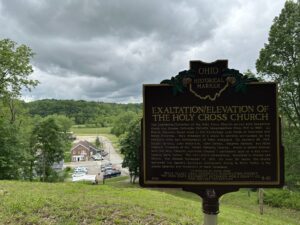
The Exaltation/Elevation of the Holy Cross Church served both Byzantine Greek and Russian Orthodox Catholic congregations from 1915 to 1967. As Slovak migrants found work in the Cambridge coal fields of Guernsey and Noble Counties, they dreamed of a place to worship surrounded by the religious rites and iconography of their homeland. On January 26, 1914, Daniel Varhola, John Fetkovich, John Demko, Stephen Varhola, and Mike Zeleznik (trustees of the “Greek Catholic Church, which is united forever with the Holy Catholic Apostolic Church”) purchased land on a hill overlooking Belle Valley. The two-sided cornerstone, inscribed in Russian and Slovak, was blessed November 15, 1915. For over 50 years, the church anchored the Eastern European immigrants living in Belle Valley to the ethnic identity and traditions of their homeland. (Continued on other side)
A native of New Boston, Vernal G. Riffe Jr. served the 92nd House District in the Ohio General Assembly from 1959 to 1994. As Speaker of the Ohio House of Representatives from 1974 through 1994, he served longer than any other speaker in the state’s history. Widely regarded as Ohio’s most influential legislator of the late 20th century, Riffe, a Democrat, built effective political alliances across party lines. A powerful advocate for southern Ohio, he was instrumental in the growth and expansion of Shawnee State University.
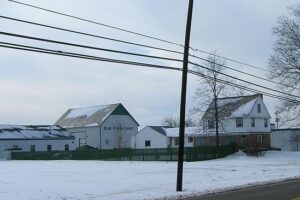
In 1927, Henry Abell, a master plumber, purchased a 100-acre dairy farm. When the Great Depression struck the nation two years later, Abell could find little work as a plumber and decided to develop his dairy farm. In 1934, he and his family began the Dairy, growing the farm to 500 acres and producing enough milk, ice cream, and other dairy products to supply five counties. The dairy closed in 1979, but today houses America’s Ice Cream and Dairy Museum, dedicated to the cultural history of the ice cream and dairy industry in Ohio and the United States.
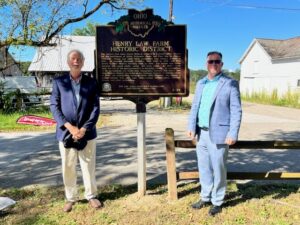
The historic Law Farm (circa 1846) is situated in a broad valley formed by the confluence of Little Stillwater Creek and Plum Run in Monroe Township. Henry Law (1812-1869) immigrated from Ireland to Ohio in 1830. He married Elizabeth McMillan (1818-1892) in 1839, and they moved to their Monroe Township farm by 1846. The couple had eleven children and raised cattle, sheep, and other crops. By 1860, their farm was one of the most productive in Harrison County. In recognition of its agricultural and Scots-Irish immigration history, the Henry Law Farm Historic District was listed on the National Register of Historic Places in 2002. Its contributing buildings (1846-1920) included: two houses; a summer kitchen; tool, milk, coal, smoke houses; multiple barns; carriage houses; and other outbuildings.
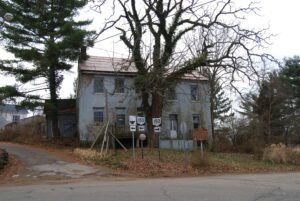
After witnessing the slave trade in Wheeling, Virginia, Quaker abolitionist Benjamin Lundy (1789-1839) resolved to battle the institution, first organizing the Union Humane Society in St. Clairsville in 1815. In 1821, Lundy moved to Mount Pleasant and began publishing the Genius of Universal Emancipation, a newspaper devoted wholly to anti-slavery issues. The newspaper would later be published in Tennessee, Baltimore, Washington D.C., and Philadelphia. Lundy traveled widely to promote circulation, lecturing on the moral evils of slavery and its associated negative economic and social effects. The Lundy home served as an Underground Railroad stop.
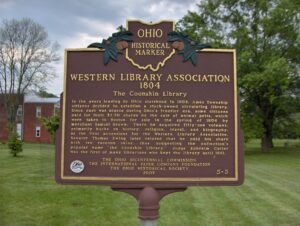
In the years leading to Ohio statehood in 1803, Ames Township citizens decided to establish a stock-owned circulating library. Since cash was scarce during Ohio’s frontier era, some citizens paid for their $2.50 shares by the sale of animal pelts, which were taken to Boston for sale in the spring of 1804 by merchant Samuel Brown. There he acquired fifty-one volumes, primarily books on history, religion, travel, and biography, as the first accessions for the Western Library Association. Senator Thomas Ewing later related that he paid his share with ten raccoon skins, thus suggesting the collection’s popular name “the Coonskin Library.” Judge Ephraim Cutler was the first of many librarians who kept the library until 1861.