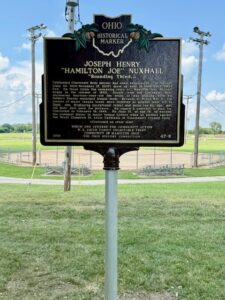
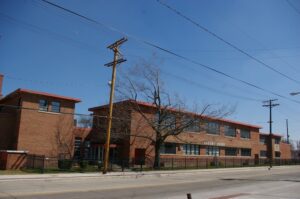
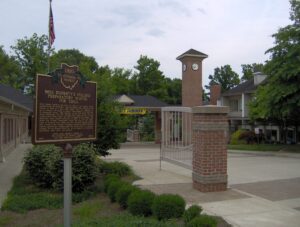
Celebrated Cincinnati Reds pitcher and radio broadcaster, Joe Nuxhall (July 30, 1928 – November 15, 2007) grew up here in Hamilton’s North End. On these fields the endearing story of “Hamilton Joe” Nuxhall began in the summer of 1943. Scouts from the Cincinnati Reds discovered fourteen-year-old Joe while he was playing with his father’s Sunday municipal league team. Because of World War II, the rosters of major league teams were depleted as players went off to fight. Joe, displaying exceptional talent and poise for his age, met the Reds’ dire need for pitchers. He signed a contract to play for Cincinnati on February 18, 1944. On June 10, at age 15, he became the youngest player in major league history when he pitched against the World Champion St. Louis Cardinals at Cincinnati’s Crosley Field. (Continued on other side)
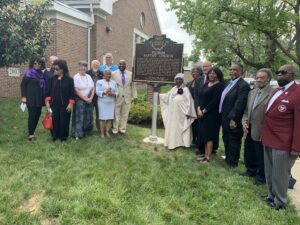
On January 9, 1919, a group of eight men and three women, being led by the Holy Spirit, met at a house on Wallace Street to form a new black Missionary Baptist Church in Hamilton, Ohio. The group quickly raised $150 to make the down payment on a two-story brick building at 333 Chestnut Street being sold for $1,850. The building was occupied on March 25, 1919, and the name Pilgrim Baptist Church was suggested and accepted. On May 11, 1919, a special council requested admittance into the Western Union Baptist Association, a district association now affiliated with the Ohio Baptist General Convention. Requirements for admission were met and Pilgrim Baptist Church was recognized as a Missionary Baptist Church. In 2019, Pilgrim Baptist Church celebrated a centennial of faithfulness in Hamilton.
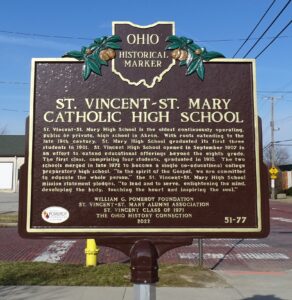
St. Vincent-St. Mary High School is the oldest continuously operating, public or private, high school in Akron. With roots extending to the late 19th century, St. Mary High School graduated its first three students in 1901. St. Vincent High School opened in September 1907 in an effort to extend educational offerings beyond the eighth grade. The first class, comprising four students, graduated in 1910. The two schools merged in late 1972 to become a single co-educational college preparatory high school. “In the spirit of the Gospel, we are committed to educate the whole person,” the St. Vincent-St. Mary High School mission statement pledges, “to lead and to serve, enlightening the mind, developing the body, touching the heart and inspiring the soul.”
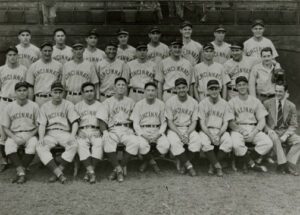
The 1869 Cincinnati Red Stockings made history not only as the most dominant baseball club of its time, but also as the first band of professional ballplayers. Cincinnati’s decision to pay players proved to be a success, and other cities soon began establishing their own professional clubs throughout America. In 1876, the Reds joined the newly formed National League. Baseball soon became one of Cincinnati’s most popular entertainment venues, aided in part by the team’s World Series titles in 1919 and 1940. Cincinnati’s “Big Red Machine,” featuring players such as Johnny Bench, Joe Morgan, and Pete Rose, dominated baseball in the 1970s, picking up additional titles in 1975 and 1976. A surprise wire-to-wire title again in 1990 strengthened the Reds’ legacy and helped ensure future generations of Reds fans.
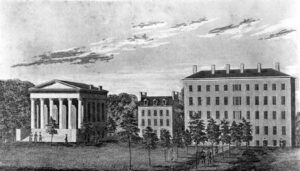
The Lanes, Baptist merchants from New Orleans, and the Kempers, a Presbyterian family from Cincinnati, gave money and land respectively for Cincinnati’s first manual labor theological seminary and high school, which opened in suburban Walnut Hills in 1829. The Reverend Lyman Beecher came from Boston as its first president. The president’s house, now known as the Stowe House after Beecher’s daughter Harriet Beecher Stowe, author of Uncle Tom’s Cabin, still remains at Gilbert and Foraker. Lane Theological Seminary, bound by present day Gilbert, Chapel, Park, and Yale streets, continued to educate Presbyterian ministers until 1932, when it was merged with McCormick Theological Seminary in Chicago.
Karamu House, Incorporated was established in 1915 as the Playhouse Settlement, one of Cleveland’s many settlement houses for migrant and immigrant communities. Initiated by the Men’s Club of the Second Presbyterian Church, in 1915 Oberlin College and University of Chicago social work graduates, Russell and Rowena Woodham Jellliffe were hired as the founding directors. Originally located at 2239 East 38th Street, the Playhouse Settlement offered children’s theater and other social, recreational, and educational activities. It soon developed a partnership with the Dumas Dramatic Club, a local African American theater company that later became known as the Gilpin Players. (continued on other side)
Mary Harlan Doherty was born in 1862 in the Dayton Street neighborhood of Cincinnati. She graduated from Woodward High School in 1880 at a time when women were not expected to go to college, but rather to marry, raise children, and take care of household duties. Miss Doherty, as she was known, saw the world differently. She felt strongly that women should not only possess solid social skills, but also be prepared for college. She graduated from Cornell University in 1899. In 1906 she established the College Preparatory School for Girls in the former home of Superior Court Judge and Ohio Governor George Hoadley, with a class of 125 students. Enrollment doubled by 1920, with Miss Doherty guiding her students under the school’s motto, Ad Summum, meaning “To the Highest Point,” or, as she viewed it, to strive for excellence, hard work, and service.
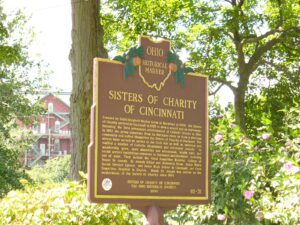
Founded by Saint Elizabeth Bayley Seton in Maryland in 1809, the Sisters of Charity arrived in Cincinnati in 1829 to open a school and an orphanage, becoming the first permanent establishment of Catholic sisters in Ohio. In 1852 the group separated from its Maryland roots to form a diocesan community and called themselves the Sisters of Charity of Cincinnati. The sisters later served as nurses in the Civil War as well as operated and staffed a number of Catholic elementary and secondary schools. As membership grew, their ministries and educational, health care, and social service institutions expanded in Cincinnati and elsewhere, including out of state. They include the Good Samaritan Hospital, College of Mount St. Joseph, St. Joseph Infant and Maternity Home, Santa Maria Social Service Agency, and Seton High School in Cincinnati and Good Samaritan Hospital in Dayton. Mount St. Joseph has served as the motherhouse of the Sisters of Charity since 1884.