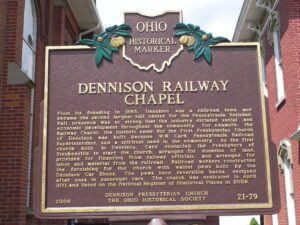
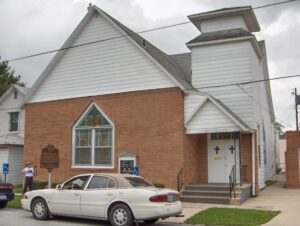
From its founding in 1865, Dennison was a railroad town and became the second largest rail center for the Pennsylvania Railroad. Rail presence was so strong that the industry dictated social and economic development throughout the community. For example, the Railway Chapel, the historic name for the First Presbyterian Church of Dennison was built because W.W. Card, Pennsylvania Railroad Superintendent, saw a spiritual need in the community. As the first church built in Dennison, Card contacted the Presbytery of Steubenville to start the church, arranged for donation of land, provided for financing from railway officials, and arranged for labor and material from the railroad. Railroad workers constructed the furnishing for the church with walnut pews built by the Dennison Car Shops. The pews have reversible backs, designed after ones in passenger cars. The church was dedicated in April 1871 and listed on the National Register of Historical Places in 2009.
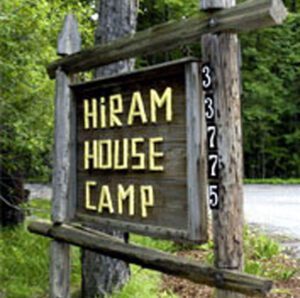
Hiram House was Ohio’s first settlement house and among the earliest in the nation, opening in October 1896 in Cleveland’s Whiskey Island neighborhood. Representing the ideals of a late-1800s urban progressive movement, settlement houses provided–through “service, not charity” –health, recreational, and self-development opportunities that were not widely available in this era. Founded by Hiram College divinity graduate George A. Bellamy (1872-1960), Hiram House administered a wide range of social services for people of different ethnic and economic backgrounds. Bellamy established the “Fresh Air Camp” circa 1900; Cleveland industrialist Samuel Mather donated this tract of land in 1903. In continuous operation since its founding, Hiram House has provided outdoor experiences and educational programs for thousands of Ohio children.
Frances Dana (Barker) Gage was born on October 12, 1808, in Marietta. She married James L. Gage in 1829 and they raised eight children, including four sons who served with Union forces during the Civil War. Throughout much of her life, Frances was deeply involved with the Temperance and Anti-Slavery movements and Women’s Rights issues. Presiding over the Women’s Rights Convention in Akron in 1851, she invited Sojourner Truth to give her famous “Ain’t I a Woman” speech. The Gage family moved in 1853 to St. Louis, the western extension of the Mason-Dixon Line, where her life was threatened whenever she spoke out against slavery. During the Civil War, she traveled south to aid Union soldiers and teach freed slaves. Though crippled and permanently disabled by a stroke, she continued to lecture on social issues until 1867. Frances Dana Gage died on November 10, 1884, in Greenwich, Connecticut.
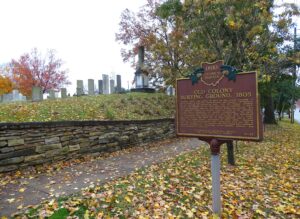
Granville, Ohio, was settled in 1805 by the Licking Company, a group formed in Granville, Massachusetts, and Granby, Connecticut, for the purpose of emigrating west. The Old Colony Burying Ground was defined on the first town plat of Granville in 1805. Many of Granville’s pioneers are interred within this ground, and the cemetery retains its original form and most of its westward facing rows of sandstone and marble gravestones. The early settlers buried here helped to lay out this town and determined the appearance and development of the village as it is today. The first burial, the infant son of Ethan Bancroft, was in April 1806. The oldest extant gravestone is dated 1808. Eighteen veterans of the Revolutionary War, thirty-nine from the War of 1812, and sixteen Civil War veterans rest here along with ministers, farmers, industrialists, physicians, young mothers, children, and other citizens of Granville.
In spite of small numbers and being welcomed by the mostly white congregation of First Methodist Episcopal Church, African Americans in Findlay in the 1880s wanted to express their faith in ways that best reflected their freedoms and traditions. By the mid-1880s, the congregation was meeting in members’ homes and the Odd Fellows Hall, but began fund raising to build their own church in 1885. The congregation was admitted to the North Ohio Conference of the Third Episcopal District of the African Methodist Church in 1885, one of the first churches to be so admitted. The building on Liberty Street was well underway by the end of 1887 on a lot donated by Judge D. J. Cory. The original twenty foot by forty foot building cost $2,000 and immediately became a focal point for religion and social events for Findlay’s African American community. (Continued on other side)
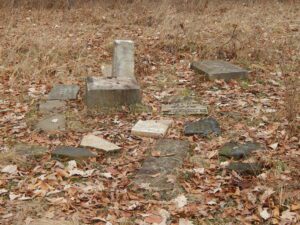
There are 48 known members of the Postle family buried in the cemetery. Their stories are interwoven with the history of Prairie Township, Franklin County, and Ohio. In 1810, Shadrach and Anna Stacia Postle were among the first settlers of Prairie Township. Their son Job was a veteran of the War of 1812 and later owned the Checker Inn, a popular stopping place on the National Road. In the 1860s, Smith Postle and his son, William Sylvester Postle, were some of the first manufacturers of clay drainage tile in Ohio. Their products improved drainage in farm fields and fostered the growth of the tile industry in the state. Gabriel Postle was the first Postle buried in the cemetery in 1829. Twelve graves are of children under the age of six, which testifies to the hardships endured by the area’s early residents. Other graves include those of John Whitehurst, a freed slave who lived with the family of the Job Postle and John Tracy, a veteran of the Civil War. In 1870, Nancy Postle was the last person buried in the cemetery.
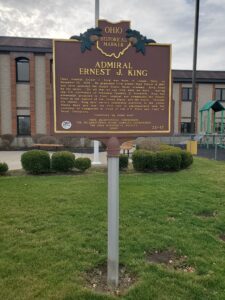
Fleet Admiral Ernest J. King was born in Lorain, Ohio, on November 23, 1878. He graduated from Lorain High School in 1897 and later attended the United States Naval Academy. King lived by his motto, “Do all that we can with what we have.” Having the full confidence of President Franklin D. Roosevelt, King was eventually promoted to Fleet Admiral and commanded the largest fleet in the history of the United States and the world. Through his career, King held various leadership positions in the United States Navy and was the first man to simultaneously hold the positions of Commander in Chief of the U.S. Fleet and Chief of Naval Operations. (continued on other side)
801 E. Pete Rose Way, Bicentennial Commons at Sawyer Point
Cincinnati
, OH
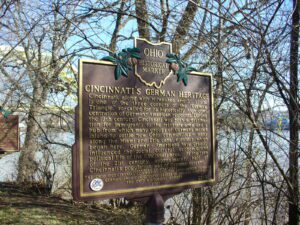
Cincinnati, along with Milwaukee and St. Louis, is one of the three corners of the “German Triangle,” so-called for its historically high concentration of German-American residents. During the 19th century, Cincinnati was both a destination for immigrants to the tri-state area and a hub from which many groups of Germans moved inland to settle new Ohio communities-many along the Miami and Erie canal corridor which began here. German-Americans have greatly influenced the social, cultural, economic and political life of the Cincinnati area. At the turn of the 21st century, approximately half of Cincinnati’s population was of German descent. (Continued on other side)