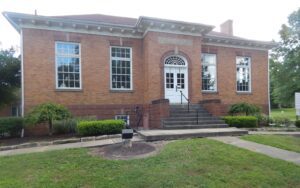
In 1912, an endowment of $6,000 from Andrew Carnegie made it possible for the Bristol Public Library to become a reality. Four years earlier, the newly organized Bristol Library Association, headed and promoted by retired Judge Norman A. Gilbert, had established a subscription book service at the Congregational Church in Bristolville with books loaned from the state library. The Bristol Board of Education appointed a six-member Library Board of Trustees and a one mill levy provided financial support. Charles C. Thayer and Son designed the building in accordance with Carnegie’s recommendations and the local trustees’ suggestions. With Judge Gilbert’s unexpected death in November 1911, Board Secretary Dr. Edward Brinkerhoff was elected president to complete the vision of Judge N. A. and Mrs. Anna Gilbert for the library. (Continued on other side)
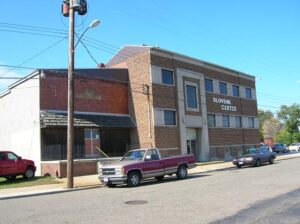
In 1918, early Slovene immigrants organized the Slovenian Independent Society Home and later constructed this hall, which became the center for Barberton Slovene cultural, social, and recreational activities. They formed dramatic and singing clubs, conducting performances in their native language. In the early twentieth century, prior to employers providing insurance or health care for their workers, the society acted to ensure sick and death benefits for its members. It also prepared members for citizenship in their newly chosen country. First generation Slovenes provided the labor that helped spur the growth of local industries while succeeding generations have continued to contribute to the community in various business, industrial, professional, and governmental capacities.
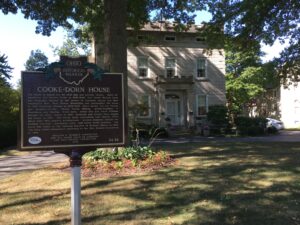
Eleutheros Cooke. The Cooke-Dorn house was the last home of attorney Eleutheros Cooke (1787-1864) who served four years in the Ohio legislature and one term in the 22nd Congress of the United States. An early proponent of railroads, Cooke received one of the first charters granted to a railroad west of the Alleghany Mountains, for the Mad River & Lake Erie line. He and wife Martha had six children, four of whom lived to adulthood. Two rose to prominence in the Civil War era. Jay was a successful banker and became known as the “financier of the Civil War” for his efforts to secure loans from Northern banks to support the Union’s war effort. Henry was appointed as the first governor of the short-lived Territory of the District of Columbia in 1871 (which was replaced in 1874).
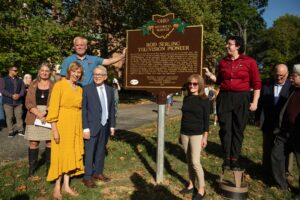
Rodman Edward Serling (1924-1975) enrolled at Antioch College in 1946 following military service in World War II. He began college as a physical education major, but soon discovered writing as a way of working through his war experiences. As a student, he contributed short fiction to The Antiochian literary magazine, managed the student-run Antioch Broadcasting System, and wrote and produced award-winning radio dramas. In July 1948, Serling married classmate Carolyn “Carol” Kramer. Shortly after earning his degree in 1950, he took a copy writer job at Cincinnati’s WLW radio. Serling quickly focused on selling scripts to national television networks. After eight years in Ohio, he and his wife moved to Connecticut. He returned to Antioch after the third season of The Twilight Zone to teach writing, drama, and media during the 1962-1963 academic year.
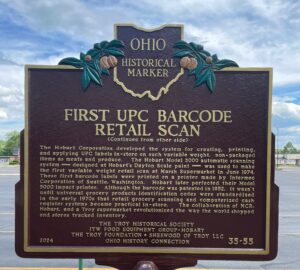
On June 26, 1974, the first retail scan of a product marked with a Universal Product Code (UPC or barcode) was made in the checkout line of Troy’s Marsh Supermarket located at 982 N. Market Street. A ten-pack of Wrigley’s Juicy Fruit chewing gum was scanned to simulate the purchase of a product. The barcode was scanned on the NCR 255 computerized check-out system developed by National Cash Register (NCR). The system featured a Spectra Physics Model A scanner and an NCR 726 in-store computerized cash register. The Troy grocery store, considered a “typical” American grocery, was conveniently located near NCR and Hobart facilities. Spectra Physics and NCR later donated one of the original scanners and cash registers used at Marsh’s to the National Museum of American History, Smithsonian. (Continued on other side)
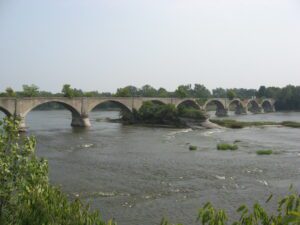
The Lima and Toledo Traction Company Bridge was construted in 1907 by the National Bridge Company of Indianapolis, and it was considered to be a revolutionary type of bridge construction. The Old Electric Bridge, as it was called, was built of steel reinforced concrete and filled with earth. In fact, for this period some considered the bridge to be the longest such railroad bridge in the world. Twelve spans of Roman aqueduct architectural design anchor the 1220-foot bridge in solid river bedrock. The bridge linked Lucas and Wood counties and connected a busy Toledo with points south by means of an electric trolley. This Interurban Bridge was placed on the National Register of Historic Places in 1972.
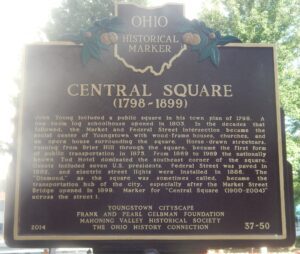
John Young included a public square in his town plan of 1798. A one-room log schoolhouse opened in 1803. In the decades that followed, the Market and Federal Street intersection became the social center of Youngstown with wood-frame houses, churches, and an opera house surrounding the square. Horse-drawn streetcars, running from Brier Hill through the square, became the first form of public transportation in 1875. From 1869 to 1969 the nationally known Tod Hotel dominated the southeast corner of the square. Guests included seven U.S. presidents. Federal Street was paved in 1882, and electric street lights were installed in 1886. The “Diamond,” as the square was sometimes called, became the transportation hub of the city, especially after the Market Street Bridge opened in 1899. Marker for “Central Square (1900-2004)” across the street.
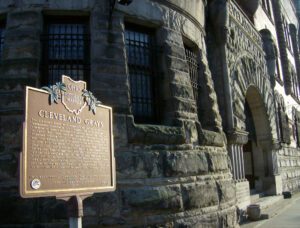
The Cleveland Grays were organized by statute in 1837 as an independent volunteer militia company. The Grays were the first company to leave Cleveland for service during the Civil War. In April 1861, they were designated Company E, 1st Ohio Volunteer Infantry (OVI). They saw action at Vienna Station and First Manassas and also served in the 84th OVI and were on duty with the 150th OVI at Fort Stephens when Confederate General Jubal Early attacked Washington in the summer of 1864. During the Spanish-American War the Grays volunteered for service and were admitted to the National Guard as the 1st Battalion of Engineers, 10th OVI. In 1916, they joined General John J. Pershing’s Punitive Expedition against Mexico. After service on the Mexican border, the Grays became part of the 1st Battalion, 148th Infantry Regiment, 37th “Buckeye” Division. (continued on other side)