

, OH
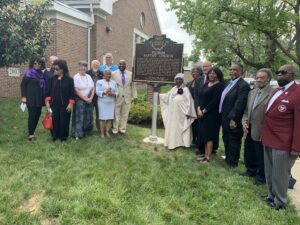
On January 9, 1919, a group of eight men and three women, being led by the Holy Spirit, met at a house on Wallace Street to form a new black Missionary Baptist Church in Hamilton, Ohio. The group quickly raised $150 to make the down payment on a two-story brick building at 333 Chestnut Street being sold for $1,850. The building was occupied on March 25, 1919, and the name Pilgrim Baptist Church was suggested and accepted. On May 11, 1919, a special council requested admittance into the Western Union Baptist Association, a district association now affiliated with the Ohio Baptist General Convention. Requirements for admission were met and Pilgrim Baptist Church was recognized as a Missionary Baptist Church. In 2019, Pilgrim Baptist Church celebrated a centennial of faithfulness in Hamilton.
, OH
The Lincoln School building stood at 2402 Central Avenue for almost a century. In 1919, a twenty-year bond levy provided for the construction of five schools, including the “new east school” Lincoln Elementary. Construction began in 1921 on the eight-acre site while students attended classes in temporary structures. Lincoln School opened in 1923 with 500 students enrolled. Lincoln Field, football grounds for McKinley High School’s “Middies,” stood behind Lincoln from 1930 until 1950 when Barnitz Field Stadium was built on South Main Street. Additions to the original Lincoln building included a maintenance annex in 1935 and a gymnasium in 1959. Lincoln School closed in November 1980 during a 1980-1981 Middletown City School District reorganization. Students from Lincoln and Sherman schools moved to the refurbished Roosevelt School at 2701 Central Avenue.
, OH
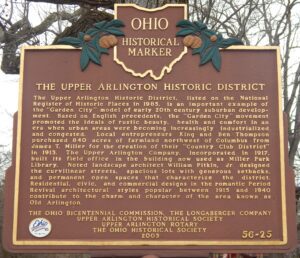
The Upper Arlington Historic District, listed on the National Register of Historic Places in 1985, is an important example of the “Garden City” model of early 20th century suburban development. Based on English precedents, the “Garden City” movement promoted the ideals of rustic beauty, health and comfort in an era when urban areas were becoming increasingly industrialized and congested. Local entrepreneurs King and Ben Thompson purchased 840 acres of farmland northwest of Columbus from James T. Miller for the creation of their “Country Club District” in 1913. The Upper Arlington Company, incorporated in 1917, built its field office in the building now used as Miller Park Library. Noted landscape architect William Pitkin, Jr. designed the curvilinear streets, spacious lots with generous setbacks, and permanent open spaces that characterize the district. Residential, civic, and commercial designs in the romantic Period Revival architectural styles popular between 1915 and 1940 contribute to the charm and character of the area known as Old Arlington.
, OH
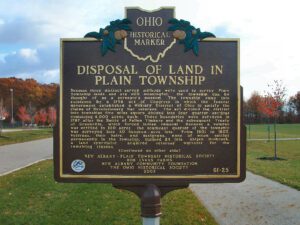
Because three distinct survey methods were used to survey Plain Township lands and are still meaningful, the township can be thought of as a surveyor’s museum. The township came into existence by a 1796 act of Congress in which the federal government established a Military District of Ohio to satisfy the claims of Revolutionary War veterans. The act divided the district into townships five miles square divided into four quarter-sections containing 4,000 acres each. These boundaries were surveyed in 1797 after the Battle of Fallen Timbers and the subsequent Treaty of Greenville, which forced Indian removal. Because a veteran was entitled to 100 acres, the southeast quarter of the township was surveyed into 40 hundred-acre lots. From 1801 to 1805, veterans, their heirs, and assignees, none of whom settled permanently in the township, claimed 24 lots. Abijah Holbrook, a land speculator, acquired veterans’ warrants for the remaining sixteen. (continued on other side)
, OH
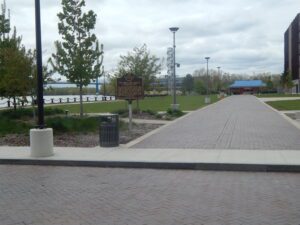
On the night of January 3, 1894, Toledo’s largest fire broke out in the massive King-Quale grain elevators. A westward wind from Maumee River drove flames toward the center of Toledo’s business district. The blaze destroyed several buildings including the Chamber of Commerce and the West and Truaz building. Despite the best efforts of city firefighters using horse-drawn steam pumpers, the fire continued until a serendipitous shift in the winds allowed the firefighters to contain the conflagration.
, OH
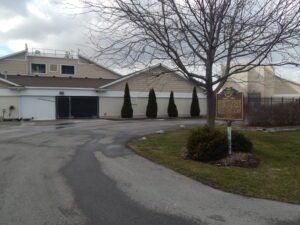
In 1931, the France Stone Company ceased operations. Robert Burge leased 19 acres of the site for recreational swimming and opened Centennial Quarry in 1934. Five years later, Burge and associates opened Centennial Terrace, whose centerpiece was “Dancing Under the Stars,” an outdoor, 10,000 square-foot Terrazzo dance floor. Centennial Terrace was a regular stop for many big bands of the 1940s and ’50s. In 1969, the complex was donated to Lucas County and local band leaders kept the people dancing from 1971 to 1993. In 1994, the City of Sylvania leased the facility and renovated and reopened the quarry. The Sylvania Area Joint Recreation District purchased the complex in 2007 and made further improvements to insure that Centennial Terrace and Quarry remains a popular recreation destination.
, OH
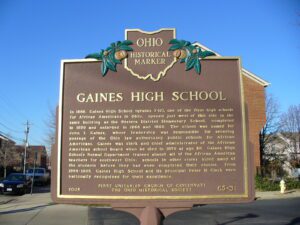
In 1866, Gaines High School (grades 7-12), one of the first high schools for African Americans in Ohio, opened just west of this site in the same building as the Western District Elementary School, completed in 1859 and enlarged in 1866 and 1868. The school was named for John I. Gaines, whose leadership was responsible for securing passage of the Ohio law authorizing public schools for African Americans. Gaines was clerk and chief administrator of the African American school board when he died in 1859 at age 38. Gaines High School’s Normal Department trained almost all of the African American teachers for southwest Ohio; schools in other states hired many of the students before they had even completed their studies. From 1866-1886, Gaines High School and its principal Peter H. Clark were nationally recognized for their excellence.
, OH
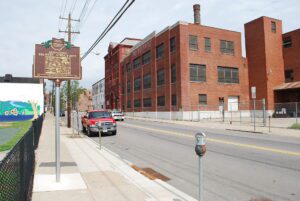
The Brewery District contains the majority of Cincinnati’s remaining breweries and associated structures such as icehouses, bottling buildings, offices, and stables. With the first brewery north of Liberty Street founded in1829, German immigrants fueled the growth of the brewing industry; by 1891, Cincinnati breweries produced over four barrels of beer per resident annually, almost twice as much as any other city in the nation. The brick breweries were typically designed in the Romanesque Revival style, and larger complexes often covered multiple city blocks. To produce the lager style beer common by 1860, typically very deep basements were dug or tunnels were cut into hillsides for the lagering process. At the height of production, 18 of the 36 breweries in greater Cincinnati were operating in Over-the-Rhine and the West End. Prohibition in 1919 closed most of the breweries permanently.