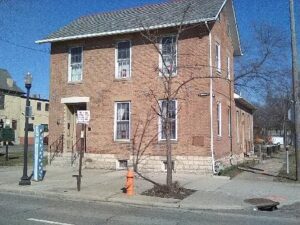
Thomas Jefferson was president when the original two-story Federal-style brick building was built in 1807. The house is located on the east half of in-lot 123, a part of Franklinton since its beginning. Surveyed by Nathanial Massie on October 28, 1796, the lot was part of Virginia Military District entry #1393, comprising 1,000 acres on the west fork of the Scioto River. Captain Robert Vance, a veteran of Virginia Continental Line during the Revolution, claimed the land. Lucas Sullivant, the founder of Franklinton, acquired it from Vance. The acreage was a part of the 1797 plat of Franklinton, recorded by Sullivant in 1802 at the Ross County Courthouse in Chillicothe. Franklinton became Franklin County’s first seat in 1803 and preceded the founding of Columbus by 15 years. In its early years, Franklinton’s nearest neighbors were the Wyndat and Haudenosaunee people. (Continued on other side)
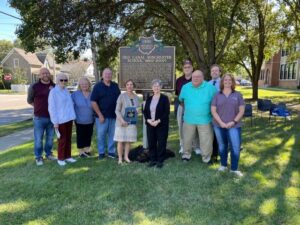
Over its 145 years, the Old Canal Winchester School building played a significant role in the community. The original four-room building opened in 1862 and its first high school class graduated seven in 1886. Canal Winchester’s growth is reflected in the school’s several additions, the first of which was in 1875. Other expansions include a separate high school building in 1909, a three-story connector in 1929 between the 1862 and the 1909 buildings, and elementary school wings in 1956 and 1967. The school was also the site of continuing education and vocational classes for adults in the 1930s and 1950s, agricultural programs for veterans after World War II, and a cannery from the time of that war to 1952. The school was added to the National Register of Historic Places in 2017 and it remains the district’s administrative center and a community gathering space.
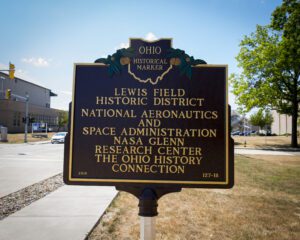
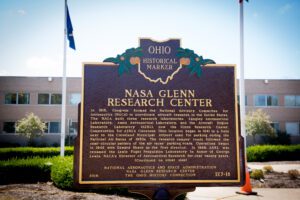
In 1915, Congress formed the National Advisory Committee for Aeronautics (NACA) to coordinate aircraft research in the United States. The NACA built three research laboratories: Langley Aeronautical Laboratory, Ames Aeronautical Laboratory, and the Aircraft Engine Research Laboratory (AERL), now the Glenn Research Center. Construction for AERL’s Cleveland, Ohio location began in 1941 in a field next to the Cleveland Municipal Airport used for parking during the National Air Races of the 1930s. The research campus’ roads followed the semi-circular pattern of the air races’ parking roads. Operations began in 1942 with Edward Sharp as the first director. In 1948, AERL was renamed the Lewis Flight Propulsion Laboratory in honor of George Lewis, NACA’s Director of Aeronautical Research for over twenty years.
Iuka Ravine, developed on land from the “Indianola Farm” that belonged to the Neil Family, is significant for its early 20th century architecture. The ravine’s natural beauty influenced architects to design homes for the upper middle class that incorporated “features of the old oak forest and glacial boulders.” Several ravine homes were designed by Frank Packard and Charles Inscho. Two classically-designed bridges built in 1912 insulated the area from traffic to create what became known during the 1920s-1950s as a “quiet professor enclave.” Iuka’s curvilinear street, one of the first in Columbus, as well as its stone walls, glacial erratics, and mature hardwoods created a “unique urban experience.” The Iuka Ravine Historic District was listed in The National Register of Historic Places in 1986 and added to the Columbus Register of Historic Properties in 1985.
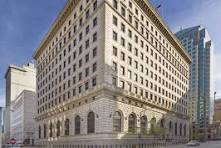
Cleveland was chosen as one of the country’s twelve Federal Reserve cities after a competitive selection process and opened its bank on November 16, 1914. The Federal Reserve Banks promote maximum employment and stable prices as part of the central banking system authorized by the 1913 Federal Reserve Act. Cleveland’s Bank serves the communities of the Fourth Federal Reserve District through supervision and regulation of financial institutions, analyzing and reporting on regional economic trends, and producing research on economic issues of importance to the nation and world. The first woman officer in any of the twelve banks was promoted to her role in 1956 by the Cleveland Fed. In 1982, the first woman in any of the nation’s Federal Reserve Banks served as the sixth President of the Federal Reserve Bank of Cleveland.
The building at 1380 E. 6th Street, designed by Walker and Weeks, served as the Cleveland Board of Education 1931-2013. During the 1950s and 1960s, the segregation of Cleveland Public Schools was the center of the city’s civil rights movement. Parents, like Daisy Craggett and Eddie Gill, protested relay classes and intact busing. The United Freedom Movement, a coalition of 50 civic, religious, and parent organizations, initiated demonstrations, sit-ins, and pickets, to galvanize the fight for education equality. On April 7, 1964, Reverend Bruce Klunder, vice president of Cleveland’s Congress of Racial Equality, was accidentally killed by a bulldozer at the future Stephen E. Howe Elementary School while he lay in a construction ditch to protest school re-segregation. His death ignited an April 20 boycott in which 85-95% of Cleveland’s Black students participated. (Continued on other side)