

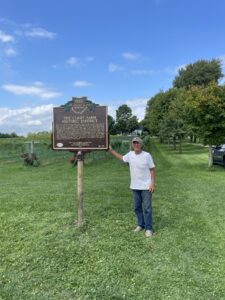
, OH
George Curry (1819-1885) was one of seven children born to a tenant sheepherder in the Cheviot Hills of Scotland. He immigrated to Ohio during the 1840s and married Scottish immigrant Agnes Milligan (1830-1893) in 1855. The couple moved to Licking County in 1865, and purchased 160-acres of farmland in 1873 to establish a sheep farm. They soon became known for their fine Spanish Merino herd. In the late nineteenth century, Ohio was a leader in the wool trade, with Licking County leading the state’s wool production by 1870. At the time of his death, George Curry was “a well-known stock dealer, and was greatly esteemed” in the community. Five generations of George and Agnes Curry’s family lived and farmed their Licking County land, until it was divided into parcels and sold in 1979.
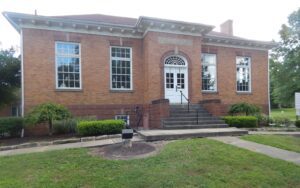
, OH
In 1912, an endowment of $6,000 from Andrew Carnegie made it possible for the Bristol Public Library to become a reality. Four years earlier, the newly organized Bristol Library Association, headed and promoted by retired Judge Norman A. Gilbert, had established a subscription book service at the Congregational Church in Bristolville with books loaned from the state library. The Bristol Board of Education appointed a six-member Library Board of Trustees and a one mill levy provided financial support. Charles C. Thayer and Son designed the building in accordance with Carnegie’s recommendations and the local trustees’ suggestions. With Judge Gilbert’s unexpected death in November 1911, Board Secretary Dr. Edward Brinkerhoff was elected president to complete the vision of Judge N. A. and Mrs. Anna Gilbert for the library. (Continued on other side)
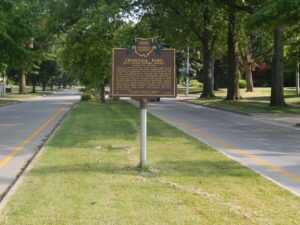
, OH
Crandall Park is the heart of the historic district and includes Fifth Avenue, Redondo Road, Catalina Avenue, and Tod Lane. Most of the district’s historic structures were built between 1904 and 1930, Youngstown’s heyday as an urban and industrial center. The district encompasses 92 houses, 32 outbuildings, a pavilion and rustic stone shelter in Crandall Park, and the concrete arch bridge carrying Fifth Avenue over the park. The North Heights Land Company and the Realty Guarantee Trust Company developed much of the neighborhood. Homes in the district were built for the city’s prominent industrialists and businessmen. The houses feature the work of architects Morris Scheibel, Charles F. Owsley, Fred Medicus, Barton Brooke, and Cook and Canfield and are distinguished by their grand scale, high-style design, spacious lots, landscaping, and orientation to the park or boulevard roads. (Continued on other side)
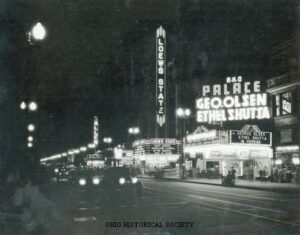
, OH
The Theater District, bound by Chester Avenue, Prospect Avenue, East 18th, East 9th and East 12th Streets, came into being at the turn of the 20th century, when Cleveland emerged as a thriving metropolis. Built between 1890-1928, the area hosted a variety of fine retail stores, theaters, prestigious clubs, restaurants, and distinct office buildings. The rise of television and flight to the suburbs sent downtown entertainment into a death spiral, until a 1970 grass roots effort saved from demolition the surviving post-World War I theaters (the State, Ohio, Hanna, Allen, and Palace), making it the “world’s largest theater restoration project.” It became a catalyst for reinvestment in downtown properties, restoring civic pride and giving testimonial to the creative vision of the city’s civic leaders and citizenry. By the year 2000, Cleveland’s Theater District boasted the nation’s 2nd largest performing arts center.
, OH
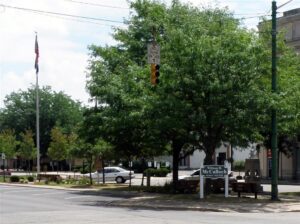
William McCulloch was born in Holmes County where he was educated in a one-room schoolhouse before moving to Wooster to attend high school and the College of Wooster. He attained prominence as Ohio’s Speaker of the House from 1939-1943 and House member from the Fourth Ohio Congressional District from 1948-1973. During his time in Washington, McCulloch was best known as a co-sponsor and staunch advocate of the Civil Rights Act of 1964. He was recognized by President Lyndon Johnson as the prime mover for passage of this landmark legislation. As a conservative Republican voice in the House, he was instrumental in championing other civil rights legislation, including fair housing and public accommodations. McCulloch was a founding partner in 1928 of the Piqua law firm that bears his name.
, OH
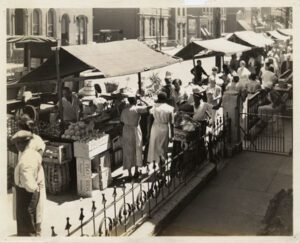
Public markets housing butchers, fish merchants, and produce vendors were once the primary source of perishable foods for residents of America’s cities. Cincinnati operated nine in 1859. Only Findlay Market, built here in 1852, survives. Cincinnati’s lost indoor markets include: Fifth Street Market: 1829 to 1870, Fifth between Vine and Walnut Wade Street Market: 1848 to 1898, corner of Wade and Bauer Avenue Canal Market: 1829 to 1864, Court between Vine and Walnut Court Street Market: 1864 to 1914, replaced Canal Market Jabez Elliott Flower Market: 1890 to 1950, Sixth between Elm and Plum Sixth Street Market: 1895 to 1960, Sixth between Plum and Western Row Pearl Street Market: 1901 to 1934, Market between Sycamore and Broadway
, OH
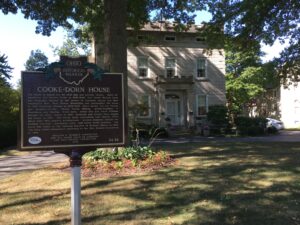
Eleutheros Cooke. The Cooke-Dorn house was the last home of attorney Eleutheros Cooke (1787-1864) who served four years in the Ohio legislature and one term in the 22nd Congress of the United States. An early proponent of railroads, Cooke received one of the first charters granted to a railroad west of the Alleghany Mountains, for the Mad River & Lake Erie line. He and wife Martha had six children, four of whom lived to adulthood. Two rose to prominence in the Civil War era. Jay was a successful banker and became known as the “financier of the Civil War” for his efforts to secure loans from Northern banks to support the Union’s war effort. Henry was appointed as the first governor of the short-lived Territory of the District of Columbia in 1871 (which was replaced in 1874).
, OH
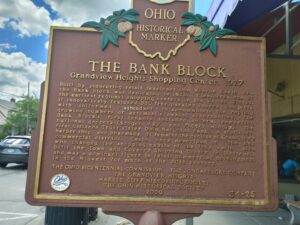
Built by pioneering retail developer Don Monroe Casto Sr., the Bank Block was dedicated in 1928. Considered one of the earliest regional shopping centers in the United States, it innovatively featured 350 free parking spaces-complete with uniformed attendant-to accommodate the rapidly growing numbers of automobile-owning suburbanites. The Bank Block’s first tenants included several competing national grocers (Kroger, A&P, and Piggly Wiggly), the First Citizens Trust (later Ohio National Bank), a stationer, barber shop, and pharmacy. It remains the nucleus of Grandview’s commercial district. Casto, once described as “the man who changed the shopping habits of the free world,” also built the Town and Country Shopping Center in Whitehall and was a dominant figure in retail commercial development in the Midwest for much of the 20th century.