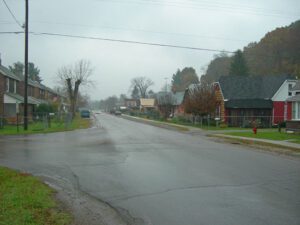
Originally known as Hocking Furnace, Haydenville was founded by and named for Columbus industrialist Peter Hayden (1806-1888), who energetically developed the coal, iron, sandstone, and fire clay deposits found in abundance in this area. Here he operated an iron furnace, coal mines and sandstone quarries, shipping products on the Hocking Canal and, later, the Hocking Valley Railroad he helped build. The incorporation of the Haydenville Mining and Manufacturing Company in 1882 initiated the manufacture of brick and ceramic tile from fire clay. Business boomed in the late 19th century as cities paved their streets with brick and fireproof construction became popular in the wake of widely publicized and tragic fires.
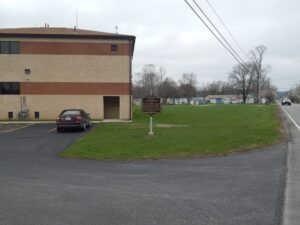
Massie’s Station, built in 1791, was the fourth permanent settlement center in Ohio and the last stockade settlement built in Ohio. It provided protection from the Indians for Manchester’s settlers until 1794. Manchester was the first settlement in the Virginia Military District and the site of the first court held in Adams County, September, 1797.
The SW corner of N Market Street and W Emmitt Street/US 23
Waverly
, OH
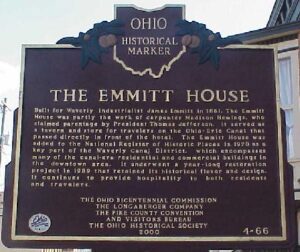
Built for Waverly industrialist James Emmitt in 1861, The Emmitt House was partly the work of carpenter Madison Hemings, who claimed parentage by President Thomas Jefferson. It served as a tavern and store for travelers on the Ohio-Erie Canal that passed directly in front of the hotel. The Emmitt House was added to the National Register of Historic Places in 1978 as a key part of the Waverly Canal District, which encompasses many of the canal-era residential and commercial buildings in the downtown area. It underwent a year-long restoration project in 1989 that retained its historical flavor and design. It continues to provide hospitality to both residents and travelers.
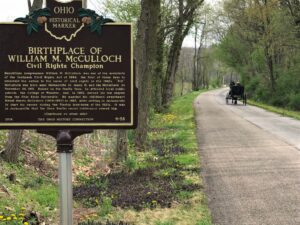
Republican congressman William M. McCulloch was one of the architects of the landmark Civil Rights Act of 1964, the first of three laws to recommit the nation to the cause of civil rights in the 1960s. “Bill” McCulloch was born near Holmesville to James H. and Ida McCulloch on November 24, 1901. Raised on the family farm, he attended local public schools, the College of Wooster, and, in 1925, earned his law degree from the Ohio State University. He married his childhood sweetheart Mabel Harris McCulloch (1904-1990) in 1927, after settling in Jacksonville to start his career during the Florida land-boom of the 1920s. It was in Jacksonville that the Deep South’s racial intolerance seared him. (Continued on other side)
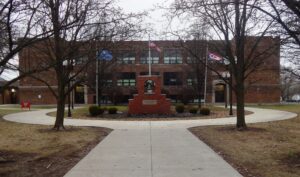
In 1893, Ohio and Indiana constructed the first Union School on the state line separating Ohio and Indiana. For 111 years, students from both states have been educated in what is the only schoolhouse located in Ohio and Indiana. In 1925, a new Union School was designed to replace the old schoolhouse. The dedication of this new school building took place on December 21, 1926. A new addition was added in 2004. The Union School Building has special architectural features such as a center stone placed on the Ohio and Indiana state line and Ohio and Indiana arched doorways. The bell from the 1893 Union School is displayed to the south side of the current school.
A native of New Boston, Vernal G. Riffe Jr. served the 92nd House District in the Ohio General Assembly from 1959 to 1994. As Speaker of the Ohio House of Representatives from 1974 through 1994, he served longer than any other speaker in the state’s history. Widely regarded as Ohio’s most influential legislator of the late 20th century, Riffe, a Democrat, built effective political alliances across party lines. A powerful advocate for southern Ohio, he was instrumental in the growth and expansion of Shawnee State University.
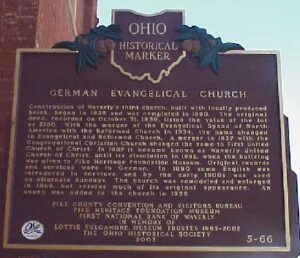
Construction of Waverly’s third church, built with locally produced brick, began in 1859 and was completed in 1860. The original deed, recorded on October 31, 1859, listed the value of the lot as $180. With the merger of the Evangelical Synod of North America with the Reformed Church in 1934, the name changed to Evangelical and Reformed Church. A merger in 1957 with the Congregational Christian Church changed the name to First United Church of Christ. In 1987 it became known as Waverly United Church of Christ, until its dissolution in 1992, when the building was given to Pike Heritage Foundation Museum. Original records and services were in German. In 1890 some English was introduced in services, and by the early 1900s was used on alternate Sundays. The church was remodeled and enlarged in 1869, but retains much of its original appearance. An annex was added to the church in 1959.
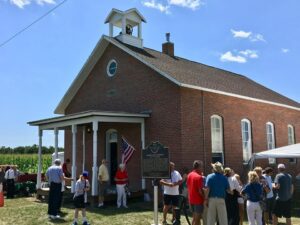
Bridenbaugh District No. 3 School. One-room schools were commonly named for people who furnished land for the building. Michael Bridenbaugh (1820-1895), who settled in Riley Township in 1835, and wife Jemima (1834-1903) sold a half-acre of land to the Riley Township school board in 1873. The first school on the site was a wooden structure, built in 1878. It was replaced by a brick building in 1889. The school operated until 1927, after which the district was consolidated. Students attended classes in nearby Pandora. (Continued on the other side)