

, OH
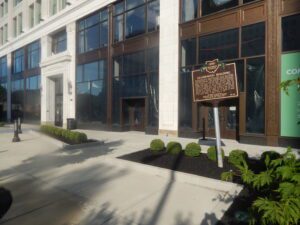
Steel-frame skyscrapers and retail buildings replaced wood-frame residences as the downtown evolved into a commercial district. A small public library branch occupied the north side of the square from 1923 to 1954. The Keith-Albee Theater (later the Palace) in the northeast corner of the square from 1926 to 1964, featured vaudeville performances and movies. Streetcar tracks around the square were removed for scrap during World War II. With expansion of suburban shopping malls, downtown theaters and department stores gradually closed. In 1973-74 Central Square was converted to a pedestrian Federal Plaza by closing off traffic on Federal Street one block east and west of Market Street. Central Square reopened in 2004 with a new traffic pattern, planting beds, and street furniture. Marker for “Central Square (1798-1899)” across the street.
, OH
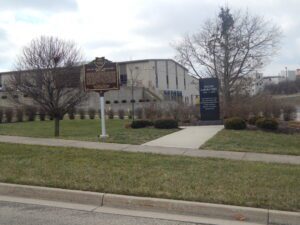
The facilities once here propelled the United States through the Nuclear and Space Ages and were named for the nearby pre-historic Miamisburg Mound. The Manhattan Engineer District of the War Department began construction of Mound Laboratory in 1946. The facility consolidated production of the nuclear-reaction initiators, developed for the United States’ first atomic bombs during World War II. Previously (1943-1946), the work to separate, purify, and process the element polonium used in these initiators occurred at facilities throughout the Dayton area. Mound Laboratory was the nation’s first permanent post-WWII Atomic Energy Commission site. Mound Laboratory had 116 buildings and at its peak employed approximately 2,500 scientists, engineers, and skilled workers. Contractors operating at the site were Monsanto (1947-1988), Edgerton, Germeshausen, and Grier (1988-1997), and Babcock and Wilcox (1997-2002). (Continued on other side)
, OH
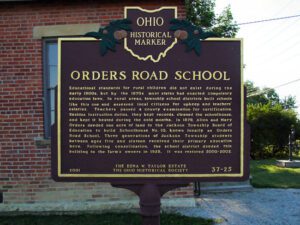
Educational standards for rural children did not exist during the early 1800s, but by the 1870s most states had enacted compulsory education laws. In rural areas, township school districts built schools like this one and assessed local citizens for upkeep and teacher’s salaries. Teachers passed a county examination for certification. Besides instruction duties, they kept records, cleaned the schoolhouse, and kept it heated during the cold months. In 1879, Allen and Mary Orders deeded one acre of land to the Jackson Township Board of Education to build Schoolhouse No. 10, known locally as Orders Road School. Three generations of Jackson Township students between ages five and sixteen received their primary education here. Following consolidation, the school district deeded this building to the farm’s owners in 1928. It was restored in 2000-2002.
, OH
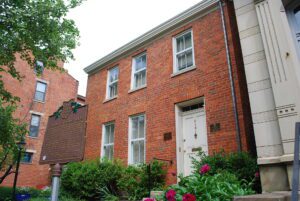
The oldest building in Cincinnati’s basin area, the Betts House exemplifies a national trend on the expanding frontier of impermanent log and frame structures giving way to more permanent brick architecture. It is the earliest surviving brick building in the city. During Cincinnati’s period of settlement in the early 1800s, the William and Phebe Betts family established a brickyard here that supplied building materials for the rapidly growing frontier city. The Betts House lends its name to the Betts-Longworth Historic District. Established in 1983, the district represents the last nineteenth century remnant of Cincinnati’s lower West End and surrounds the older Betts House with tall, narrow mid-and late-nineteenth century buildings. The Betts house is oriented to the cardinal directions, rather than to the city’s slightly skewed grid.
, OH
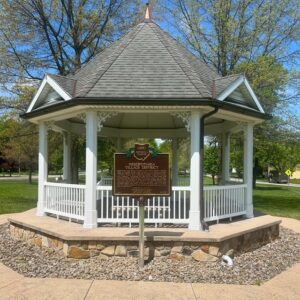
Mesopotamia Village District was listed in the National Register of Historic Places on December 24, 1974. Many consider it to be “the most unspoiled nineteenth century central green type of village in northeastern Ohio.” The district includes houses, commercial buildings, a town hall, churches, and a cemetery. Surrounding the 1600-foot-long public green these structures represent Greek Revival, Gothic Revival, Queen Anne, Italianate, and vernacular architectural styles constructed between 1820 and 1902. One of the oldest buildings in the district is the colonnaded Greek Revival commercial building at the southwest end of the green. Built in the 1820s for early resident Isaac Clark, it was operated as a store by F.C. Peck. Over the ensuing centuries it has served as a barber shop, post office, and an undertakers. (Continued on other side)
, OH
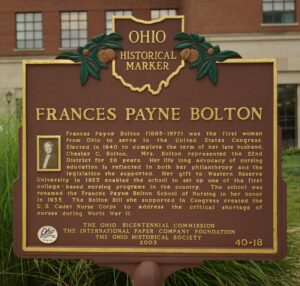
Frances Payne Bolton (1885-1977) was the first woman from Ohio to serve in the United States Congress. Elected in 1940 to complete the term of her late husband, Chester C. Bolton, Mrs. Bolton represented the 22nd District for 28 years. Her life long advocacy of nursing education is reflected in both her philanthropy and the legislation she supported. Her gift to Western Reserve University in 1923 enabled the school to set up one of the first college-based nursing programs in the country. The school was renamed the Frances Payne Bolton School of Nursing in her honor in 1935. The Bolton Bill she supported in Congress created the U.S. Cadet Nurse Corps to address the critical shortage of nurses during World War II.
, OH
Fout Hall was one of three original buildings on the Bonebrake Theological Seminary campus. Constructed 1920-1923, it was named for Dr. J. E. Fout, who managed campus construction. Bonebrake Seminary was founded in 1871 by Dayton’s United Brethren in Christ Church and became co-educational in 1873. Generous cash and land gifts (1909-1911) enabled the construction of a new campus. Fout Hall, the administration building, and a powerhouse were designed by Dayton architect Frederick J. Hughes in the Jacobethan Revival style. The three-story buff-brick dormitory was the largest of the buildings and cost $250,000. As well as dining hall, laundry, and storage facilities, it featured 12 single rooms, 54 two-room suites, and 6 three-room suites. Fout Hall was an integral part of the National Register listing of the Dayton View Triangle Historic District in 2022.
, OH
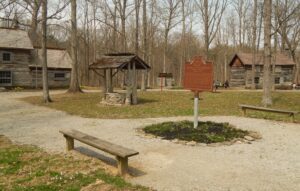
Edward Bebb, father of William Bebb and first Welshman to settle in Paddy’s Run, Morgan Township, Butler County purchased this cabin in 1801. Originally the cabin stood four miles southeast of this site on the Dry Fork of the Whitewater River. It was here that William Bebb was born on December 8, 1802, the first white child born in Butler County west of the Great Miami River. At the age of twenty, after attending district schools, William Bebb became a teacher. In 1826 he became the first teacher at Paddy’s Run School. Two years later Bebb and his wife opened a boarding school on his father’s farm. While teaching school he began the study of law and in 1831 passed the state bar examination. A year later he began to practice law in Hamilton, where he soon became an active politician. In 1840 he stumped the state for Harrison and Tyler and in 1846 he was nominated for Governor by the Whig party. He was elected on the slogan “Wm. Bebb and a Home Currency against David Tod and Pot Metal.” After his term as governor, Bebb served in a number of government positions until his retirement to his farm near Rockford, Illinois. He died on October 23, 1873.