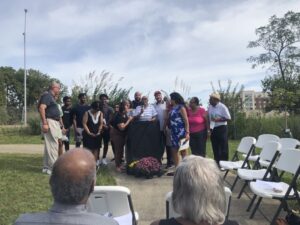
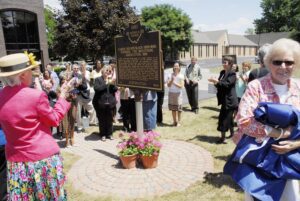
James W. Rankin served four consecutive terms (1971-1978) in the Ohio House of Representatives. Born and raised in Cincinnati, he graduated from Withrow High School and The Ohio State University’s School of Social Work. While working in Cincinnati’s Seven Hills neighborhood, he ran for office to “involve the disadvantaged in the governmental processes that affected their lives.” He won his first bid and served the next seven years as a state representative for the 69th House district, later the reapportioned 25th district. Representative Rankin fought passionately for civil and human rights in education and public policy. He served on the Reference, Human Resources, and Finance committees. When Rankin died of pneumonia, aged 52, the Cincinnati Enquirer proclaimed him a “Friend of the Poor.”
The Breathing Association was founded in 1906 as the Tuberculosis Society under the leadership of public health advocate Carrie Nelson Black. The society provided nutrition, medical care, and sanitorium services to people who could not afford proper medical care. A tuberculosis dispensary was operated at 40 South Third Street in Columbus for Ohioans needing consultation and treatment. Tuberculosis, known as the White Plague, killed one out of nine persons in Columbus during the early 1900s. An Open Air School was established on Neil Avenue in 1913 for children in homes where there were one or more cases of tuberculosis. In 1931, the Nightingale Cottage was opened on Brice Road as a tuberculosis preventorium for children. As tuberculosis became controllable, the agency became focused on emerging lung health issues. Today, The Breathing Association continues as a leading resource on lung health issues and preventing lung disease.
NE of the intersection of W Broad Street and Marconi Blvd, along the Scioto River
Columbus
, OH
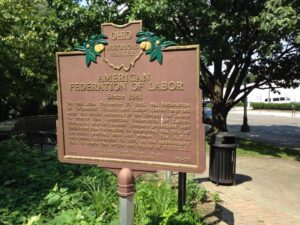
One this site, December 10, 1886, the Federation of Organized Trades and Labor Union merged with the trade unionists of the Knights of Labor to create the American Federation of Labor. Delegates elected Samuel Gompers president and dedicated the Federation to improving the life of America’s working men and women. The A.F.L. recognizes November 15, 1881, as its anniversary date to honor the origin and legacy of F.O.T.L.U.
Market Square, home to the Pearl Street Market, was located on the corner of Pearl and Lorain Streets (now West 25th St. and Lorain Ave.) in what was then known as the City of Ohio. The land that Market Square occupies was donated by local businessmen Josiah Barber and Richard Lord in 1840 for the public’s use. Farmers and food vendors gathered to sell their wares after a public market moved here in 1859. In 1868, an enclosed wood-framed Pearl Street Market building was erected.
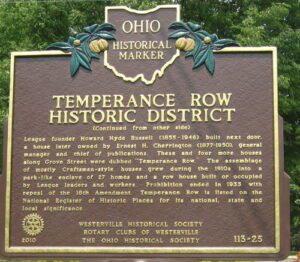
Here lived the reformers of the Anti-Saloon League of America who led the movement that turned the United States “dry” in 1920 with the 18th Amendment prohibiting the manufacture, sale or transportation of intoxicating liquor. Moving its headquarters to Westerville in 1909, the League built a publishing house that buried the liquor industry in a 10-year avalanche of books, pamphlets and periodicals that helped win Prohibition and made Westerville the “Dry Capital of the World.” Rev. Purley A. Baker (1858-1924), the League’s general superintendent, bought 11 acres and erected his rustic home at Park and Grove streets in 1910. (Continued other side)
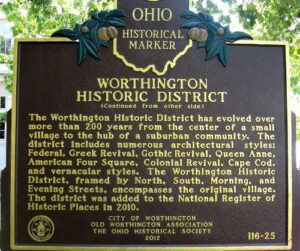
Worthington was founded in 1803 by the Scioto Company, settlers from Connecticut, and named after Thomas Worthington, a major proponent of Ohio statehood. The original plat included a 3-1/2 acre village green bounded on the east by 1-1/2 acre school and church lots. The green was surrounded by 160 residential and commercial lots, each measuring 3/4 of an acre. By 1812, Worthington was a finalist for designation as the capital of Ohio. (Continued on the other side.)
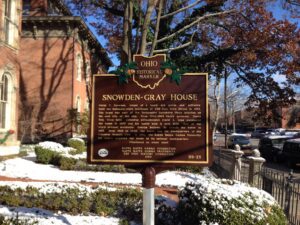
Philip T. Snowden, owner of a fancy dry goods and millinery, built the Italianate-style residence at 530 East Town Street in 1852. The house was part of the fashionable University Place addition on the east side of the city. From 1862-1864 Ohio’s governor, David Tod, lived here. Columbus philanthropist David S. Gray purchased the house in 1870 and his family held it until 1922. One of the city’s premier architects, George Bellows, Sr. rebuilt the house in 1872. From 1923 to 1940, the house was the headquarters of the Columbus Women’s Club. In 1951, the Kappa Kappa Gamma fraternity for women acquired the house as its national headquarters. (Continued on other side)
Near the Intersection of W Rich Street and W. Main Street
Columbus
, OH
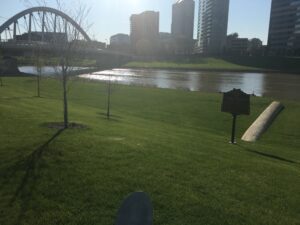
The historic district extends from the former Main Street Bridge to Long Street and encompasses the public buildings on either side of the Scioto River. The 580 foot long low-head concrete arch Main Street Dam was constructed in 1918 in response to the catastrophic 1913 flood. The dam helped reshape the Downtown Columbus Scioto River basin into a reflecting pool for the monumental riverfront buildings of teh Civic Center, which were influenced by the City Beautiful movement of the 1890s and early 1900s. Nearly a century after its construction, however, the dam had contributed to an unhealthy environment for aquatic life and was removed in late 2013 as part of teh Scioto Greenways river restoration project.