

, OH
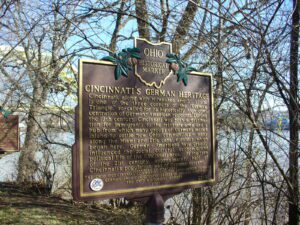
Cincinnati, along with Milwaukee and St. Louis, is one of the three corners of the “German Triangle,” so-called for its historically high concentration of German-American residents. During the 19th century, Cincinnati was both a destination for immigrants to the tri-state area and a hub from which many groups of Germans moved inland to settle new Ohio communities-many along the Miami and Erie canal corridor which began here. German-Americans have greatly influenced the social, cultural, economic and political life of the Cincinnati area. At the turn of the 21st century, approximately half of Cincinnati’s population was of German descent. (Continued on other side)
, OH
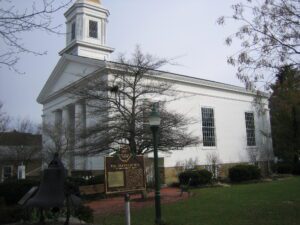
In 1804 a group of neighbors in Granville, Massachusetts and Granby, Connecticut formed The Licking Company for the purpose of moving to “Newlands” in Ohio. Inspired and informed by the settlement of Worthington in 1803, the Company purchased 29,040 acres in the U.S. Military District. Advance parties surveyed and mapped a site, established a mill, and planted grain. The Company planned a public square, a school, library, quarry, burying ground, and property for the support of churches. In November and December 1805, some 150 emigrants in ox-drawn wagons arrived in their new home and built temporary shelters on the designated public square. On December 9 through 12 1805, Company members selected their Granville lots in an auction that was described as peaceable and honest.
, OH
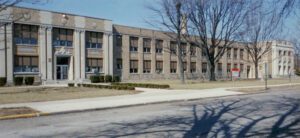
The North Baltimore Elementary and High School stood at 124 S. Second St. and was dedicated November 11, 1927. The tan and brown brick building replaced a school (built 1884) that a fire destroyed on January 26, 1926. The new school building, for children in grades 1-12, also included classrooms for home economics and business courses, as well as a 900-seat auditorium (including balcony), second floor cafeteria, gymnasium, administrative offices, and a public library. E.E. Leidy was the school’s superintendent and R. Vern Northup was the high school principal. The members of the board of education were Dr. E.A. Powell, President, D.B. Bushey, Vice President, C.G. Nigh, Clerk, and Nellie Roberts and R.E. Simon. Previously known as the “Independents,” the school’s sports teams became the “Tigers” in 1931. (Continued on other side)
, OH
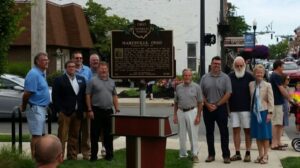
Marysville, Ohio. On August 10, 1819, Samuel W. Culbertson (1780-1840), a Zanesville lawyer, established Marysville at the convergence of Mill Creek and the road connecting Delaware to Urbana. Culbertson purchased 450 acres of land on July 10, 1817 and authorized Charles Roberts to survey the village, which originally contained 96 lots. Culbertson named the village in honor of his daughter, Mary Ellen (1810-1853), who later married US Congressman, Joshua Mathiot (1800-1849). The village was originally in Delaware County, located in part of the Virginia Military District. It was land given as bounties to soldiers from Virginia after the Revolutionary War. Union County, which included Marysville, was created in 1820, and Marysville became the county seat in 1822. (Continued on other side)
, OH
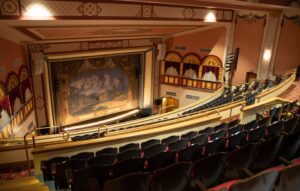
The Peoples Bank Theatre, built in 1919 and called the Hippodrome, marks an age when movies transitioned from silent films and nickelodeons into a major national industry and pastime. Designed by Columbus architect Fred Elliott for the C&M (Cambridge and Marietta) Amusement Company, the theatre featured a granite archway, 1,200 seats, a 35-by-55-foot stage, an orchestra pit, and the first air conditioning of its kind in Marietta. The Hippodrome opened May 9, 1919 with the silent film Daddy Long Legs, starring Mary Pickford. Shea Theatres of New York bought the Hippodrome and remodeled it in 1949, replacing the Hippodrome’s distinctive stone archway with a two-story southern colonial-style facade. Renamed the “Colony,” it opened June 25, 1949, showing the Esther Williams’ musical Neptune’s Daughter. (Continued on other side)
, OH
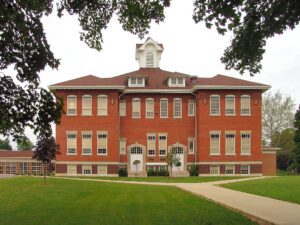
The first school in what is now Pataskala was a “subscription school” operated by Amariah Cubberly on the nearby banks of the South Fork of the Licking River in the 1820s. Subscription schools, which charged fees, were the forerunners of rural public schools in many parts of Ohio. By the 1830s several one-room public schools served the children of the area, but in 1870 the civic minded citizens of Pataskala provided a centralized building for grades one through twelve on Main Street, where the old Town Hall now stands. This school was moved to the new building on this site in 1908. When the Southwest Licking Local School District was established in 1953, Pataskala Elementary School continued in the building. Additions in 1968 and 2000 enhanced its educational capabilities. This 1908 Queen Anne architectural style building was listed on the National Register of Historical Places in 1983.
, OH
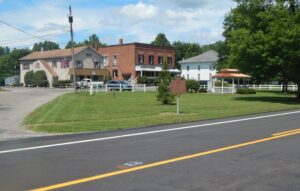
Originally called Westfield Township, Samuel Fowler purchased this area in 1798 from the Connecticut Land Company for $12,903.23 while living in Westfield, Massachusetts. His brother Abner arrived the following year to survey the land and separate it into smaller plots that could be sold to people wanting to settle here. A Revolutionary War veteran, Abner was the first to arrive here and also the first recorded death in 1806, the same year that his son Abner Fowler II married the first school teacher in Fowler Ester Jennings. In 1817, Samuel Fowler gave five acres of land to Fowler Center to be used as a park or “common” with the provision that no permanent building ever be built on it. At about the same time, the township name was changed to Fowler to honor its founding family. Agriculture was and remains the main occupation in the Fowler area.
, OH
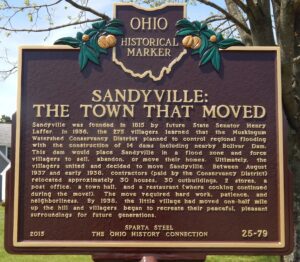
Sandyville was founded in 1815 by future State Senator Henry Laffer. In 1936, the 275 villagers learned that the Muskingum Watershed Conservancy District planned to control regional flooding with the construction of 14 dams including nearby Bolivar Dam. This dam would place Sandyville in a flood zone and force villagers to sell, abandon, or move their homes. Ultimately, the villagers united and decided to move Sandyville. Between August 1937 and early 1938, contractors (paid by the Conservancy District) relocated approximately 30 houses, 30 outbuildings, 2 stores, a post office, a town hall, and a restaurant (where cooking continued during the move!). The move required hard work, patience, and neighborliness, By 1938, the little village had moved one-half mile up the hill and villagers began to recreate their peaceful, pleasant surroundings for future generations.