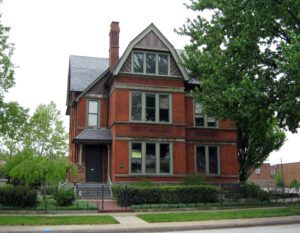
The Sarah Benedict House is a rare survivor of the once fashionable Upper Prospect neighborhood that included “Millionaires Row” on adjacent Euclid Avenue. Sarah Rathbone Benedict had this Queen Anne-inspired house built in 1883, when she was 68, and lived here until her death in 1902. She was active in the social, religious, and charitable life of Cleveland. Sarah Benedict was the widow of George A. Benedict, editor of the Cleveland Daily Herald. The house was given to the Cleveland Restoration Society by Dr. Maxine Goodman Levin in 1997 and rehabilitated for its headquarters in 1998. It is listed in the National Register of Historic Places and contributes to the locally designated Prospect Avenue Historic District.
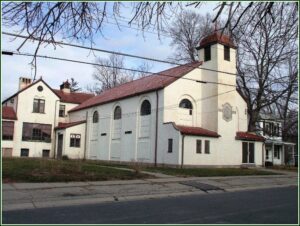
Eckstein Elementary School operated on this site from 1915 to 1958, serving Glendale’s Negro children from Kindergarten through eighth grade. The school was named in honor of Eleanor Eckstein, who taught the children at various locations in the village during the time of segregation in America. Upon completing eighth grade, Eckstein School’s students were integrated with their white counterparts in grades nine through twelve at Congress Avenue School. The Eckstein School building evolved from a single family dwelling into its present structure through a series of expansions, the last of which was the addition of the gymnasium in 1928. In the mid-1950s Glendale became a part of the Princeton School District. A new consolidated high school opened in 1958, the Congress Avenue School became Glendale Elementary, and Eckstein was closed. This commemorative text was composed by alumni of the Eckstein School.
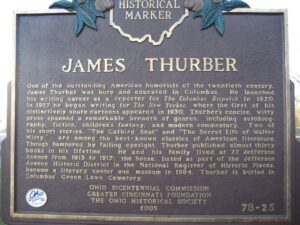
One of the outstanding American humorists of the twentieth century, James Thurber was born and educated in Columbus. He launched his writing career as a reporter for The Columbus Dispatch in 1920. In 1927 he began writing for The New Yorker, where the first of his distinctively spare cartoons appeared in 1930. Thurber’s concise, witty prose spanned a remarkable breadth of genres, including autobiography, fiction, children’s fantasy, and modern commentary. Two of his short stories, “The Catbird Seat” and “The Secret Life of Walter Mitty,” are among the best-known classics of American literature. Though hampered by failing eyesight, Thurber published almost thirty books in his lifetime. He and his family lived at 77 Jefferson Avenue from 1913 to 1917; the house, listed as part of the Jefferson Avenue Historic District in the National Register of Historic Places, became a literary center and museum in 1984. Thurber is buried in Columbus’ Green Lawn Cemetery.
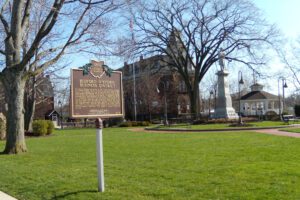
The town of Bedford was settled in 1837. Early residents, Hezekiah and Clarissa Dunham donated the land that serves as Bedford Public Square. The Dunhams built one of the area’s first homes in 1832, which stands at 729 Broadway with the letters H & D above the doorway. Early settlers were attracted to the area by the abundance of natural resources and a large waterfall for mill sites. Bedford also served as a stagecoach stop on the route from Cleveland to Pittsburgh. The road or Turnpike Road as it was called was originally part of the Mahoning Indian Trail. By 1895 the road was renamed Main Street (and later Broadway) when the Akron, Bedford, and Cleveland Railway Company (ABC) traversed the middle of the street carrying passengers. The interurban is called “America’s first high speed long distance electric interurban” with speeds in excess of 60 miles per hour. [continued on other side]
Sisters of Notre Dame de Namur, 701 East Columbia Avenue
Reading
, OH
The Sisters of Notre Dame de Namur were founded in 1804 by Saint Julie Billiart to spread the message “Ah, how good it is to serve God.” In 1840, at the request of Bishop John B. Purcell in 1840, the Sisters travelled to Cincinnati, Ohio to help educate the city’s growing Catholic population. Choosing to serve the poor, the Sisters turned down land in Brown County and instead founded schools at Sixth Street in Cincinnati. Since the start of the 21st century, the Sisters serve in twenty-seven other states, the District of Columbia, and in South America, Europe, Africa and Asia. Sister Dorothy Stang, while working for land reforms for the poor in Brazil, was martyred in 2004.
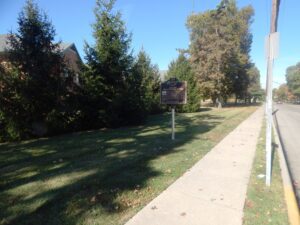
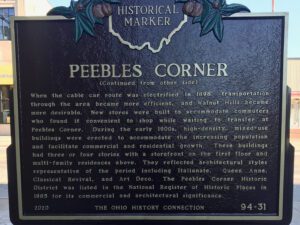
When the cable car route was electrified in 1898, transportation through the area became more efficient, and Walnut Hills became more desirable. New stores were built to accommodate commuters who found it convenient to shop while waiting to transfer at Peebles Corner. During the early 1900s, high-density, mixed-use buildings were erected to accommodate the increasing population and facilitate commercial and residential growth. These buildings had three or four stories with a storefront on the first floor and multi-family residences above. They reflected architectural styles representative of the period including Italianate, Queen Anne, Classical Revival, and Art Deco. The Peebles Corner Historic District was listed in the National Register of Historic Places in 1985 for its commercial and architectural significance.
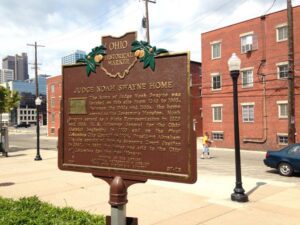
The first tax supported free public library in Columbus was formed in 1873 and housed in City Hall. In 1901, City Librarian John Pugh petitioned Andrew Carnegie for funding and was granted $200,000. In 1903, the Swayne home was razed and construction began. The library opened to the public on April 4, 1907. The library’s purpose is inscribed on the front of the building – Bibliotheca Fons Eruditionis: The library is a fountain of learning; Our Treasures Are Within; and Open To All.
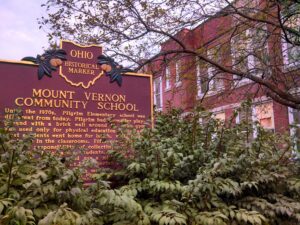
Pilgrim Elementary School, now East Pilgrim, was the community school for the Mount Vernon area and was a focal point for community activities. The Parent Teacher Association was active with members of the community and the school was used as a meeting place. The 1977 Ohio Supreme Court case of Penick v. The Columbus School Board ended the segregation of schools in Columbus. Students from Pilgrim were bussed to other schools in the district.