

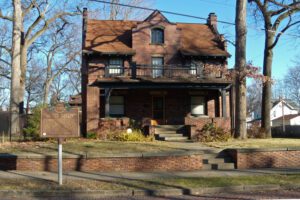
, OH
Akron, an industrial boomtown in the early twentieth century, grew in population nearly fivefold between 1900 and 1920. As the city industrialized, middle class residents sought homes on West Hill, away from the smoke and soot of heavy industry on the East Side. The Hall Park Allotment Historic District in West Hill represents a notable early twentieth century neighborhood. Developed by Philander Hall between 1902 and 1919 during the height of Akron’s “rubber boom,” it consists of several houses representing the picturesque styles of the period, including the American Foursquare, Craftsman, Colonial, and Medieval Revival Styles. With its gently curving brick streets, hilly topography, and mature trees, the Hall Park Allotment Historic District evokes the feeling of a distinct period of time in Akron’s history and constitutes a neighborhood of distinctive historical character and architectural merit.
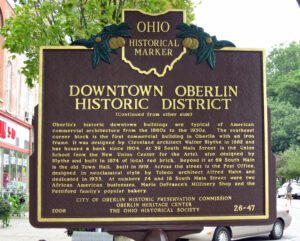
, OH
The intersection of Main and College streets has been the center of Oberlin since the town and college were founded in 1833. The first downtown buildings were made of wood and were destroyed by a series of spectacular fires. The first college building, Oberlin Hall, stood on the southwest corner of College and Main and included recitation rooms, a dining hall, chapel, offices, and lodging. In 1887, Akron architect Frank Weary designed the large brick building at numbers 5 to 13 West College. Number 23 West College (Gibson Block) once housed a silent movie theater on the second floor. East College Street’s historic buildings include the Apollo Theater, which showed Oberlin’s first talking movie on May 11, 1928. From 1897 to 1929, an interurban streetcar line connected Oberlin’s downtown to Cleveland. Oberlin’s downtown historic district was placed on the National Register of Historic Places in 2003.
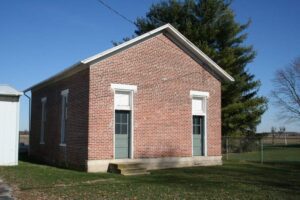
, OH
Elizabeth Township was founded in 1807. The Elizabeth Township House was built about 1870, serving as the community’s assembly hall. The building is similar to the seven remaining one-room, brick schoolhouses, built throughout the township between 1868 and 1873. In 1997, the township was added to the National Register of Historic Places as Ohio’s first rural historic district. The district includes all of Elizabeth Township and parts of Staunton and Bethel townships. This marker erected to commemorate the 200th anniversary of the township’s founding.
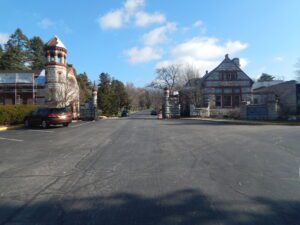
, OH
Founded in 1841, Woodland is one of the nation’s oldest rural garden cemeteries, the style of which was a dramatic departure from traditional church burial grounds at the time. Woodland’s oldest portion, including Victorian Era burial sections, a Romanesque gateway, and a Tiffany chapel, forms a district listed on the National Register of Historic Places. The Arboretum, with over 3,000 trees on more than 200 acres, completes this outdoor museum of Dayton history. Among those buried here are cemetery founder John Van Cleve, the Wright Brothers, inventors John Patterson and Charles Kettering, poet Paul Laurence Dunbar, Col. Edward Deeds, Governor James M. Cox, and humorist Erma Bombeck.
, OH
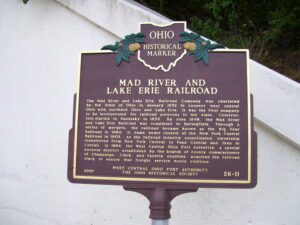
The Mad River and Lake Erie Railroad Company was chartered by the State of Ohio in January 1832 to connect west central Ohio with northern Ohio and Lake Erie. It was the first company to be incorporated for railroad purposes in the state. Construction started in Sandusky in 1835. By June 1849, the Mad River and Lake Erie Railroad was completed to Springfield. Through a series of mergers, the railroad became known as the Big Four Railroad in 1890. It came under control of the New York Central Railroad in 1905. As the railroad industry consolidated, ownership transferred from New York Central to Penn Central and then to Conrail. In 1994, the West Central Ohio Port Authority, a special purpose district established by the boards of county commissioners of Champaign, Clark, and Fayette counties, acquired the railroad track to ensure that freight service would continue.
, OH
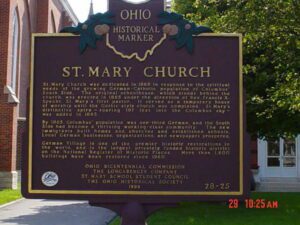
St. Mary Church was dedicated in 1868 in response to the spiritual needs of the growing German-Catholic population of Columbus’ South Side. The original schoolhouse, which stands behind the church, was erected in 1865 under the direction of Rev. Francis X. Specht, St. Mary’s first pastor. It served as a temporary house of worship until the Gothic-style church was completed. St. Mary’s distinctive spire – soaring 197 feet into the Columbus sky – was added in 1893. By 1865, Columbus’ population was one-third German, and the South Side had become a thriving working-class community. The new immigrants built homes and churches and established schools. Local German businesses, organizations, and newspapers prospered. German Village is one of the premier historic restorations in the world, and is the largest privately funded historic district on the National Register of Historic Places. More than 1,600 buildings have been restored since 1960.
, OH
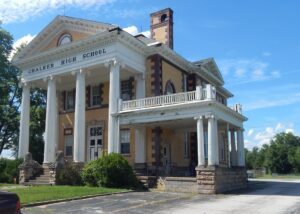
Southington native Newton Chalker built, furnished, and donated Chalker High School to his community in 1907. Chalker was born in 1842 in Southington Township and lived there until adulthood. He later built a prosperous law and real estate practice in Akron. Chalker’s dedication to improve educational opportunities in the township likely originated with his personal struggle to complete high school, which was repeatedly interrupted by financial concerns and family obligations. The Chalker High School building was designed in the Neo-Classical Revival architectural style which was favored for public buildings, churches and schools early in the twentieth century. The building exhibits Classical influences through the use of fluted columns that support a pedimented gable, resembling a Greek temple. Chalker High School and the Civil War Monument were listed in the National Register of Historic Places in 2010. (Continued on other side)
, OH
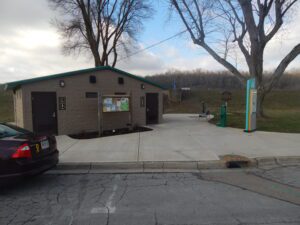
In late March 1913, a series of three severe rainstorms inundated the already saturated and frozen ground of the Miami Valley, causing one of Ohio’s greatest natural disasters, the Flood of 1913. On March 25, the Great Miami River overflowed its banks at Miamisburg, fed by runoff from Bear and Sycamore creeks. Homes, businesses, and the bridges at Linden Avenue and Sycamore Street were swept away or wrecked by floodwaters reaching as high as eleven feet on Main and First streets. Early reports indicated that six people in the area died. Cleanup and recovery efforts took approximately a year. (Continued on other side)