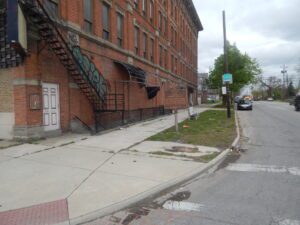
The pioneer village of Vistula is now bounded by Walnut, Champlain, Chestnut, Magnolia, and Summit streets. Established in 1833 by Benjamin F. Stickney and Edward Bissell, Vistula was merged with its rival, Port Lawrence, and in 1837 both villages were incorporated as Toledo. The Vistula Historic District, Toledo’s oldest neighborhood, was listed on the National Register of Historic Places in 1978.
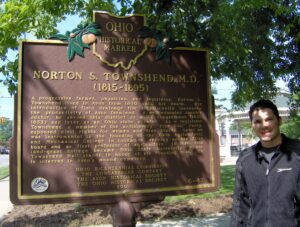
A progressive farmer, physician, and legislator, Norton S. Townshend lived in Avon from 1830 until his death. His introduction of field drainage tile significantly increased the productivity of Avon farmland. A well-educated country doctor, he served this district as a U.S. congressman (1851-1853) and later as an Ohio state senator. As a legislator Townshend, a member of the antislavery “Free Soil” Party, espoused civil rights for women and free blacks. Later he was instrumental in the founding of the Ohio Agricultural and Mechanical College in Columbus, serving on the first board and as its first professor of agriculture. In 1878, this land-grant college became Ohio State University, where Townshend Hall stands in honor of his founding role. He is interred in Avon’s mound cemetery.
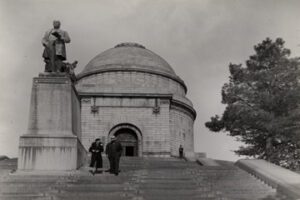
William McKinley served the nation as president, the people of Ohio as governor, and the citizens of his congressional district as a representative. McKinley was shot by an assassin in Buffalo, New York, in September 1901 and died several days later. The McKinley National Memorial, funded by children’s donations, was dedicated in 1907. It is the burial site of the 25th President, First Lady Ida Saxton McKinley, and two daughters. Designed by architect Harold Van Buren Magonigle, the pink Milford granite structure was designated a National Historic Landmark in 1975.
Steubenville Marina, along the Ohio River N of the US 22 bridge
Steubenville
, OH
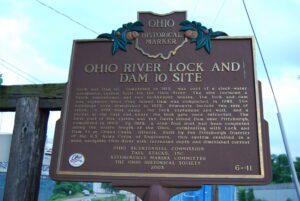
Lock and Dam 10, completed in 1915, was part of a slack-water navigation system built for the Ohio River. The site included a brick powerhouse and two lockkeeper houses. The lock and dam was replaced when Pike Island Dam was completed in 1965. The buildings were demolished in 1975. Remnants include two sets of steps, a 600-foot ramp, the lock esplanade and wall, and a recess at the east end where the lock gate once retracted. The first part of this system was the Davis Island Dam near Pittsburgh, completed in 1885. By 1929, a nine-foot pool had been completed along the entire length of the Ohio, culminating with Lock and Dam 53 at Grand Chain, Illinois. Built by the Pittsburgh District of the U. S. Army Corps of Engineers, this system resulted in a more navigable Ohio River with increased depth and diminished current.
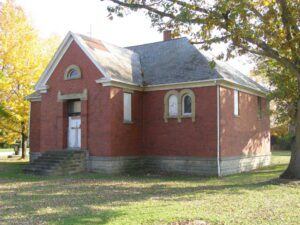
This Little Red Schoolhouse served children from Berea, Brookpark, and Middleburg township. The first mayor and council of Middleburgh Heights were elected here. During its colorful history, the schoolhouse has been a City Hall where town meetings were held, a speak-easy, a railroad way station, and a private residence.
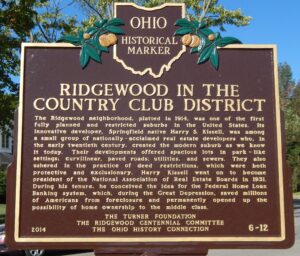
The Ridgewood neighborhood, platted in 1914, was one of the first fully planned and restricted suburbs in the United States. Its innovative developer, Springfield native Harry S. Kissell, was among a small group of nationally-acclaimed real estate developers who, in the early twentieth century, created the modern suburb as we know it today. Their developments offered spacious lots in park-like settings; curvilinear, paved roads; utilities, and sewers. They also ushered in the practice of deed restrictions, which were both protective and exclusionary. Harry Kissell went on to become president of the National Association of Real Estate Boards in 1931. During his tenure, he conceived the idea for the Federal Home Loan Banking system, which, during the Great Depression, saved millioins of Americans from foreclosure and permanently opened up the possibility of home ownership to the middle class.
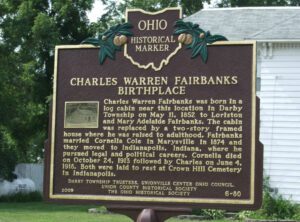
Charles Warren Fairbanks was born in a log cabin near this location in Darby Township on May 11, 1852 to Loriston and Mary Adelaide Fairbanks. The cabin was replaced by a two-story framed house where he was raised to adulthood. Fairbanks married Cornelia Cole in Marysville in 1874 and they moved to Indianapolis, Indiana, where he pursued legal and political careers. Cornelia died on October 24, 1913 followed by Charles on June 4, 1918. Both were laid to rest at Crown Hill Cemetery in Indianapolis.
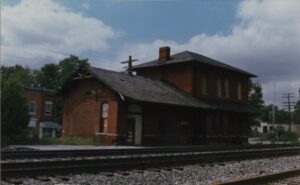
By the mid 1830s, Ohio had developed a canal system that linked Lake Erie in the north to the Ohio River in the south. Despite the success of the canals, transportation companies searched for other methods to traverse the state. They found their answer in the railroad industry, which proved to be much faster, cheaper, and more reliable than canals. Located on Lake Erie, Sandusky, Ohio was a major trading depot in the area. Plans were made to connect Sandusky to Cincinnati’s port on the Ohio River. On September 4, 1835, construction began in Sandusky on the Mad River and Lake Erie Railroad line, forming the first railroad line located entirely in Ohio. The railroad reached Tiffin by 1841 and Springfield by 1848, where it merged with the Little Miami Railroad line, connecting Lake Erie to the Ohio River.