

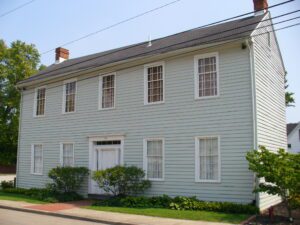
, OH
First Lady Lucy Ware Webb Hayes was born in this four-room Federal Vernacular house in 1831. Well educated for her time, she attended local schools, took classes in the preparatory department of Ohio Wesleyan University in Delaware, and graduated from Wesleyan Female College in Cincinnati in 1850. She married lawyer and future U.S. President Rutherford B. Hayes in 1852. They raised five children to adulthood. As a colonel’s wife during the Civil War, “Mother Lucy” boosted morale for the soldiers of the 23rd Ohio Volunteer Infantry regiment. In 1870, during Hayes’ first term as governor of Ohio, Lucy helped establish the Ohio Soldiers’ and Sailors’ Orphans’ Home as a state institution. (continued on other side)
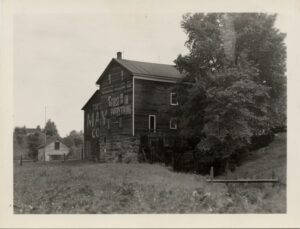
, OH
Fowlers Mill (originally Fowler’s Mills) developed around a group of mills built in the 1830s on the Chagrin River. Opportunities from these mills led to Fowlers Mill becoming the commercial center of Munson Township. From the 1830s into the twentieth century, the community expanded with construction of churches, a post office, township hall, stores, hotel, blacksmith shop, schools, and houses built in such styles as Federal, Greek Revival, Italianate, and Queen Anne. This type of community center was common in rural, nineteenth century America, but rarely survives with so much original fabric intact. On Mayfield Road, the Disciple Church was built in 1842. East of the church, the brick central school built in 1913 replaced earlier one-room schoolhouses. The gristmill is the only mill standing in Geauga County. The cemetery contains burials dating from the 1830s. The Fowler’s Mills Historic District was placed on the National Register of Historic Places in 2002.
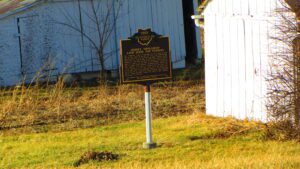
, OH
John “Appleseed” Chapman (b. September 26, 1774—d. March 18, 1845) was the first lessee of this 160 acre tract (NW 1/4, S 20, T 20, R 16), when he secured it for 99 years from the Virginia Military District School Lands on April 10, 1815. This $320 lease complied with the Ordinance of 1785 which stipulated that proceeds from the sale or lease of a 36th of all new land in the Northwest Territory be used to support public education. Perrysville author, Rosella Rice, knew Appleseed. In a history of Ashland County, she wrote, “One of his nurseries is near us and I often go to the secluded spot on the quiet banks of the creek [Blackfork]…with sod never broken since the old man did it.” Attributed as Green Township’s first permanent settler, Abram Baughman’s original 160 acres (c. 1807) adjoined this property to the west.
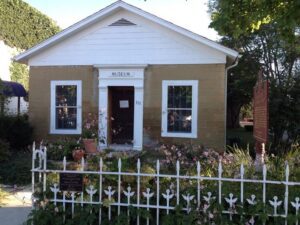
, OH
Built by William Stedman in 1816 of local stone, this building served as the Bank of the Alexandrian Society, which printed its own currency. The bank failed in 1817 and 1837. This building has also been used as a store, post office, and interurban railway depot. It was enlarged and opened as a museum during Granville’s Sesquicentennial Celebration in 1955, and was listed on the National Register of Historic Places as part of the Granville Historic District in 1980.
, OH
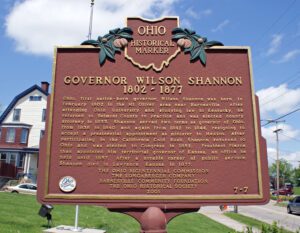
Ohio, first native-born governor, Wilson Shannon was born in February 1802 in the Mt. Olivet area near Barnesville. After attending Ohio University and studying law in Kentucky, he returned to Belmont County to practice and was elected county attorney in 1833. Shannon served two terms as governor of Ohio, from 1838 to 1840 and again from 1842 to 1844, resigning to accept a presidential appointment as minister to Mexico. After participating in the California Gold Rush, Shannon returned to Ohio and was elected to Congress in 1852. President Pierce then appointed him territorial governor of Kansas, an office he held until 1857. After a notable career of public service, Shannon died in Lawrence, Kansas, in 1877.
, OH
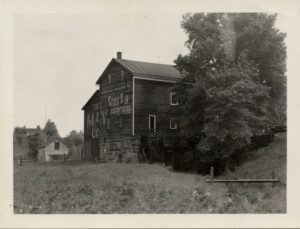
Fowlers Mill (originally Fowler’s Mills) developed around a group of mills built in the 1830s on the Chagrin River. Opportunities from these mills led to Fowlers Mill becoming the commercial center of Munson Township. From the 1830s into the twentieth century, the community expanded with construction of churches, a post office, township hall, stores, hotel, blacksmith shop, schools, and houses built in such styles as Federal, Greek Revival, Italianate, and Queen Anne. This type of community center was common in rural, nineteenth century America, but rarely survives with so much original fabric intact. On Mayfield Road, the Disciple Church was built in 1842. East of the church, the brick central school built in 1913 replaced earlier one-room schoolhouses. The gristmill is the only mill standing in Geauga County. The cemetery contains burials dating from the 1830s. The Fowler’s Mills Historic District was placed on the National Register of Historic Places in 2002.
, OH
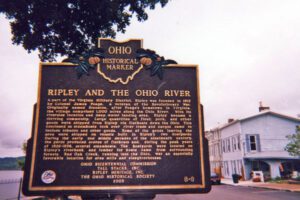
A part of the Virginia Military District, Ripley was founded in 1812 by Colonel James Poage, a veteran of the Revolutionary War. Originally named Staunton, after Poage’s hometown in Virginia, the village comprised 1,000 acres along the Ohio River. With its riverside location and deep water landing area, Ripley became a thriving community. Large quantities of flour, pork, and other goods were shipped from Ripley via flatboats down the Ohio. This continued as steamboats took over river trade and cargos came to include tobacco and other goods. Some of the goods leaving the area were shipped on vessels built in Ripley’s two boatyards. During the early and middle decades of the nineteenth century, the yards produced scores of flatboats and, during the peak years of 1826-1836, several steamboats. The boatyards were located on Ripley’s riverbank and lumber for boats came from surrounding forests. Red Oak Creek, running into the Ohio, was an especially favorable location for area mills and slaughterhouses.
, OH
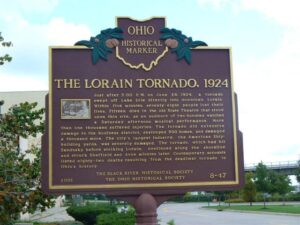
Just after 5:00 P.M on June 28, 1924, a tornado swept off Lake Erie directly into downtown Lorain. Within five minutes, seventy-eight people lost their lives. Fifteen died in the old State Theatre that stood upon this site, as an audience of two hundred watched a Saturday afternoon musical performance. More than one thousand suffered injuries. The tornado did extensive damage to the business district, destroyed 500 homes, and damaged a thousand more. The city’s largest industry, the American Shipbuilding yards, was severely damaged. The tornado, which had hit Sandusky before striking Lorain, continued along the shoreline and struck Sheffield and Avon minutes later. Contemporary accounts listed eighty-two deaths resulting from the deadliest tornado in Ohio’s history.