W side of intersection of Riverside Drive and Busenbark Road
Trenton
, OH
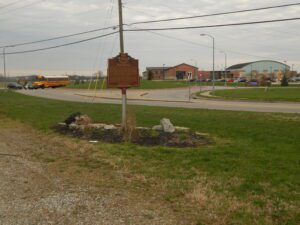
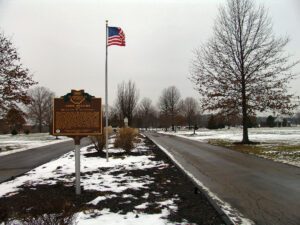
In 1833, Robert Busenbark deeded land to the directors of School District No. 6 for Busenbark School. Twenty years later, Robert and son David granted a right-of-way on their property for a station on the Cincinnati, Hamilton & Dayton Railroad (CH&D). One of eleven depots in Butler County, Busenbark station attracted the Kinsinger-Augspurger Warehouse and the Kennel Grain Elevator to the area in the 1860s. The railroad also enabled the cross-roads settlement to host an American championship prize fight in 1867. Fighting with bare knuckles in an outdoor ring, Mike McCoole bested Aaron Jones in a match seen by thousands. The Busenbark generating station supplied power to interurban lines until 1912 and later furnished electricity to local residents. Farmers and the Miami Poultry Yards depended on the trains and interurban to ship produce. The railroad depot disappeared between 1914 and 1916; the school closed after 1937; interurban service ended in 1939. All that remains of Busenbark is Busenbark Road, which was established in 1858.
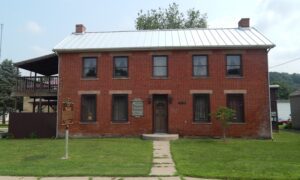
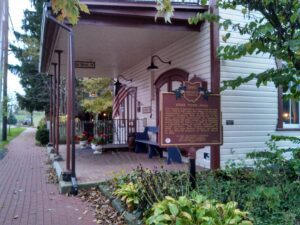
Named for General Zebulon Pike, killed in the War of 1812, Pike County was organized in February 1815. Commissioners were charged with establishing a county seat and on May 12, 1815 accepted a conveyance of 40 acres from Elisha Fitch. The new seat was named “Piketon.” In 1816, the commissioners let a contract for the construction of a courthouse and jail. A fine two story courthouse with brick laid in Flemish bond was finished in 1819. A fire destroyed some country courthouse offices on October 9, 1844. The repaired courthouse was the seat of county government until 1861 and is part of the Piketon Historic District, which was listed on the National Register of Historic Places in 1974. Limestone headers above the windows have the names of the county government offices.
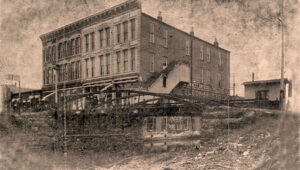
Emmitt-Greenbaum Building, 200 North Market Street, was built around 1878 by businessman and politician James Emmitt (1806-1893) to replace his 1837 wooden warehouse. The brick three-story Italianate building featured five vertical cast iron belts of simulated stone, a projecting cornice, reeded pilasters, and a “fortress-like fourteen bay front.” A covered wooden stairway on the building’s south side originally projected over the canal. Charles Louis Greenbaum (1871-1935) purchased the building in 1912 and opened his department store advertising it as “The Store with The Goods!” Over 140 years, the Emmitt-Greenbaum building was occupied by Jas. Emmitt Dry Goods, Hoffman’s, Greenbaum’s, Armbruster and Armbruster, Waverly Drugs, and the Bee Hive Tavern. A structural collapse after decades of deterioration condemned the building and the southwestern half was razed in 2021.
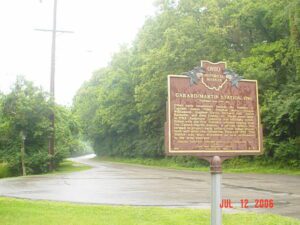
Site of the first fortified settlement in Anderson Township and one of the first in the Virginia Military District. John Garard and Joseph Martin were the founders of this Station, who, with Elias Garard, Joseph Frazee, and others, came by two flatboats with families and livestock from Garards Fort, Pennsylvania, via the Ohio and Little Miami rivers. They landed here on December 23, 1790, and proceeded to erect the fortification.(Continued on other side)
The Society of Separatists of Zoar built the Zoar Town Hall in 1887 when the village was formally incorporated. Established in 1817 by German religious dissidents, Zoar became one of the most successful experiments in communal living during the 19th century. Early hardships encouraged the Zoarites, in 1819, to establish a communal system to ensure economic and social security. The Society disbanded in 1898. The Zoar Historic District was added to the National Register of Historic Places in 1969.
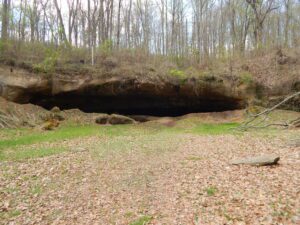
On a forested hillside south of New Straitsville, the spacious 1000 square foot Robinson’s Cave offered a secluded location with great acoustics where large groups of Hocking Valley coal miners could meet in secret. Beginning in about 1870, labor-organizing meetings were held at the cave by various emerging unions including the Knights of Labor. New Straitsville resident Christopher Evans, a well-known union organizer, used Robinson’s Cave to lead miners throughout the long Hocking Valley Coal Strike of 1884-1885. These meetings gave the miners a voice in the formation of a national organization called the National Federation of Miners and Mine Laborers, later renamed the National Progressive Union. The cave was also where non-union miners met to plan to set the Columbus & Hocking Coal & Iron Company mines on fire in a desperate attempt to end the Hocking Valley Strike. [continued on other side]
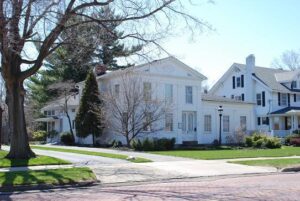
Among the fifty-four buildings that comprise the Mentor Avenue District are examples of Federal, Greek Revival, Early Romanesque Revival, Italianate, Second Empire, Queen Anne, and twentieth century eclectic styles. Renowned master builder Jonathan Goldsmith (1783-1847), whose Federal and Greek Revival designs define the so-called “Western Reserve” style, built at least two of these houses; the Denton-Powers House (ca. 1820) is representative. The Mentor Avenue District was added to the National Register of Historic Places in 1979. The Painesville City Hall, the Sessions House (157 Mentor Avenue) and the Smead House (187 Mentor Avenue) are also listed individually on the National Register.
Anson Williams visited Ohio in 1834 before he moved to Orange Township. A former resident of New York State, Williams purchased this site and the surrounding 1,000 acres of U.S. Military District lands and hoped to find opportunity for himself and his family. He bought the land for $6.00 an acre from James D. Wolf, who owned the 4,000-acre section three of Orange Township. The Village of Williamsville was laid out with 80 lots in 1836 on both sides of the Columbus and Sandusky Turnpike. Williams built his home and a hotel with a store and tavern. A hotel and tavern, owned by George Gooding and where the stage changed horses, had already been established north of Williamsville. Competition may have led to Williamsville’s decline. A church was built in 1845 and remained until 1900. Anson died in 1847, and his wife Hannah passed away in 1851. Both are buried in nearby Williamsville Cemetery.